Tag: <span>PARADOX</span>

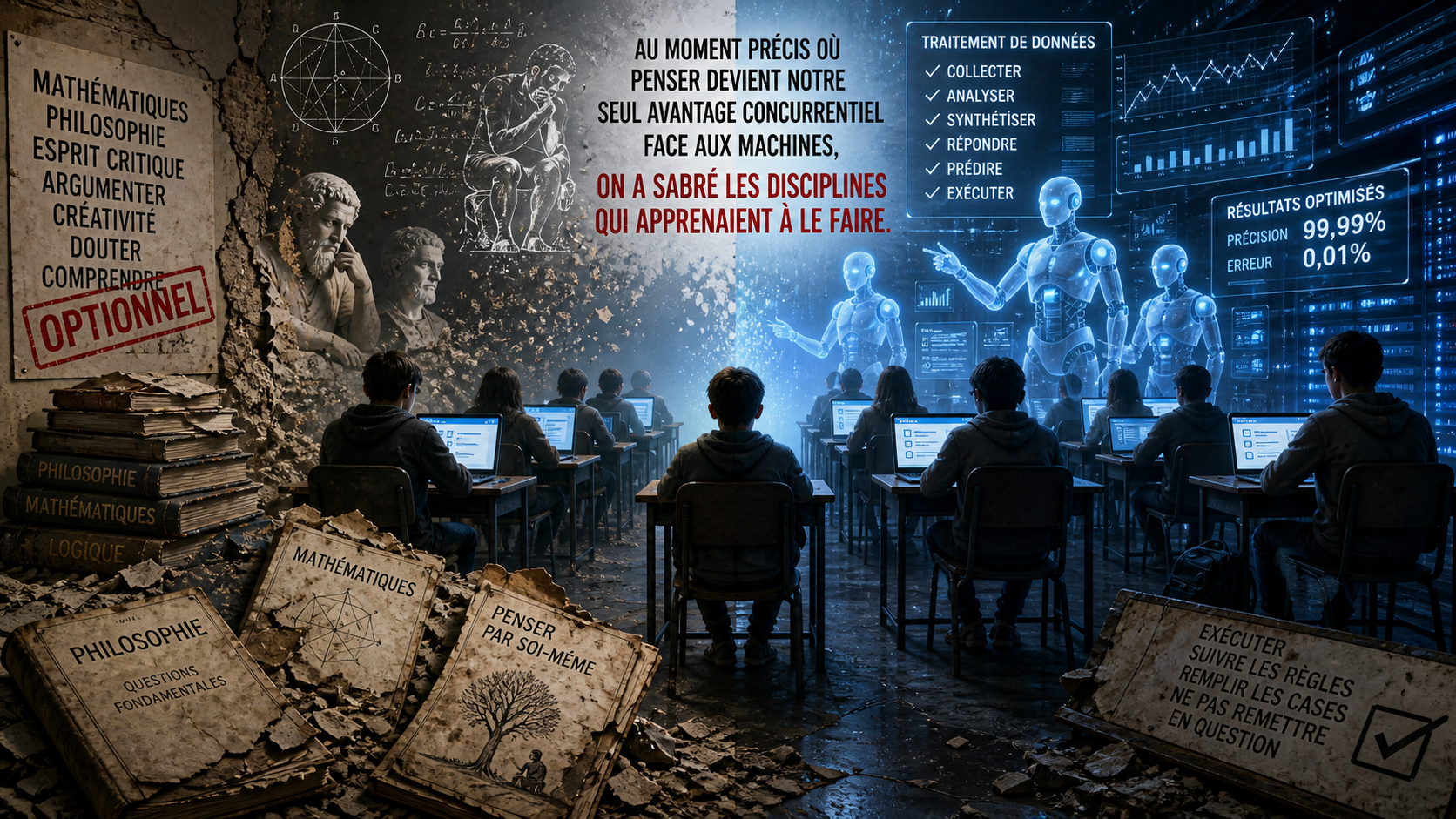
Schools spent 50 years training executors. AI just made that model obsolete.

The worst part? We knew it. We still cut maths from the core curriculum. We sidelined philosophy. We rewarded those who followed instructions rather than those who challenged them.

The result: entire generations trained to do exactly what algorithms do today… better, faster, no coffee break needed.

What cannot be replaced is critical thinking. Doubt. Intuition built through experience. The very skills the World Economic Forum now ranks at the top of recruiters’ priorities worldwide.

The same ones we made optional.

In this second part, we dig into the paradox: at the exact moment when thinking becomes our only competitive edge over machines, we gutted the disciplines that taught us how to do it.

The full article is linked below. It stings a little. That was the point.

#Education #ArtificialIntelligence #FutureOfWork #CriticalThinking #AI #Skills #Learning #Innovation

OPINION

ChatGPT has already transformed the way we work, learn, create, and even structure our thinking. Yet behind the spectacular performance of artificial intelligence lie deeper limitations as well, hallucinations, bias, opacity, technological dependence, and a quiet reshaping of our intellectual bearings. This article explores how ChatGPT is revolutionizing the world, not only in our everyday uses, but also in our relationship with knowledge, education, work, and even the future of our civilization.

OPINION

Have you ever spent twenty minutes scrolling, reading, watching… then closed LinkedIn with a strange feeling, the sense of having consumed a lot without really learning anything?

This is not a lack of curiosity or discipline. It is the effect of a new information environment where AI produces smooth, reassuring, instantly consumable content, yet often poor in substance. This is what we call AI slop, intellectual food that satisfies in the moment, without ever nourishing thought.

OPINION

GPS corrects you before you make a wrong turn. Spellcheck smooths out your sentences. Code assistants anticipate your intentions. Everything becomes easier, faster, more seamless. But in this drift toward absolute comfort, something invisible happens: we gradually stop thinking for ourselves.

The philosopher Bernard Stiegler had a word for this: the proletarianization of knowledge. Where once the factory worker lost their craft to the machine, we now lose our capacity to reflect, decide, create. First, factories dispossessed the hand. Then, cultural industries standardized our ways of life. Now, artificial intelligence is proletarianizing thought itself.

This process didn’t happen overnight. It unfolded in three waves:

– The hand: the artisan becomes proletarian, the gesture empties of its intelligence
– Life: the consumer absorbs symbols they no longer create
– Thought: the thinker delegates judgment to the machine

Today, with generative AI, we’re crossing a new threshold. Thinking becomes a paid service. Creativity, a premium option. And surveillance capitalism, already capturing our data and predicting our behaviors, is preparing to monetize even our ideas.

But nothing is inevitable. Stiegler preached neither the rejection of technology nor nostalgia for the past. He invited us to understand that technology is a pharmakon: both poison and remedy. Everything depends on how we inhabit it.

So what do we do? Take back control of our attention. Redirect tools toward contribution rather than consumption. Make technology an extension of human intelligence, not its substitute. The choice doesn’t belong to machines. It depends on the care we bring to our own thinking.

It’s Prometheus’s fire: no longer the stolen flame, but the preserved light.

OPINION

What if, by letting machines think for us, we were slowly forgetting how to think at all?

Once, we had to get lost to learn how to find our way. Today, a synthetic voice guides us step by step, and our mind quietly drifts to sleep. We outsource everything: memory to the cloud, logic to algorithms, decisions to recommendations. It feels smooth, effortless, almost magical. But comfort comes at a cost, the slow erosion of intellectual effort.

We call it progress. Yet behind this promise of efficiency lies a silent drift: cognitive laziness. That subtle surrender where we stop reasoning, doubting, searching, and simply validate what a machine suggests.

This article explores that phenomenon, not to condemn technology, but to question what it’s turning us into: ever-assisted beings, seemingly brilliant, yet increasingly absent from their own thinking.

And perhaps, in this age of constant assistance, thinking is our last true act of freedom.

OPINION