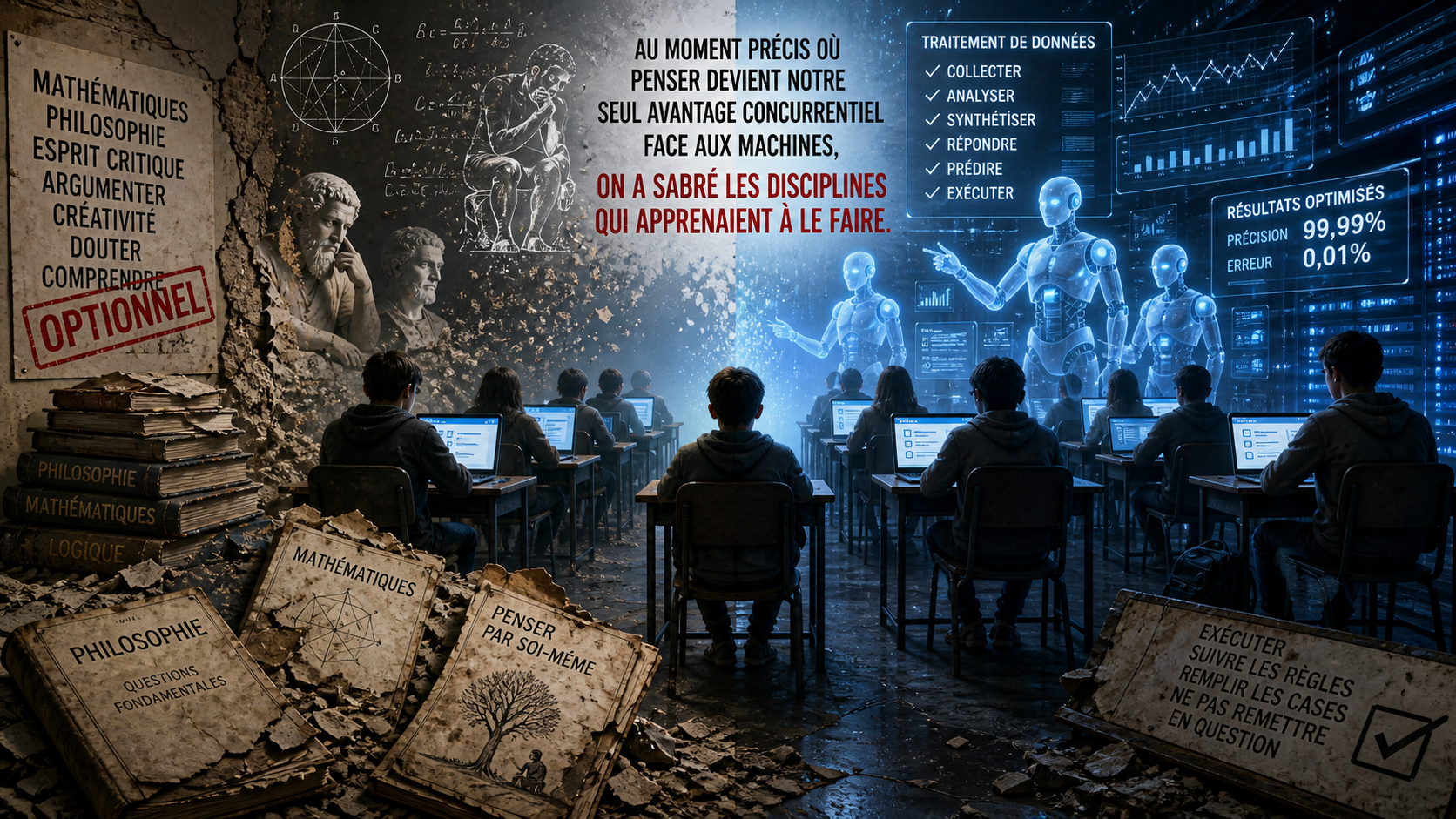
We spent 50 years training people for a world that no longer exists.
In the first part of this article, we explored how the education system was built on an industrial model, designed to produce compliant executors and human storage units for information. But today, artificial intelligence performs that task infinitely better than we do. Faced with this reality, a dizzying question emerges: what remains of the human when the machine executes perfectly?
Executing versus thinking: the great illusion
Artificial intelligence is like a train running at full speed that never stops, even when the tracks suddenly end. It produces text with flawless syntax, summaries of perfect clarity, arguments structured with an apparently unbreakable logic. But make no mistake: it does not think. It calculates. It predicts the next word in a sentence with remarkable statistical precision, based on the ingestion of billions of human texts, but it has absolutely no idea, no awareness of what it is saying. It answers, but it does not question. It arranges words without grasping their weight or the disturbance they may carry.
What the machine fundamentally lacks, and what lies at the very core of human intelligence, is lived, embodied, and sensitive experience. AI does not feel the dead end of a reasoning gone astray. It never experiences that subtle internal friction, that fleeting intuition whispering, “Wait, something is off here, this does not make sense.” It does not hold a position out of moral or philosophical conviction, because it has nothing to lose, no reputation, no integrity. It does not transform lived pain, endured injustice, or overwhelming joy into something new and original. No line of code, however complex, has yet managed to reproduce this intimate friction, this contact with reality from which genuine thought and breakthrough innovation emerge.
Cognitive psychologist and decision-making expert Gary Klein devoted his career to studying how humans make critical decisions in complex, stressful, and unpredictable situations, observing firefighters in the field and emergency physicians in intensive care units. He demonstrated that expert intuition is not a mystical gift or a sixth sense, but a rapid ability to recognize subtle patterns built and refined through thousands of lived experiences and corrected mistakes. It is this practice-forged intuition that allows a human expert to sense that a situation will deteriorate before being able to explain it rationally. AI, on the other hand, has no lived experience, no body, no intuition. It cannot build intuition from embodied experience, it only processes cold data.
And yet, it is precisely this ability to execute without thinking, to apply procedures without questioning them, that we have rewarded for decades in our schools and organizations. We have trained entire generations to become excellent executors, capable of following instructions to the letter, filling standardized forms, and ticking the right boxes at the right time. We have created a system where error is systematically punished, marked in red ink, instead of being seen as a natural and necessary step in learning. But error, hesitation, and failure overcome are the very engines of critical thinking and innovation. It is by being wrong, by doubting one’s own certainties, by adjusting one’s trajectory in response to reality, that a truly autonomous and resilient intelligence is built.
There is a deep irony here. We built an education system that penalizes error, when error is precisely the one thing the machine cannot do in a productive way. AI does not doubt, does not question itself, does not experience the vertigo of uncertainty. It produces with confidence, even when it is wrong. This is what specialists call AI “hallucinations”: false statements delivered with the same fluency as true ones. The ability to distinguish truth from a well-formulated hallucination is now the key skill that school never truly taught.
Artificial intelligence does not replace humans who think, create, and doubt. It replaces those who have been trained, almost conditioned, not to think. It replaces, without mercy, those whose daily work consists solely of processing information in a routine manner, applying predefined rules without cognitive added value. And this is where the problem lies: our education system has spent 50 years producing exactly this type of worker, making them particularly vulnerable to automation today.
We made optional what allows us to think
The paradox is striking, almost cruel. At the very moment when deeply human abilities, critical thinking, intuition, creativity, the capacity to argue and hold a position in the face of contradiction, become irreplaceable and constitute our only real added value compared to machines, what do we do in education? We cut, reduce, or make optional the very disciplines that develop them.
Take the emblematic case of mathematics and philosophy in France, two historical pillars of intellectual training. In 2019, a major high school reform made the surprising decision to remove mathematics from the compulsory core curriculum for students in their final years. Officially, the goal was to allow students to “choose their path” by selecting specializations. In theory, this sounded like welcome flexibility. In practice, it meant that tens of thousands of students simply abandoned mathematics altogether.
The result was immediate, measurable, and damaging, particularly for young women, whose presence in scientific tracks dropped sharply within just a few years. The numbers speak for themselves: a boy is now 2.3 times more likely than a girl to graduate with a strong scientific profile. Faced with widespread criticism, the government had to reverse course in 2022 and reintroduce compulsory mathematics.
But the damage was done, and this episode reveals a deeper misunderstanding of what mathematics truly is. Too often, it is seen as a purely utilitarian toolbox for calculating percentages or balancing budgets. In reality, it is, above all, a rigorous training ground for the mind. Mathematics teaches how to carry a proof to completion, how to build a logical argument step by step without flaw, how to accept nothing as true without demonstration. It cultivates the critical mindset needed to interpret data, detect misleading statistics, and navigate probabilities. In a world where AI can generate convincing charts and figures in seconds, being able to read statistics critically is no longer optional, it is essential.
Philosophy suffers a similar fate. Often dismissed as abstract or disconnected from practical reality, it is in fact the discipline that teaches how to detect conceptual dead ends before falling into them. It develops the art of structured doubt, the ability to question lazy assumptions, to deconstruct fallacious arguments, and to maintain a reasoned position under pressure. In a world saturated with algorithmically generated discourse, philosophy may well be one of the most necessary disciplines of all.
Bloom’s taxonomy, a widely recognized educational framework, organizes learning objectives into a hierarchy. At the base are the simplest levels, remembering and basic understanding. At the top are the most complex and valuable ones, analyzing, evaluating, and creating. For decades, education has focused primarily on the base, because it is easier to assess with standardized tests. The top levels, those that develop truly human capabilities, have been treated as secondary, left to the initiative of the most dedicated teachers.
In a hyperconnected world where information flows endlessly, where we are overwhelmed by data, fake news, and AI-generated content, what becomes rare and valuable is no longer access to knowledge. It is the filter. It is doubt. It is informed intuition. These higher cognitive abilities are precisely what we have mistakenly made optional at the moment they became indispensable.
Today, warning signals are everywhere. The World Economic Forum, hardly known for romantic idealism, regularly publishes reports on the future of work. In its 2025 edition, the most sought-after skills are no longer procedural memory or routine execution. They are analytical thinking, resilience, flexibility, mental agility, creativity, and emotional intelligence. In other words, the very abilities cultivated by mathematics, philosophy, the arts, literature, and the humanities. The same disciplines our education systems have gradually marginalized or reduced to optional choices.
If execution skills now belong to machines, and we have neglected the teaching of critical thinking, how do we escape this dead end? This is what we will explore next week in the third and final part of this article: what schools should truly teach if we want to preserve our usefulness in the world to come.
References
For those who still take the time to verify, compare, and understand sources, these references remind us of a simple truth: information still exists. But in a near future, even this simple act may become a luxury, as AI-generated content multiplies and the real risk shifts from misinformation to the dilution of reality in an ocean of plausible narratives.
[5] Klein, G. (1998). “Sources of Power: How People Make Decisions”. MIT Press, Cambridge, Massachusetts.
[6] Ouest-France (2022). “La suppression des maths en Première et Terminale était-elle une mauvaise idée ?”. Disponible sur : https://www.ouest-france.fr/education/la-suppression-des-maths-en-premiere-et-terminale-etait-elle-une-mauvaise-idee-b3a99e26-8803-11ec-937e-83af349e51ad
[7] Libération (2024). “La réforme Blanquer a provoqué une chute de la présence des filles en filière scientifique”. Disponible sur : https://www.liberation.fr/societe/education/la-reforme-blanquer-a-provoque-une-chute-de-la-presence-des-filles-en-filiere-scientifique-20240315_O32DKDAI7BDHNDP5COF7U43QYI/
[8] Bloom, B. S. (Ed.) (1956). “Taxonomy of Educational Objectives, Handbook I: The Cognitive Domain”. David McKay Co Inc., New York. Révision par Anderson, L. W., & Krathwohl, D. R. (2001). “A Taxonomy for Learning, Teaching, and Assessing: A Revision of Bloom’s Taxonomy of Educational Objectives”. Longman, New York.
[9] World Economic Forum (2025). “The Future of Jobs Report 2025”. Disponible sur : https://www.weforum.org/publications/the-future-of-jobs-report-2025/