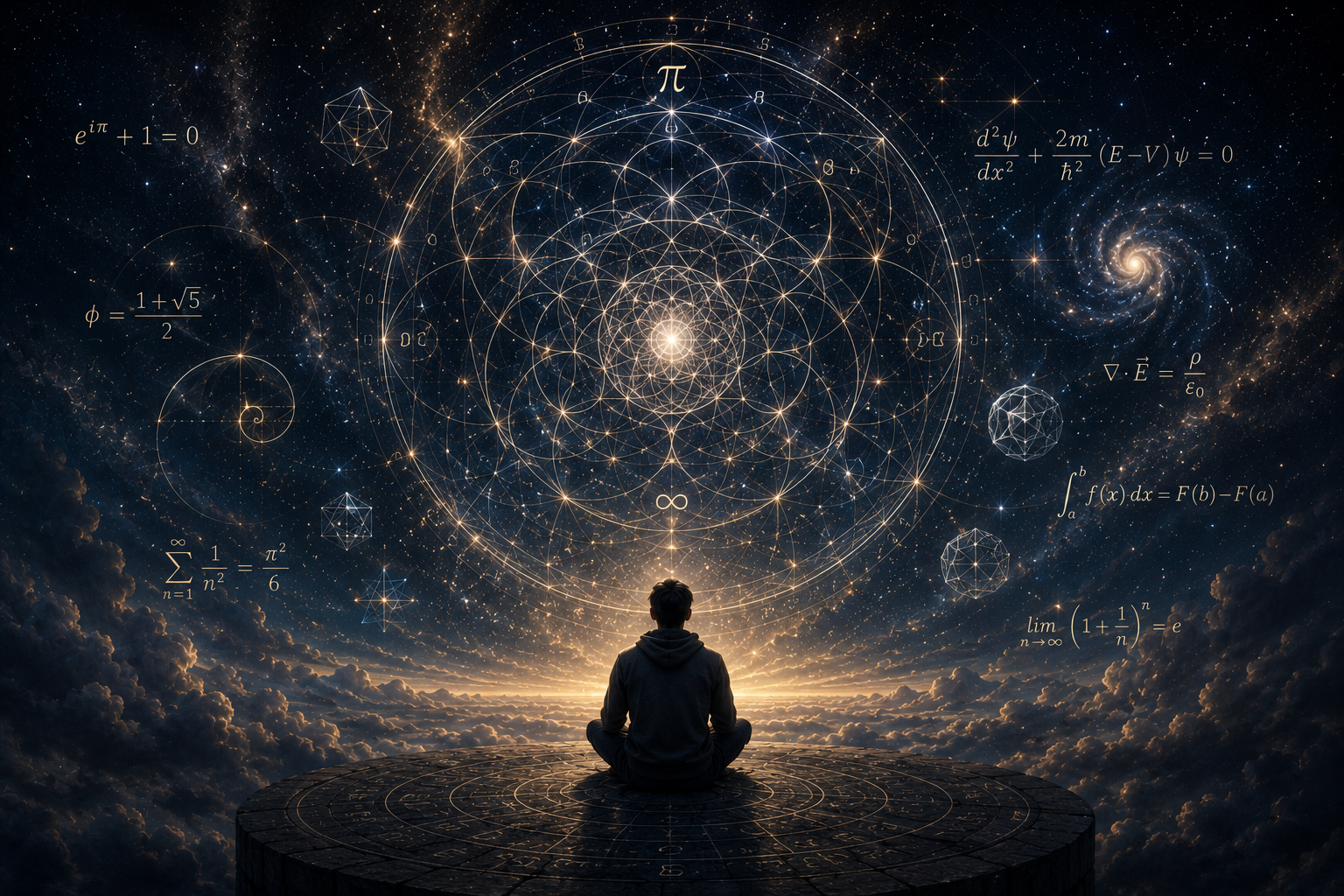
… and why it’s a misunderstanding
“And what do you do for a living?”
The question drops, inevitable, in the middle of the din of a dinner party. I take a quiet breath. I know what comes next. It’s a little theatrical scene I know by heart, a silent drama that plays out in a fraction of a second across my interlocutor’s face. I answer, with a smile I hope is disarming: “I’m a mathematician.”
And there it is. The mask. A veil falls over the features of the person in front of me. Their eyes freeze, their smile tightens slightly, their shoulders rise by a centimetre. It’s a polite dread, a contained social panic. In an instant, I see flicker in their gaze the ghost of every school trauma: the humiliation of failing at the blackboard, the anxiety of a surprise test on derivatives, the mortal boredom of an afternoon spent staring at isosceles triangles without understanding why they exist. It’s as though, by my mere profession, I had just awakened a sleeping monster, an old pain lurking in a corner of their memory for decades.
The verdict never takes long to arrive, often in the tone of a bitter, almost liberating, confession: “Maths, what a nightmare!” Sometimes the phrase turns more accusatory, more final: “I never understood any of it, and it’s never been any use to me.” And recently, a new refrain has been added to the score, carried by the spirit of the times and the artificial intelligence revolution: “Anyway, there’s no point learning maths anymore, I’ve got AI.”
Every time, I feel a mixture of sadness and immense tenderness. Sadness at seeing how this discipline, which I find so full of life, surprise, and a singular beauty, has been a source of suffering for so many intelligent, curious people. Tenderness for the vulnerability that surfaces so unguardedly, for the scar that school has left on so many brilliant minds. Because this rejection is not born of ignorance or stupidity; it is the consequence of a tragic misunderstanding, a missed appointment between one of the greatest adventures of the human mind and most of us.
This article is an attempt to repair that missed appointment. We will see why this vision is so far from reality, how school has so often betrayed the spirit of this discipline, but above all, we will explore the hidden power and beauty of mathematics. It is an invitation to look at mathematics differently. Not as a catalogue of dead formulas or an instrument of torture for schoolchildren, but as a workout for the mind, a quest for truth, and even, I dare say it, a form of poetry. This journey will lead us to explore why this science is so often misunderstood, what its true role is in shaping our thinking, and how it secretly shapes the world around us. We will try to detect the beauty hidden in the rigour of a proof, the harmony nestled at the heart of an equation. We will try to hear, if only for a moment, the whisper of the stars in the silence of a line of reasoning.
Because no, artificial intelligence will not make mathematics obsolete. Quite the contrary, in fact. On one hand, it forces us more than ever to focus on what makes us human: not the ability to calculate, but the ability to understand. And understanding is precisely what mathematics, in its purest essence, teaches us to do. On the other hand, and this is the most stimulating paradox, we will need mathematics even more to imagine and build the algorithms that will make tomorrow’s artificial intelligences even more capable. AI is not the end of mathematics; it is a new frontier, a new continent to explore with the tools of abstraction, logic, and creativity that only mathematical thinking can offer us. But before exploring these new frontiers, we must first answer the question that keeps coming up, the one hiding behind my interlocutors’ polite dread: what are mathematics really for?
The gym for the soul
Faced with this wall of incomprehension, the temptation is strong to launch into a passionate defence of the usefulness of mathematics. To brandish a list of applications, from the cryptography behind our bank cards to the algorithms that optimise our GPS routes, by way of epidemic modelling and aircraft wing design. That’s a fair defence, and we’ll come back to it. But it is, in my view, incomplete. Because it misses the essential point, the deepest reason why we ought to cherish this discipline.
Answering the question “what’s the point?” solely with practical examples is a bit like justifying the existence of poetry by pointing out that it can help write advertising slogans. True, but terribly reductive. The real value of mathematics, the one that endures even after you’ve forgotten how to solve a triple integral, lies not in what it does, but in what it makes of us.
Mathematics is a mental workout. A gym for the soul. The problems we solve there are our intellectual dumbbells. Nobody asks an athlete what “use” it is to lift a metal bar in everyday life. You don’t heave your shopping bags with the same technique, and yet everyone understands that this seemingly gratuitous effort strengthens muscles, improves endurance, and prepares the body for a host of unforeseen physical situations. Mathematics plays this role for our cognitive faculties. Every problem solved, every proof understood, is a rep that sculpts our thinking, making it stronger, more supple, sharper. This is indeed what the 2004 British report Making Mathematics Count stated, affirming that “mathematical training disciplines the mind, develops logical and critical reasoning, and develops to a high degree the skills of analysis and problem-solving” [1].
This idea is not just a pretty metaphor. It is supported by empirical data. A study published in 2020 in the journal PLoS One by Clio Cresswell and Craig Speelman compared logical reasoning performance in individuals with very different levels of mathematical training, from first-year students to university professors. Their conclusion is clear: individuals with advanced mathematical training perform significantly better on logical reasoning tasks, independently of their general intelligence. Mathematics measurably trains our capacity to reason [2]. The gym works.
This mental workout develops four cardinal skills, four pillars upon which free and structured thinking rests.
The first pillar is the art of breaking down complexity. Faced with a tangled mathematical problem, a frontal assault is almost always doomed to fail. The mind is forced into patience and strategy. It must learn to break the big problem down into a series of smaller, simpler questions, to identify the relevant information amid the noise, to recognise patterns and structures hidden beneath the surface of things. It is an intensive training in method, in the art of not being overwhelmed. This skill, once acquired, infuses every other area of our lives. Analysing a contract to spot the hidden clauses, planning a project by identifying the critical path, diagnosing a fault by working through elimination: all these tasks, apparently so different, call upon this same faculty of logical deconstruction, this composure in the face of complexity that mathematics teaches with infinite patience.
The second pillar is the wisdom of distinguishing intuition from proof. Our brain is a prodigious intuition machine, a poet who constantly whispers shortcuts, impressions, and apparent certainties into our ear. It is an essential survival mechanism. But this inner poet is also a chronic liar. Mathematics is the place where this lie is exposed without mercy. A statement may seem “obvious”, a result may appear “natural”, but until it has been put through the mill of demonstration, it remains a mere conjecture, a mirage in the desert of reasoning. Take a classic example. The formula n² + n + 41, proposed by Euler, generates prime numbers for every integer value of n from 0 to 39. Intuition screams that the formula is perfect, universal. Yet for n = 40, it gives 1681 = 41², which is not prime. The intuition was wrong. A proof is a chain of crystal-clear deductions, where each link is firmly attached to the previous one, leaving no room for doubt, ambiguity, or approximation. Learning this is acquiring a form of intellectual caution, a mental hygiene. It means learning to be wary of one’s own certainties, to question the obvious, to demand that reality account for itself. In our world saturated with fake news and sweeping declarations, this skill is not a luxury; it is a tool for democratic survival.
The third pillar, which grows from the second, is the discipline of rigour. A mathematical proof is a model of intellectual honesty. Every step must be justified. There is no argument from authority that holds. “Trust me, it’s true” carries no weight. Only the solidity of the logical chain matters. Learning to build such a line of reasoning means learning to articulate one’s thoughts clearly, coherently, and convincingly. It means learning to construct an argument that is not a sandcastle but a fortress. It is a skill that serves the lawyer preparing their case, the engineer designing a bridge, the doctor working through a differential diagnosis, the citizen seeking to form an informed opinion on a complex subject.
Finally, the fourth pillar is the power of abstraction. This is often what puts people off the most, this habit mathematicians have of juggling x_s and _y_s, spaces of _n dimensions, and objects with forbidding names. But this abstraction is not a flight from the real. It is, on the contrary, a detour to grasp it more fully. Abstraction is the art of holding the world at a distance in order to understand its deep structure. It’s like looking at a map to understand a city. The map is an abstraction: it has erased the colours, the sounds, the smells. But it is precisely this simplification that allows you to see the overall layout, the main arteries, the hidden connections. By reasoning about abstract concepts, one learns to recognise the same logical structure in situations that seem on the surface entirely different. One discovers that the same equation can describe the vibration of a violin string, the oscillations of an electrical circuit, and the waves on the surface of water. Abstraction reveals the secret unity of the world.
There is one further benefit, less often cited, that this practice brings: resilience in the face of uncertainty. A difficult mathematical problem can go unsolved for hours, days, sometimes weeks. Learning to live with that uncertainty, to resist panic or discouragement, to keep searching methodically even when no lead seems promising, is a profound lesson. It is the lesson of intellectual perseverance, this capacity to sit in the comfort of discomfort, to trust the process even when the result remains elusive. Andrew Wiles, the mathematician who spent seven years, alone in his attic, proving Fermat’s Last Theorem, a problem open for three hundred and fifty years, described the experience as crossing a darkened house: “You enter the first room of the mansion and it’s completely dark. You stumble around bumping into the furniture. Gradually, you learn where each piece of furniture is. Finally, after six months or so, you find the light switch, you turn it on, and suddenly it’s all illuminated.” [18] This capacity to inhabit the darkness without panic, to believe that there is a light switch somewhere, is one of the most precious things mathematics can teach us.
So that is the real “service” of mathematics. It gives us not so much answers to practical problems as the capacity to solve them. It does not fill our heads with knowledge; it strengthens them. And faced with the lazy argument of AI, this vision becomes more relevant than ever. Leaving calculation to the machine is obvious, and that’s all to the good. But leaving it reasoning, understanding, critical thinking? That would be abdicating our humanity. AI is a prodigious tool, an extension of our mind. But a tool, however powerful, is useless in the hands of someone who doesn’t know what to do with it. Mathematics, by teaching us to think, gives us precisely the instruction manual for all the tools to come, including artificial intelligence itself.
The hidden symphony of the world
Before even listing the applications, one must insist on a fundamental property of mathematics that sets it apart from all other languages: its universality. Pythagoras’ theorem is true in Paris, in Tokyo, and on the planet Mars. It was true in Euclid’s time and it will still be true in a million years. This truth transcends cultures, eras, and even species. If we were one day to communicate with an extraterrestrial intelligence, our first message would probably be a sequence of prime numbers or the value of π. For the laws of logic and mathematical structures are, as far as we know, the same everywhere. Mathematics is the only language we share with the universe itself. It is this that led the mathematician and physicist Eugene Wigner to marvel at “the unreasonable effectiveness of mathematics in the natural sciences” [9], this astonishing capacity of concepts developed with no practical intent to prove, centuries later, fundamentally useful for describing reality.
And the beauty of all this is that this mental workout is not merely an end in itself. For while our minds strengthen themselves in abstraction, mathematics is also, very concretely, shaping the world around us. And if I have insisted on the fact that the primary value of mathematics is intrinsic, that does not mean they are devoid of practical applications. Far from it. Mathematics is the silent language in which the laws of the universe are written, the invisible grammar that structures our reality and our technology. Most of the time, we are not aware of it. We are like people who enjoy the warmth and light of the sun without ever looking up to see the star itself. Allow me to show you a few of its rays.
Predicting the invisible: the prophetic power of mathematics
But the power of mathematics does not stop at describing reality. It goes further: it predicts it. The history of science is studded with extraordinary discoveries made first on paper, through the sheer force of calculation, then confirmed by observation years, even decades later. In 1846, astronomers Urbain Le Verrier and John Couch Adams, intrigued by unexplained perturbations in the orbit of Uranus, postulated the existence of an eighth planet and calculated its probable position in the sky. A few months later, astronomer Johann Galle pointed his telescope at the indicated spot and found, less than one degree from the predicted position, the planet Neptune [22]. In 1915, Albert Einstein, completing his theory of general relativity, predicted that light from a distant star should be bent by the Sun’s gravitational field. Four years later, in 1919, an expedition led by astronomer Arthur Eddington used a solar eclipse to observe this phenomenon and confirmed Einstein’s prediction with breathtaking precision [23]. More recently, in 1964, physicists Peter Higgs, Robert Brout, and François Englert postulated the existence of a field that permeates the entire universe and gives elementary particles their mass. It would take nearly half a century and the construction of the largest particle accelerator ever built, the LHC at CERN, for the Higgs boson, the particle associated with this field, to be finally detected in 2012, exactly where theory had predicted [24]. In each of these cases, mathematics was not merely a descriptive tool; it was a guide, a compass pointing toward a reality still invisible.
Seeing the invisible: the magic of tomography
When you have a medical scan, you lie down in a ring that rotates around you, bombarding you with X-rays from different angles. The machine measures the attenuation of these rays through your body. But how does one move from these thousands of one-dimensional measurements to a detailed cross-sectional image of your organs? The answer is a small mathematical miracle called the Radon transform. Developed by Austrian mathematician Johann Radon in 1917, this theory remained a purely abstract curiosity for more than fifty years [3]. Radon had asked himself a question that seemed entirely disconnected from reality: is it possible to reconstruct a function in two dimensions if you know the value of its integrals along all possible straight lines? He proved not only that it was possible, but provided the formula for doing so. It was not until the 1970s that physicist Allan Cormack and engineer Godfrey Hounsfield realised that this abstract idea was the key to seeing inside the human body without opening it. They developed the algorithms that, by applying a discrete version of the inverse Radon transform, reconstruct a 2D image from the 1D projections of X-rays. For this feat, they received the Nobel Prize in Medicine in 1979 [4]. Every time a doctor diagnoses a tumour or a fracture using a scanner, they are paying tribute, without knowing it, to the beauty of a mathematical idea born of pure intellectual curiosity, fifty years before anyone could imagine putting it to use.
Compressing infinity: the poetry of JPEG and MP3
Every day, we exchange billions of images and pieces of music over the internet. If these files had to be stored in their raw format, our hard drives and networks would instantly be overwhelmed. The reason we can send a photo in a second or listen to streaming music comes down to one word: compression. And at the heart of this compression lies, once again, a mathematically profound and beautiful idea: the Fourier transform and its cousin, the Discrete Cosine Transform (DCT). At the beginning of the 19th century, the French mathematician Joseph Fourier had a lightning intuition: any complex signal, whether the sound of an orchestra or the colour variations along a line of an image, can be broken down into a sum of much simpler signals, pure sinusoidal waves of different frequencies and amplitudes. The DCT, used in JPEG compression, does exactly this. It cuts the image into small 8×8 pixel squares and, for each square, decomposes it into a sum of 64 basic patterns. The brilliant trick is that the human eye is very sensitive to low frequencies (slow colour changes) but barely sensitive to high frequencies (very fine details). The JPEG algorithm can therefore discard a large portion of the high-frequency information without us noticing almost anything, drastically reducing file size [5]. Behind every selfie and every song you listen to lies the invisible hand of Joseph Fourier, who taught us to write the poetry of the world with a simpler alphabet.
Taming chance: the architecture of risk
The world of modern finance, with its complex derivatives and risk-hedging strategies, might appear to be the temple of unfettered capitalism. Yet at its heart lies one of the most elegant equations of the 20th century: the Black-Scholes-Merton model. Before 1973, pricing a financial option fairly was an obscure art. Fischer Black, Myron Scholes, and Robert Merton changed the game by using mathematical tools borrowed from physics: stochastic calculus and Brownian motion. Their fundamental idea was to create a “risk-free” portfolio by continuously buying and selling the underlying asset to offset the option’s price fluctuations. By applying a no-arbitrage argument, they derived a partial differential equation whose solution gives the theoretical price of the option. Scholes and Merton received the Nobel Prize in Economics in 1997 for this contribution [6]. This example also illustrates the dual nature of mathematical power: applied without discernment, a beautiful equation can also lead to catastrophe, as the 2008 financial crisis cruelly reminded us. Mathematics gives us the power to tame chance, but not the power to abolish human greed or folly.
Organising knowledge: Google’s vote of confidence
In the early days of the internet, finding relevant information was a feat. In 1998, two Stanford students, Larry Page and Sergey Brin, had a revolutionary idea inspired by graph theory. They modelled the Web as an enormous graph where pages are vertices and hyperlinks are edges. Their algorithm, named PageRank, rests on a democratically simple idea: the importance of a page is proportional to the importance of the pages that link to it. Mathematically, this amounts to finding the principal eigenvector of a matrix of several billion rows and columns, a classic linear algebra problem applied at an unprecedented scale [7]. The algorithm that made Google the giant we know is the elegant solution to a problem of mutual endorsement, a direct application of century-old mathematical concepts.
Protecting our secrets: the beauty of prime numbers
Every time you make an online payment, check your messages, or access your bank account, your data is protected by an encryption system. The most widespread, the RSA protocol, invented in 1977 by Rivest, Shamir, and Adleman, rests on a mathematically simple fact of great depth: it is very easy to multiply two large prime numbers together, but it is extraordinarily difficult, even for the most powerful computers, to do the reverse, that is to say, to recover the two prime factors of a large number [8]. This asymmetry between the ease of multiplication and the difficulty of factorisation is the foundation of the security underpinning the entire global digital economy. Prime numbers, those objects which the Greeks studied out of pure curiosity two thousand five hundred years ago, now protect trillions of dollars in transactions every day. It is the most striking illustration of what mathematician Eugene Wigner called “the unreasonable effectiveness of mathematics”: the astonishing capacity of concepts developed with no practical intent to prove, centuries later, fundamentally useful [9].
Forecasting the unforeseeable: the mathematics of climate
Climate change modelling is one of the most ambitious scientific and mathematical challenges of our era. Climate models are systems of partial differential equations that describe the interactions between the atmosphere, the oceans, ice sheets, and land surfaces. These equations, drawn from fluid mechanics and thermodynamics, are so complex that they cannot be solved analytically. They are discretised: the Earth is divided into a three-dimensional grid of millions of cells, and the equations are solved numerically for each cell, at each time step. The resulting simulations, validated against historical data, allow climate evolution to be projected over decades. It is these projections that feed into IPCC reports and underpin global climate policies. Behind every temperature curve and every sea-level rise scenario lie thousands of equations, millions of calculations, and a deep faith in mathematics’ capacity to capture the complexity of the real world [20]. Mathematics is not only the tool of technology; it is the tool of our collective survival.
Understanding the wind: the quadratic equation and the weather
Sometimes a very simple mathematical idea, taught in secondary school, can illuminate a complex natural phenomenon. Take the wind that rotates around depressions and anticyclones. Its behaviour is governed by what is called the “gradient wind equation”, which balances three forces: the pressure gradient force (which pushes air from high to low pressure), the Coriolis force (due to the rotation of the Earth), and the centrifugal force (due to the curvature of the air’s path). This equation can in fact be reduced to a simple quadratic equation of the type ax² + bx + c = 0, which every secondary school student learns to solve [25].
Analysing this equation reveals something surprising. For an anticyclone, the term under the square root (the famous “discriminant”) imposes a limit: if the pressure gradient becomes too strong or the radius of curvature too small, one ends up with the square root of a negative number, which is impossible in the real world. Consequence: anticyclones cannot have very strong winds near their centre, and their isobars (lines of equal pressure) must be spaced apart. For a depression, however, the sign in the equation is different, and this limit does not exist. Winds there can theoretically be infinite, and isobars can crowd together to an extreme degree, forming “pits” of low pressure. This explains the violence of hurricanes and tornadoes. A mathematician who had never seen a weather map in their life could deduce these fundamental characteristics of atmospheric circulation through the analysis of a quadratic equation alone. It is a perfect example of how a simple mathematical structure can reveal the hidden logic of a natural phenomenon.
These few examples are just scattered notes of a symphony playing all around us, and within us. From the spiral structure of galaxies to that of our DNA, from the laws of quantum physics to the optimal strategy in poker, mathematics is the invisible fabric of reality. Learning their language is not merely acquiring a tool. It is opening one’s eyes to a deeper level of reality, beginning to perceive the logic, the order, and the beauty hidden in the very texture of the world.
The lost paradise of education
If mathematics is both an essential workout for the mind and the hidden language of the universe, why does school, whose mission is to open us to the world, so often fail to give us the key? Why do so many of us emerge from this journey feeling we have visited a dry and joyless land? It is because the teaching of mathematics too often commits an unforgivable sin: it betrays the very spirit of the discipline it claims to serve. It shows us a corpse and is surprised that we do not fall in love with it.
This betrayal takes the form of three pedagogical impostures, three illusions that empty mathematics of their soul.
The first imposture is that of finished knowledge. The mathematics lesson often unfolds like a funeral procession of definitions, theorems, and formulas. Knowledge is presented as a finished product, smooth, perfect, descended from some Platonic heaven. We are given the discriminant formula for solving quadratic equations, but we are hidden the centuries of groping by Babylonians, Greeks, Arabs, and Italian Renaissance scholars who wrestled with these equations. We are handed Pythagoras’ theorem like a truth in marble, but we are denied the joy of discovering one of its hundreds of proofs, some of which, purely visual, are genuine poems without words. The student is invited to admire the cathedral, but the door to the workshop is closed. They see neither the architect’s plans, nor the scaffolding, nor the callused hands of the builders. Deprived of this genesis, this historical and human flesh, they perceive only a cold, intimidating monument whose structure and purpose they cannot grasp. They learn answers to questions they never asked.
The second imposture is that of the unique answer. Traditional teaching is obsessed with the solution, the right result, the box to tick. The goal is to find the correct answer, and ideally quickly. This race for efficiency prizes technical virtuosity at the expense of the most precious skill of all: the art of the question, the courage of exploration, the right to wander. A real mathematician spends most of their time not finding the answer. They are an explorer in unknown territory. They grope, get lost, follow trails that lead nowhere, make mistakes, start again. The solution, when it deigns to appear, is merely the reward for a long wandering. By showing students only this final destination, by handing them maps where the route is already drawn, we steal the adventure from them. We turn them into rushed tourists when mathematics is an invitation to hike. The mathematician and educator Paul Lockhart, in his pamphlet A Mathematician’s Lament, compares this approach to an art class where students learn only to paint fences by numbers, without ever being allowed to touch a blank canvas. It is, he says, “a mutilation of the soul” [10].
The third imposture, which flows from the previous two, is that of immediate perfection. The teacher, the textbook, the answer key, all present the solution in a linear, impeccable, seemingly obvious fashion. It is a performance. It masks the real path of thought, which is never a straight line but a labyrinth of trial and error. The student, alone with their sheet of paper, with its crossings-out, its doubts, its dead ends, can only compare themselves to this model of inhuman perfection. And the conclusion is inevitable: “I’m just not cut out for this.” They don’t know that the teacher themselves followed this tortuous path, but has, like a magician, erased their traces to present only the final miracle. It is a pedagogy of concealment, which breeds fear and anxiety. It turns error into a moral failing, when it is in fact the very engine of learning.
One must add to these three pedagogical impostures a phenomenon well documented by educational research: mathematics anxiety. This is not simply a lack of confidence or a passing aversion. It is a specific state of emotional distress, characterised by fear and apprehension in situations involving mathematics, that affects a significant proportion of the population. Neuroscience research has shown that in individuals suffering from mathematics anxiety, the anticipation of a mathematical task activates the brain regions associated with physical pain and danger. This is not a metaphor: for some students, mathematics literally hurts [19]. This anxiety is largely a product of the school environment: time pressure, the fear of judgment, the shame of making mistakes, competition. It creates a vicious cycle: anxiety degrades performance, poor performance reinforces anxiety, and so on. Breaking this cycle is one of the most urgent challenges in mathematics education. And the approaches that succeed best are, unsurprisingly, those that place the student’s emotional safety at the heart of their method.
Faced with this reality, the temptation is to give up. But that would be to forget that other paths are possible. Other countries have opened different routes, proving that mathematics can be taught with both rigour and humanity. Take France. The country of Descartes and great mathematicians finds itself, with melancholy irony, near the bottom of the European rankings in the TIMSS 2023 study [27]. The proportion of high-performing students is minuscule (3%) compared to countries like Singapore (46%), and France holds the European record for the performance gap between girls and boys, which widens dramatically from the very first year of primary school [28, 29]. This gap is all the more tragic given that the history of French mathematics includes extraordinary female figures. Sophie Germain, in the 19th century, had to sign her letters “Monsieur LeBlanc” to be taken seriously by her peers, and yet made decisive contributions to number theory and the theory of elasticity [31]. Two centuries later, French girls still internalise the idea that they are “not made for maths”. The irony is all the more bitter in that France was long a world model. From 1881, with the Ferry laws, until the 1960s, French primary mathematics education was recognised as among the best in the world. It was this education that nurtured the French scientific golden age (1945-1970), the era of Bourbaki, Grothendieck, and Serre. Then came the catastrophe of “modern mathematics” (1969-1984): an attempt to teach extremely abstract maths from nursery school onwards, a pedagogical fiasco from which the French education system has never truly recovered. Today a cruel paradox persists: France remains excellent in mathematical research, having produced 14 Fields Medal winners, a world record, but its school-level teaching is disastrous. The best French mathematicians did not learn their knowledge at school, but in spite of it. The causes of this paradox run deep. They stem from a singular history in which mathematics, more than anywhere else, has become a tool of ruthless selection, creating a culture of elitism and fear. The stubborn belief in an innate “maths gene”, despite the scientific evidence to the contrary, continues to wreak havoc, legitimising failure and discouraging effort. Add to this structural problems, such as grossly insufficient continuing teacher training and sometimes overly delayed delivery of the curriculum, with teachers preferring to push back chapters they consider difficult [28, 30]. The result is a system that, rather than opening the doors of reason, closes them for many, and turns an invitation to wonder into a source of anxiety.
| Country | Key pedagogical approach | Underlying philosophy | PISA 2022 ranking (maths) |
|---|---|---|---|
| Singapore | CPA method (Concrete, Pictorial, Abstract) | Deep understanding before formalisation. | 1st |
| Japan | Structured problem-solving (Neriage) | Learning through collective inquiry and discussion. | 5th |
| Finland | Student-centred pedagogy | Wellbeing, curiosity, and individual pace take precedence over competition. | 20th |
| France | Theoretical and abstract approach | Conceptual rigour and the tradition of theoretical excellence. | 26th |
In Singapore, which dominates the PISA rankings with a score of 575 against 474 for France [11], teaching never begins with the abstract. The CPA method is followed: Concrete, Pictorial, Abstract. To understand fractions, a child will not see the symbol ½. They will share a real pizza, then draw a divided cake, and only at the end, once the concept is anchored in their hands and their eyes, will the symbol be introduced. The map always represents a territory the student has already explored themselves [12].
In Japan, the mathematics lesson is a collective adventure. The teacher poses a rich, open problem (hatsumon). Then falls silent. Students search, alone or in groups (kikan-shidō). Then comes the most important moment: the neriage. Different students come to the board to present their strategies, including the wrong ones. The class discusses, compares, debates. One student’s mistake becomes an opportunity for everyone to understand something new. The goal is not to find the solution, but to build knowledge together [13].
In Finland, the emphasis is on wellbeing and curiosity. Less competition, shorter school days, more time for play and projects. The idea is that a stressed mind is a mind that cannot learn. Mathematics is connected to real problems, to nature, to art. Time is given to students who need it, because thinking has its own rhythm, which cannot be decreed [14].
These examples are not miracle recipes. But they show us that the “lost paradise” of mathematics education is not a utopia. There are schools, here and there, where mathematics is alive, human, joyful. Places where students learn not only to calculate but to think. Together.
The cold and perfect beauty
I have saved for last the most fragile and most essential argument. The secret that mathematicians share only among themselves, in hushed tones, as though slightly embarrassed by such a confession. If we do mathematics, if we lose ourselves in these abstract landscapes, it is not only because they are useful or because they strengthen our minds. It is above all because they are beautiful.
Yes, beautiful. The idea may surprise. We associate beauty with the arts, with music, with a face, with a sunset. How could a sequence of symbols on a page move us? And yet. The great British mathematician G. H. Hardy, in his twilight text A Mathematician’s Apology, stated it plainly: “The mathematician’s patterns, like the painter’s or the poet’s, must be beautiful. […] Beauty is the first test: there is no permanent place in the world for ugly mathematics.” [15]. For him, this beauty was the only justification for a life spent doing “serious” mathematics, which he said, with a touch of deliberate snobbery, had no practical application. There was something slightly provocative in this stance, but also a deep truth: mathematics, at its highest, is an aesthetic activity before it is a utilitarian one.
There is next the beauty of economy of means, the elegance of a proof that in a few lines sweeps away a problem that seemed insurmountable.
Allow me to offer you an experience of this beauty. Imagine you are a seven-year-old child in a noisy classroom in Brunswick, Germany, in 1787. Your teacher, at his wit’s end, gives you a task meant to occupy you for an hour: calculate the sum of all the numbers from 1 to 100. 1 + 2 + 3 + 4 + … + 99 + 100. Take a mental pencil and try.
The young Carl Friedrich Gauss, for it was he, raised his hand after a few seconds. He had the answer: 5050. How? He had not added a hundred numbers. He had seen something. Take a moment. Look at the sequence: 1, 2, 3, …, 98, 99, 100. What happens if you pair the first and the last number? 1 + 100 = 101. And the second with the second-to-last? 2 + 99 = 101. And the third with the third-to-last? 3 + 98 = 101. Do you see the pattern? There are exactly 50 pairs, each giving 101. Therefore: 50 × 101 = 5050.
That moment when you see the hidden structure, when the numbers rearrange themselves before your eyes into a perfect harmony: that is mathematical beauty. It is not magic. It is meaning emerging from chaos. It is exactly what a mathematician feels before an elegant proof.
Euclid’s proof of the infinitude of prime numbers possesses this same quality, this same beauty of a haiku where every word is in its place and nothing can be removed without the whole collapsing. More than two thousand years old and still as luminous, it does not set off on an endless search. Euclid imagines, by contradiction, that there is a last prime number. He multiplies them all together and adds 1. The new number thus created, by its very nature, cannot be divided by any of the primes on the original list. It is therefore either prime itself, or divisible by a prime number that was not on the list. Either way, the list was incomplete. The assumption was false. Infinity is proved. The simplicity of the idea, its power, its finality, produces an intense feeling of intellectual satisfaction.
There is finally the beauty of structure itself, the pleasure of contemplating a perfect mathematical object, like a snowflake crystal. This is group theory, the mathematical study of symmetry. The same abstract structure, the same “group”, can describe the rotations of a snowflake, the permutations of a deck of cards, the conservation laws in particle physics, and the harmonies of a musical scale. By studying this abstract object, one discovers truths that apply to all these domains at once, without even needing to know the details of each one. It is a vertiginous sensation, that of touching the very skeleton of reality, of seeing the hidden framework beneath the world’s facade.
This aesthetic emotion is not a poet’s illusion. In 2014, neuroscientist Semir Zeki and his colleagues conducted a fascinating experiment. They placed professional mathematicians inside an fMRI scanner and showed them equations. When the mathematicians saw a formula they rated as “beautiful”, such as Euler’s identity or the Cauchy-Riemann formula, a specific area of their brain was activated: the medial orbito-frontal cortex. It is exactly the same area that activates when we listen to a piece of music that transports us, or contemplate a painting that moves us [16]. Mathematical beauty is not a metaphor. It is a neurological reality, a genuine emotion whose source lies in the deepest part of our emotional brain. Our brain is wired to feel joy in the face of harmony, whether it is auditory, visual, or intellectual.
The philosopher and mathematician Bertrand Russell described this beauty with poetic precision: “Mathematics possesses not only truth, but supreme beauty, a beauty cold and austere, like that of sculpture, without appeal to any part of our weaker nature, without the gorgeous trappings of painting or music, and yet sublimely pure, and capable of a stern perfection such as only the greatest art can show.” [15]
What is remarkable about this aesthetic appreciation is its universality. What a 21st-century French mathematician considers beautiful, the elegance of a proof, the symmetry of a group, the power of a theorem, would doubtless be considered equally beautiful by a colleague from India, Brazil, or an ancient Greek scholar. The criterion is not cultural; it belongs to the very structure of the reasoning, its capacity to achieve a maximum of effects with a minimum of causes.
This idea that beauty is a criterion of truth in mathematics is not merely an aesthete’s pose. It has deep heuristic value. Paul Dirac, one of the fathers of quantum mechanics, was convinced that the fundamental equations of physics must be beautiful. “It is more important,” he wrote, “to have beauty in one’s equations than to have them fit experiment.” This assertion, which may seem unreasonable, conceals a profound intuition: mathematics that appears beautiful, elegant, simple, tends to be right. The ugliness of a formula is often a sign that the right angle of attack, the right representation, the right generalisation, has not yet been found. Beauty is a compass. It points us in the direction of truth.
This “cold beauty” is not a beauty that leaves one indifferent. It is a beauty that demands something of us. It does not yield to those who pass it at a run. It calls for slowness, attention, inner stillness. It asks that you stop, that you truly look, that you let meaning settle in. Perhaps that is why it is so rare, and so precious. Perhaps that is why those who have glimpsed it once can never do without it again. Mathematics is an art. An art practised with pure thought as its only material. An art that does not seek to represent the world but to reach its essence. It is a demanding path, one that requires patience and humility. But for those who accept the invitation, the reward is a quiet joy, a deep peace, the feeling of touching something eternal with the tips of one’s fingers.
The great mathematician Henri Poincaré, who reflected at length on the process of mathematical discovery, described the role of this aesthetic sensibility not as an ornament but as a guide. It is the sense of beauty, he said, that enables the mathematician to select, from the infinite myriad of possible combinations, those that are worthy of interest and potentially fruitful. “The utility of mathematical science,” he wrote in Science et Méthode, “is to economise our effort.” But it is beauty that tells us where to look [17].
The invitation to travel
We have come to the end of this journey. We set out from the polite dread on a dinner guest’s face at the announcement of a profession, and we arrive at the cold beauty of the stars. What have we learned along the way?
That the rejection of mathematics is less a rejection of the discipline itself than of the caricature made of it. That its true role is not to turn us into calculators, but to teach us to think, to reason, to doubt methodically, to build certainties on solid foundations. That far from being useless, mathematics is the hidden language of our technological world, the invisible foundation of our medical scanners, our secure communications, our search engines. And that, finally, it contains a deep beauty, a source of aesthetic emotion comparable to that produced by the great arts, a beauty that activates the same regions of our brain as a Beethoven symphony or a Vermeer painting.
Let us return for a moment to the artificial intelligence argument, for it deserves to be taken seriously. It is true that current AI systems can solve mathematical problems of considerable complexity, and that this capability will only grow. But confusing the ability to solve a problem with the ability to understand it is a fundamental error. A GPS can calculate the best route between two cities far better than any human being. That does not mean we no longer need to understand geography, distances, or the constraints of a journey. It means we can delegate the calculation so we can concentrate on decision, on meaning, on choice. Likewise, AI can relieve us of tedious calculations so we can focus on what truly matters: asking the right questions, interpreting results, understanding their limits, deciding on their use. All these tasks require a solid mathematical education. In a world where algorithms are making increasingly important decisions, in medicine, justice, and economics, the ability to understand how they work, evaluate their biases, and question their assumptions is a fundamental civic skill. AI does not make mathematics useless. It makes them more necessary than ever.
So what to do with all this? Perhaps, simply, change how we look at it. Stop asking mathematics to be what it is not, a mere practical tool, and accept it for what it is: an adventure of the mind. Perhaps we should forgive school for having put us off it, and attempt, humbly, to reopen the dialogue.
How? By reading a popular science book, there are magnificent ones, from Simon Singh’s Fermat’s Last Theorem to Paul Hoffman’s The Man Who Loved Only Numbers. By watching a video that explains a great concept with a storyteller’s passion. By trying to solve a small problem, for the pleasure of it, without pressure, without a grade. By playing. It is not about becoming a mathematician. It is about allowing yourself to be curious again. It is about giving yourself the pleasure of understanding.
In a world where artificial intelligence promises to relieve us of the effort of thinking, this approach is more than a pastime. It is an act of resistance. It is to affirm that we are not merely consumers of answers, but craftspeople of meaning. It is to choose to keep our minds sharp, our thinking free, our capacity for wonder intact. For wonder, that disposition of the soul to be surprised by the world, is perhaps the most precious thing we possess. And mathematics, in their austere and luminous way, are one of the greatest schools of wonder there are.
Yet even this edifice of reason acknowledges its own limits. In 1931, the logician Kurt Gödel proved his famous incompleteness theorems, showing that in any mathematical system rich enough to contain arithmetic, there will always be true propositions that cannot be proved within that system [26]. Far from discrediting mathematics, this recognition of their intrinsic boundaries is perhaps the purest act of reason: to know what one cannot know is already a form of knowledge. It is the ultimate humility of a discipline which, even at the summit of its power, remembers that it is only a tool for exploring a universe that transcends it.
The next time someone tells you they are a mathematician, do not see the ghost of your past sufferings. See a lighthouse keeper, a watcher who spends their nights contemplating structures of pure light. And ask them, not “what’s it for?”, but “show me something beautiful.” I promise you, their eyes will be full of stars when they answer.
Perhaps the last word should belong to the one who, first of all, had the audacity to say it with such clarity. Four centuries ago, Galileo wrote in The Assayer:
“Philosophy is written in this grand book, which stands continually open before our eyes (I say the Universe), but can not be understood without first learning to comprehend the language and know the characters as it is written.
“It is written in the language of mathematics, and the characters are triangles, circles, and other geometric figures, without which it is impossible to understand a single word of it; without these, one wanders about in a dark labyrinth.” [21]
That dark labyrinth is the one we wander when we deprive ourselves of the light of mathematics. Should we therefore go as far as the MeteoSwiss article that inspired part of this reflection suggests, and say that mathematics is the “language of God” [25]? The question of whether mathematics is invented or discovered, whether its astonishing correspondence with reality is the fruit of chance or necessity, is a philosophical debate that exceeds us and lies at the frontiers of science. But whatever the answer, one thing is certain: this great book lies continuously open before our eyes. And we can all learn to read it. All it takes is a little curiosity, a little courage, and the willingness to believe that beauty, far from being a luxury, is perhaps the shortest path to truth.
References
For meticulous minds, lovers of figures and sleepless nights spent checking sources, here are the links that nourished this article. They remind us of one simple thing: information still exists, provided one takes the time to read it, compare it, and understand it. But in the near future, this simple act may become a luxury, for as texts generated entirely by AI multiply, the real risk is no longer misinformation, but the dilution of the real in an ocean of merely plausible content.
[1] Great Britain, Department for Education and Skills (2004). Making Mathematics Count: The Report of Professor Adrian Smith’s Inquiry into Post-14 Mathematics Education. The Stationery Office.
[2] Cresswell, C., & Speelman, C. (2020). Does mathematics training lead to better logical thinking and reasoning? A cross-sectional assessment from students to professors. PLoS One, 15(7), e0236153. https://pmc.ncbi.nlm.nih.gov/articles/PMC7390332/
[3] Radon, J. (1917). Über die Bestimmung von Funktionen durch ihre Integralwerte längs gewisser Mannigfaltigkeiten. Berichte über die Verhandlungen der Königlich-Sächsischen Gesellschaft der Wissenschaften zu Leipzig, 69, 262-277.
[4] Hounsfield, G. N. (1980). Computed medical imaging. Nobel Lecture. Journal of Computer Assisted Tomography, 4(5), 665-674. https://www.nobelprize.org/prizes/medicine/1979/hounsfield/lecture/
[5] Wallace, G. K. (1991). The JPEG still picture compression standard. Communications of the ACM, 34(4), 30-44. https://doi.org/10.1145/103085.103089
[6] Black, F., & Scholes, M. (1973). The Pricing of Options and Corporate Liabilities. Journal of Political Economy, 81(3), 637-654. https://doi.org/10.1086/260062
[7] Page, L., Brin, S., Motwani, R., & Winograd, T. (1999). The PageRank Citation Ranking: Bringing Order to the Web. Stanford InfoLab Technical Report. http://ilpubs.stanford.edu:8090/422/
[8] Rivest, R. L., Shamir, A., & Adleman, L. (1978). A method for obtaining digital signatures and public-key cryptosystems. Communications of the ACM, 21(2), 120-126. https://doi.org/10.1145/359340.359342
[9] Wigner, E. P. (1960). The unreasonable effectiveness of mathematics in the natural sciences. Communications on Pure and Applied Mathematics, 13(1), 1-14. https://doi.org/10.1002/cpa.3160130102
[10] Lockhart, P. (2009). A Mathematician’s Lament: How School Cheats Us Out of Our Most Fascinating and Imaginative Art Form. Bellevue Literary Press.
[11] OECD (2023). PISA 2022 Results (Volume I): The State of Learning and Equity in Education. OECD Publishing. https://www.oecd.org/en/publications/pisa-2022-results-volume-i_53f23881-en.html
[12] Ministry of Education, Singapore. Using Concrete-Pictorial-Abstract (CPA) Approach in Mathematics Education. https://nel.moe.edu.sg/la/numeracy/how-can-you-do-it-/using-concrete-pictorial-abstract–cpa–approach/
[13] Batteau, V., Miyakawa, T., & Ryu, M. (2025). Collective problem-solving in Japanese primary mathematics lessons. Educational Studies in Mathematics. https://pmc.ncbi.nlm.nih.gov/articles/PMC12145323/
[14] Kupari, P. (2008). Mathematics education in Finnish comprehensive school: Characteristics and some results. ICME-11 Survey Team 4. https://www.mathunion.org/fileadmin/ICMI/files/About_ICMI/Publications_about_ICMI/ICME_11/Kupari.pdf
[15] Hardy, G. H. (1940). A Mathematician’s Apology. Cambridge University Press.
[16] Zeki, S., Romaya, J. P., Benincasa, D. M., & Atiyah, M. F. (2014). The experience of mathematical beauty and its neural correlates. Frontiers in Human Neuroscience, 8, 68. https://pmc.ncbi.nlm.nih.gov/articles/PMC3923150/
[17] Poincaré, H. (1908). Science et Méthode. Flammarion.
[18] Wiles, A. (1997). Interview, Nova, PBS. https://www.pbs.org/wgbh/nova/proof/wiles.html
[19] Lyons, I. M., & Beilock, S. L. (2012). Mathematics anxiety: Separating the math from the anxiety. Cerebral Cortex, 22(9), 2102-2110. https://doi.org/10.1093/cercor/bhr289
[20] IPCC (2021). Sixth Assessment Report (AR6), Working Group I: The Physical Science Basis. Cambridge University Press. https://www.ipcc.ch/report/ar6/wg1/
[21] Galilei, G. (1623). Il Saggiatore.
[22] Kollerstrom, N. (2006). The discovery of Neptune. National Maritime Museum.
[23] Dyson, F. W., Eddington, A. S., & Davidson, C. (1920). A Determination of the Deflection of Light by the Sun’s Gravitational Field, from Observations Made at the Total Eclipse of May 29, 1919. Philosophical Transactions of the Royal Society of London. Series A, Containing Papers of a Mathematical or Physical Character, 220(571-581), 291-333.
[24] Aad, G., et al. (ATLAS Collaboration), & Chatrchyan, S., et al. (CMS Collaboration). (2012). Observation of a new particle in the search for the Standard Model Higgs boson with the ATLAS and CMS detectors at the LHC. Physics Letters B, 716(1), 1-29.
[25] MétéoSuisse. (2023, 22 August). Les mathématiques : le langage de Dieu ? [Blog post]. https://www.meteosuisse.admin.ch/portrait/meteosuisse-blog/fr/2023/08/mathematiques.html
[26] Gödel, K. (1931). Über formal unentscheidbare Sätze der Principia Mathematica und verwandter Systeme I. Monatshefte für Mathematik und Physik, 38, 173-198.
[27] IEA. (2024). TIMSS 2023 International Results in Mathematics and Science. https://timss2023.org/results/
[28] Beyer, C. (2024, 4 December). Les élèves français toujours aussi mauvais en mathématiques. Le Figaro. https://www.lefigaro.fr/les-eleves-francais-toujours-aussi-mauvais-en-mathematiques-20241204
[29] France Inter. (2024, 4 December). Les élèves français toujours mauvais en maths et en sciences mais leur niveau cesse de baisser. https://www.radiofrance.fr/franceinter/podcasts/l-info-de-france-inter/l-info-de-france-inter-7804722
[30] The Conversation. (2022, 13 November). Maths à l’école : d’où vient le problème ? https://theconversation.com/maths-a-lecole-dou-vient-le-probleme-191691
[31] Gray, M. (2005). Sophie Germain. In C. L. T. et L. S. Grinstein (Eds.), Women in Mathematics (pp. 97-105). Greenwood Press.