Thomas, Jade and Rémi do not exist. Everything that happens to them does exist, and can be verified: the figures, the reports, the dates and the links are in the references at the end of the article, along with five appendices, the last of which is the latest PISA study for those who want to go and see for themselves.
Educational pathway monitoring team
Thomas was ten and did not understand fractions. Not a few mistakes, not a tricky phase in his relationship with numbers. Nothing. The moment a cake became a distance or a duration, he would stare at the problem with the polite attentiveness of someone being addressed in a language he does not speak.
Meeting in room 12, on the nursery-class chairs, the head teacher spending forty minutes with his knees up around his chin. The agenda posted on the door announced an educational pathway monitoring team within the framework of personalised learning. The teacher projected the skills-tracking booklet: eleven competencies, eleven orange squares, the whole thing reminiscent of the Seville metro map. Orange means “in the process of being acquired”, a formulation adopted in 2016 to advantageously replace the old and brutal “can’t do it”. Thomas, she read out, “mobilises his resources inconsistently when faced with complex numerical tasks and would benefit from securing his procedures.”
The father asked if someone could translate that into French. There was a silence, then the teacher said he didn’t understand fractions. That silence was the best moment of the meeting: everyone now knew what the problem was and no one had the slightest intention of dealing with it.
Holding him back a year would be very difficult to contemplate, announced the head teacher, in the tone reserved for shameful diseases. There followed the demonstration: stigmatisation, self-esteem, internalised failure status, and a Quebecois study that no one has ever read or managed to find again, which has been circulating through staff rooms for twenty years like some kind of patron saint. So he moves up, translated the father. He continues on his pathway, corrected the head teacher.
They set up personalised support respectful of the child’s rhythm, entered under axis 2 of the school project under the heading “Securing the fundamentals, valuing progress”: a remediation session on Thursday lunchtimes, seven children, seven different problems, and a playful educational tool for number manipulation donated by a health insurance provider — that is, a board game missing eleven cards and the die.
In the same school, three classrooms away, Jade was also ten. She handed in her homework, raised her hand without excess, got 14, sometimes 15, never below 12. In her booklet, eleven competencies and eleven green squares. No meeting was organised, no programme triggered, no box ticked in the software, and that is all there is to say about the first six years of her schooling. A pupil without rough edges triggers nothing at all. That is in fact the administrative definition of a pupil without problems: a child whose file contains no documents.
A landlord who manages flats and an administration that manages school pathways have in principle nothing to do with each other. Yet they apply the same rule: never repair what a coat of paint, a change of vocabulary or a well-chosen indicator allows you to declare in perfect condition.
A water stain on the ceiling has never cost anyone the price of a roof. It costs the price of a pot of matt white, and the tenant signs.
It takes two or three years for it to bleed back through the paint. A child who doesn’t understand fractions in year 5 takes five years to reach year 10. That is more or less the only difference between the two situations, and it works in the ceiling’s favour.
Progression dynamics of supported pupils
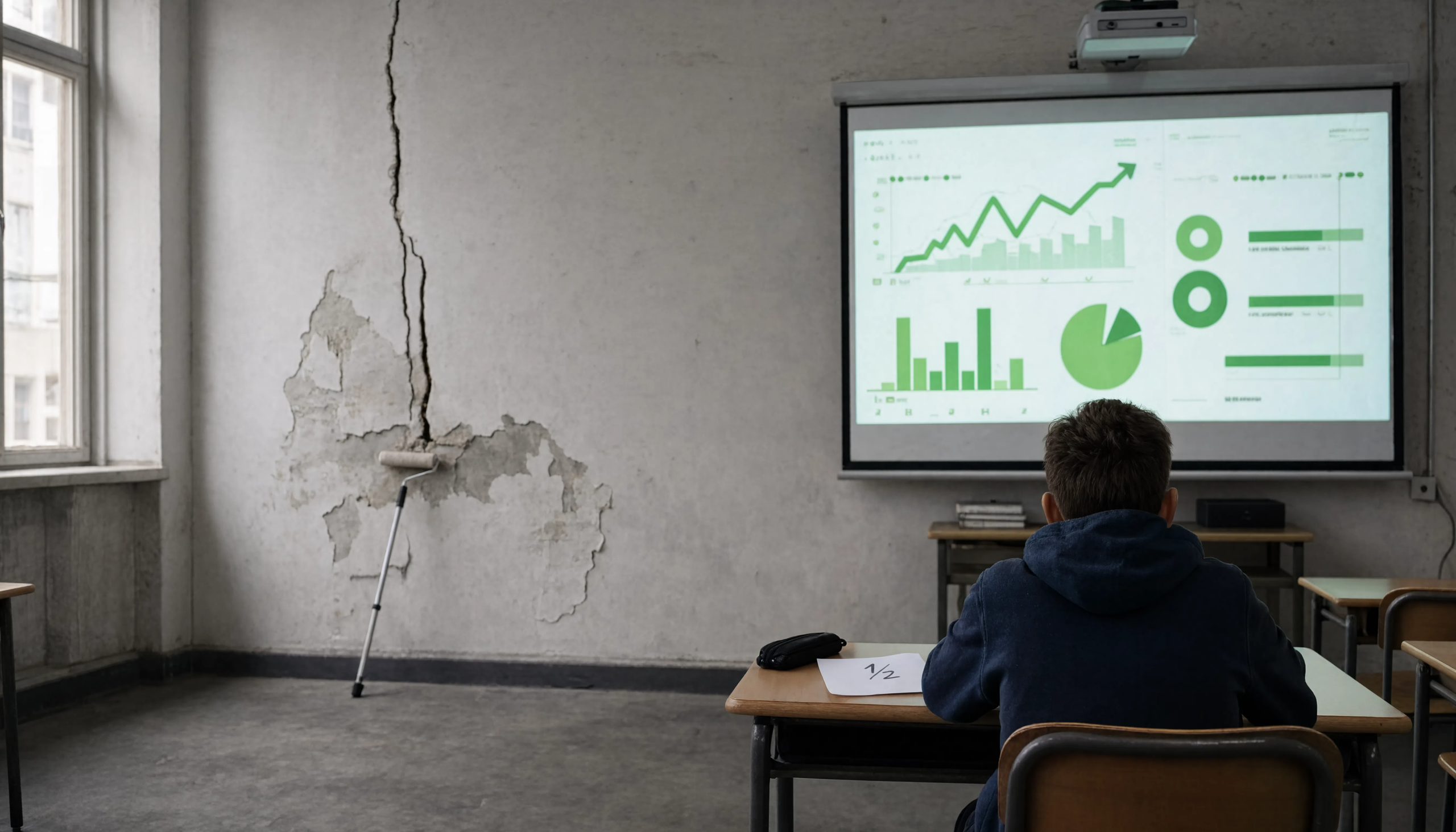
Thomas had started the year at 4 out of 20 and was finishing around 7. On a spreadsheet, with a scale judiciously calibrated between 3 and 8, this produced a curve whose slope evoked the take-off of a long-haul flight. No one had to climb on a chair to look more closely: the water stain had been converted into a graph, and a graph is viewed sitting down. The graph was projected at the school council meeting, then added to the application file for the “Benevolent Establishment” label, obtained at bronze level. The file had occupied two teachers for thirty hours — forty times the actual duration of a Thursday lunchtime session.
A plaque was presented in the presence of a deputy mayor and a buffet. It is still in the hall, screwed onto a crack. The administration that hands out these plaques is nicknamed the mammoth, which is rather unfair to the animal: the mammoth, after all, never filled in a label application file.
Is he ready for year 6, asked the father before the vote. No one answered, because the question forced a departure from the vocabulary of the pathway back into that of knowledge, which is decidedly very crude. He moved up.
Jade’s report cards, over the same period, come down to four phrases that return every term: serious pupil, satisfactory overall, discreet participation, keep it up. Six years, eighteen report cards, and not one sentence that speaks about her rather than her behaviour. No one ever had to lie about her, which explains why no one ever had to look at her.
A word now about the teacher, because this text would be dishonest without her.
She has twenty-seven pupils. Four do not read fluently, two have only been speaking French for eighteen months, one arrives with a four-page protocol that she has read in full, which no one had asked her to do. Her timetable is full from the first minute to the last, and what little isn’t already taken up by cycle meetings, parent appointments and the booklet to be filled in three times a year.
She knows Thomas doesn’t understand fractions. She has known since November, she noted it in her own notebook, along with two other names. She tried, in January, to work on them with them while the others worked independently. It lasted three weeks, and it stopped the day the others stopped working independently.
In front of her, on the screen, there are eleven competencies and three boxes: acquired, in the process of being acquired, not acquired. The first is false. The third is true, and it opens a file, triggers an educational team meeting, calls in a programme — and at the end of the chain there is no one but her, on Thursday lunchtime, with seven children and seven different problems. The second is false for no one, which is very different, and it is the only one that commits to nothing.
She ticked orange. In her place, that evening, with those hours, I don’t know what I would have ticked.
Two remediation sessions and no diagnosis
In year 7, Thomas discovered ratios and percentages, which work considerably better when you have understood fractions. By year 9, he had his theory, more economical than all the institution’s theories combined: he was rubbish at maths. The diagnosis took him four seconds against six years for the administration, and had the advantage of explaining everything without summoning anyone.
Secondary school examined the question with the same seriousness and assigned him a second remediation, exactly like the mechanic who, faced with a broken engine, hangs a second air freshener from the rear-view mirror. Then came the unifying project “Together Towards Perseverance”, endowed with a mascot co-created with the pupils in a participatory approach, which means they were made to vote and the result was completely ignored. The competition was won by a hare named Turbo, set aside by the leadership on the grounds that he conveyed a relationship with performance not in keeping with the spirit of the project. They went with the entrant in fifth place, a tortoise renamed Prudence, whose slogan was printed on three thousand bookmarks: everyone moves at their own pace, the important thing is to keep moving.
Thomas got 4 out of 20 on the proportionality test, a mark that appeared nowhere: the teaching council had decided, in an approach of positive assessment, to remove from report cards any result below 5 out of 20, a decision recorded in the minutes under the heading “harmonisation of assessment practices in the service of the learner’s sense of competence”. Out of eleven maths marks, seven disappeared. The four remaining ones gave an average of 9.5, accompanied by the comment “encouraging results, reflecting investment in clear progression”.
His parents framed the report card. It is still in the hallway at their home, next to a holiday photo.
Twenty years later, the State would make the same gesture on its own account. Short of maths teachers, the CAPES examination board set the average of the last admissible candidate for the 2025 session at 5.06 out of 20 [15]. Not 5, which would have required a decision. 5.06, which merely had to be calculated. How we got there is in appendix 5.
This is where the sentence that governs everything else must be stated, even at the cost of spoiling the surprise.
An organisation that becomes its own judge always ends up improving its score rather than its work. Not out of dishonesty: because it is infinitely cheaper, and because that is very precisely what it is asked to do. Thomas’s secondary school did not cheat by removing marks below 5. It did its job, which consists of producing good figures, and it did it rather well. This system does not work against the people who run it: at every position, only one box can be ticked, and it is always the same one.
What is missing, then, is not sincerity — there is plenty of that in this story. What is missing is someone the institution did not choose, does not pay, cannot summon, and whose verdict forces someone to do something on Monday morning.
Everything that follows describes what happens to a child, then to three, then to a country, when that judge does not exist. The acronyms, the colour chart, the bootcamp and the green tables all follow from it, and from nothing else.
Jade, that same year, was elected class representative and put in charge of distributing the bookmarks, a mission she took very seriously. She loved art history, a one-hour class on Fridays taught by a teacher who showed slides and spoke about Bruegel with infectious passion. At fourteen, she asked what it could lead to. She was told that the main thing was to do what she enjoyed. The answer made her very happy for eight years.
Educational Alliance and Co-education Mission Officer
In year 10, Thomas scored 3 out of 20 on the first test. His maths teacher was called Mr Lemaire, twenty-four years in the job, with a reputation as a man who marks quickly, says little and signs up to no unifying projects. Instead of recording the mark and moving on, he went and fetched the report cards from the previous six years and found an anthology: “needs to consolidate his foundations”, “lacks self-confidence”, “real potential to be developed”, “good attitude”, “able to mobilise cross-cutting skills in a secure environment”, “progress to be sustained over time”. He had the impression of reading the medical file of a man who had died in excellent health.
Mr Lemaire went back over a simple exercise with Thomas, then another, moving from percentages to decimals, from decimals to fractions, from fractions to division, from division to multiplication tables. He dug like an archaeologist and at every level found a cracked slab beneath a fresh coat of paint. After an hour, Thomas looked up and asked, without anger, which made it far worse: “Sir, do you think I’m stupid?”
Mr Lemaire decided to go back over fractions twice a week, in his own time, for free, which in a school constitutes an anomaly and a very serious breach of procedure.
In the same class, in the third row by the window, there was Rémi. The opposite case, and the same problem. Rémi finished tests in twenty minutes, handed in his paper and waited — behaviour listed in the school rules under the heading “passive attitude” and which had earned him two notes in his diary. One day, Mr Lemaire gave him an exercise that wasn’t on the syllabus, just to see. Rémi handed it back the next day, solved by a different method from the one expected, with a question in the margin: “Can this be generalised?”
In ten years of schooling, no one had ever given Rémi a problem he didn’t know how to solve. It is the only provision he ever needed, it cost four minutes a week, and it appeared in no axis of any school development plan.
Mr Lemaire was summoned after three weeks by his inspector. On the day of the meeting, the inspector offered him a coffee, the universal signal of tedium to come, and explained that a report had come up, that concern had been expressed about excessive pressure, and that it would be advisable not to generate counter-productive academic insecurity in the pupil. He warmly commended his commitment.
Then he announced the good news. Given his remarkable investment, the school wished to entrust him with a mission: Educational Alliance and Co-education Mission Officer, axis 3 of the school development plan. Four hours of teaching relief per week, a half-office on the first floor, co-chairing a quarterly steering committee and drafting an annual deliverable on preventing early school leaving. The four hours had to be taken from somewhere, and were taken from his timetable, which meant removing a class from him. They removed the year 10 class.
One class, two pupils, the two ends of the same room. Thomas lost the fractions he had never had. Rémi lost the only adult who had ever given him anything difficult. Neither of them appears anywhere, because a reduction in teaching hours is not a sanction and a pupil who loses a teacher fills in no form.
And so the only adult in the school who had dared to look things in the face was moved away from the wall he had begun to open, with everyone’s congratulations, and assigned to drafting a document on the root causes of academic failure. His appointment was announced in the staff room on a Friday. There was applause. A colleague told him he had deserved it, and she meant it.
The deliverable was submitted in June, twenty-two pages, presented to the steering committee and added to the school development plan. The first version was four pages and opened with a sentence the committee deemed non-consensual: “a pupil who cannot divide in year 5 will not be able to divide in year 10, and we know it from year 5.” Mr Lemaire was asked to rephrase it from a more systemic perspective, less focused on subject-specific attainment, and to take care not to target individuals.
The final version begins like this. “Academic difficulty is inscribed within a plurality of determinants, intersecting individual, family, social and environmental factors, whose entanglement makes it difficult to identify a single cause. A holistic and co-educational approach, articulating school and out-of-school time within a logic of continuity, therefore appears to be a relevant lever for securing trajectories, subject to a shared upskilling of the actors involved.”
Written by the only man who knew the answer. The document was deemed very rich.
It is online.
We do not sanction a teacher who teaches — that would be indefensible and would get out. We promote him, move him out of his classroom, thank him warmly, and the mammoth resumes its march without rancour, without a disciplinary file and without ever having had to raise its voice once.
“We” means us. There is no one else in the room.
Thomas finished the year with a supply teacher recruited in November, on interview and without having sat any competitive exam, a charming young man who never moved anything.
With Jade, no one ever had anything to move, for the excellent reason that nothing stuck out. She chose her A-level specialisms the way you choose a mobile phone plan, by looking at what the girl next to her had taken. No teacher ever looked into her file, which was perfectly justified: her file was fine. There is no summons for an excess of respectable average, no monitoring unit for 13.5s, no referral form for a teenager who doesn’t know what she wants to do but hands in her work on time. She went through sixth form without any adult ever having to deal with her, and came out with a “fairly good” grade and no idea about anything.
A careers adviser who never left school
For Thomas, there existed a trained, qualified, tenured professional. Jessica, educational psychologist, specialising in education, development and school and career guidance — a title that takes two lines on a business card for a job that consists of handing out leaflets. In her office, forty brochures, thirty-eight of them about sectors that were hiring in 2009, and a yucca that died in 2019, replaced by a plastic yucca that no one noticed, including her, who continues to water it every other Tuesday.
She saw eleven Tuesdays a year for 1,200 pupils, and her experience of the world of work amounted to three schools and a staff room. She guided pupils towards careers she knew from brochures, written by a project officer who knew them from fact sheets, produced by an operator funded on a report, which report had been entrusted to a twenty-six-year-old consultant who had read up on it in the brochures. A perfectly watertight circuit, running without the slightest contact with reality for thirty years, like an aquarium from which the water has been removed without telling the fish.
Thomas took the in-house questionnaire, forty-five items of the “would you rather repair a moped or accompany an elderly person” variety. He answered 3 to everything, out of self-preservation. The software crashed, was restarted, and the printer produced the profile of Léa, seen at 9:40, who wanted to be a vet. No one noticed.
And it wouldn’t have changed anything.
“Rather practical profile, customer-relations oriented.” Translation: business, that elegant cemetery where the institution files away the kids it failed to educate and refuses to name. The father asked what profile was in question. Jessica listened to him to the end, very gently, then showed him the results. The results were bad. So that was the profile. We let gaps accumulate for six years, then they become the proof of a vocation: mould becomes a career plan.
On the liaison form, someone wrote that the guidance had been “co-constructed within the framework of the Avenir pathway, with a pupil fully engaged as an actor in his project and a family involved at every stage of the decision”. Twenty-six words, three of which described something that had actually existed. “You shouldn’t see this as a dead end,” added Jessica, head tilted to one side.
Jade passed through the same office three weeks later, on a Tuesday in April, in a slot freed up by an absence. Same display rack, same mug, same plastic yucca, watered twice in the meantime. She had no difficulties, no gaps and no plans, which constituted a considerably more restful case for Jessica.
She explained that she quite liked art history, that she’d heard of cultural mediation, and that she didn’t really know. Jessica listened to her to the end, then told her that with a file like hers she could aim for whatever she wanted, and that above all she should follow her passion.
Follow your passion. It is the only sentence the institution addresses to pupils who cause no problems, and it must be credited with two remarkable qualities: it is warm, and it commits absolutely no one. No one that day asked how many posts existed in cultural mediation, how many graduates applied each year, or what a project manager with three years’ experience earned. That information exists, it is public, it fits on one page. Over the twenty years Jade spent in a classroom, the word “prospects” appeared once, in a brochure on a plastic display rack.
Rémi never made an appointment. He had looked it up himself, one Sunday evening, what it took to become a research mathematician, and he had found in forty minutes what eleven Tuesdays a year would never have produced. In fairness to Jessica, he never asked her anything, and in fairness to the institution, it therefore never had anything to refuse him. You cannot reproach an office for not having helped someone who never walked in. You can wonder why he never walked in.
To one, business, because his marks were bad. To the other, your passion, because her marks were good. Two opposite sentences, spoken in the same office, under the same 2017 poster, and producing the same result. To the third, nothing was said at all, and the result is still the same, except that he left.
Borrowing capacity and disposable income
Vocational diploma, fresh produce counter, nine years, cold room at two degrees. Thomas became a fishmonger, a real trade, and no one here has ever claimed that was a failure. The failure is that no one ever asked him whether he had chosen it.
Jade, meanwhile, had done things in the right order. Bachelor’s, master’s, with honours, a master’s 2 in event communication and cultural mediation, territorial innovation pathway, art philosophy option. Five years, €4,000 a year in student rent, two six-month internships paid €600, one of them in a heritage promotion association where her mission consisted of keeping a volunteer database up to date, among whom eleven had in the meantime joined the heritage themselves.
Her dissertation was 180 pages and entitled Inhabiting the Link: Cultural Mediation as a Vector of Territorial Resilience in Peri-urban Areas. The panel praised the quality of her problem statement and gave her 16, for a piece of work read by three people, two of whom were obliged to.
Then came the market, which had not read the course handbook. 187 applications, four interviews, an online personality test that classified her as “creative profile, people-oriented”, and a one-hour situational exercise where she had to propose a communication plan for a pressed cheese. Thomas would send 180 a few years later, after sixteen weeks of training. The five years and the sixteen weeks would end up at the same counter, which should raise a question for someone.
She is now Community Engagement Officer for a group of cheese dairies — a title that makes her sound like a local councillor — €1,900 gross, nine-month fixed-term contract, remote work on Fridays. Her job description announces the “steering of the multi-channel editorial strategy, animation of the brand community and co-construction of the group’s territorial narrative”, which means writing posts about Comté, moderating comments about animal rennet and handling one reputational crisis per quarter because a customer found a hair in a raclette. Her annual review has four axes, eleven indicators and one objective entitled “embodying proximity”.
At family meals, her mother mentions that she has a degree, with a slight smile after the word “degree”. A brother-in-law once asked, without the slightest malice, what exactly the philosophy of art history led to. Jade’s mother put down her fork, looked the brother-in-law up and down over the dish and replied in a dry tone: “Well, a diploma, of course, and on top of that she’ll have an extraordinary general knowledge.” The table approved, the gratin was passed round again, and no one ever asked the question again.
Her bank manager, on the other hand, proceeds differently. Jade and Thomas went to see him about a €9,000 car loan, and Jade had brought her master’s 2 in a plastic wallet, just in case. The bank manager did not ask about the subject of the dissertation. He did not ask about the grade. He did not ask what cultural mediation was. He asked for the last three payslips, the type of contract and the end date. Fixed-term. Nine months. The software displayed something, the bank manager made a little face, mentioned “borrowing capacity” and “disposable income”, then suggested revising the amount downwards or waiting for tenure — a word he used in perfect good faith, but which does not exist in Jade’s sector.
It was the first time in her life anyone had told her no. Twenty years of schooling, dozens of report cards, a dissertation graded 16, not a single door closed, and the first refusal came at twenty-seven in a bank branch, about the purchase of a second-hand Clio.
The master’s 2 stayed in the plastic wallet. In fairness to the bank manager, he has nothing against degrees: he just doesn’t count them, that’s all. What he counts is months. His software knows nothing of individual pace, psychosocial skills and the Avenir pathway; it knows only the contract end date, and it is right, since that is the only piece of data that will determine whether the loan is repaid. He is the first adult in twenty years to look at Jade without being part of the mammoth.
Here we must leave Rouen for a moment, and return to the third pupil in this story.
Rémi, the one in the third row by the window, defended his mathematics thesis the same year. Two years of classes préparatoires, an engineering school, a master’s, then three years of doctoral study funded by a doctoral contract at €1,866 net — which, relative to the eight years of study that preceded it, put his hourly pay somewhere below that of the fresh produce counter. He never mentioned it, because that wasn’t the point and he loved what he was doing.
He applied in France. One lectureship, 87 applicants, four interviewed, twenty minutes before a committee, and a reply five months later ranking him second, which is of no use. He was told he needed to publish more, be patient, try again next year, possibly with a temporary teaching and research contract at €1,700. He did the sums on the corner of a table: three more years, perhaps, for a job, perhaps.
ETH Zurich replied in eleven days. Postdoc, three years, an office, a travel budget, a salary with no common measure, and in the email a sentence no one in France had ever written to him: “We have read your work on numerical schemes and would like you to continue it here.”
He left in September with two suitcases and a box of books. His mother said at the table that he had succeeded. She was right. He is in fact the only one of the three of whom that can be said without irony.
Jade, for her part, stayed. The communication plan provides for four in-store activation operations per year, a formula that designates the act of going to film cheese in a supermarket. And so one Thursday in November, Jade found herself at the deli counter of a hypermarket on the outskirts of Rouen, three metres from Thomas’s display. She had a tripod, an authorisation signed by the manager and eighteen seconds to fill. He held the lamp for her while a wheel turned in the light, suggested moving the crushed ice tray to avoid the reflection, and she thought he had a good eye. The video got 43,000 views, her manager used the word “viral” in a meeting and there was applause.
They married eighteen months later, at the town hall, thirty-two people and a drinks reception in the village hall. They never told each other the details of their schooling, for lack of material: one had always been rubbish, the other had always been serious, and those two sentences close a conversation rather than open it. It took them a while to realise they had walked the same corridors, in exactly the same years, three classrooms apart, under the same plaque screwed onto the same crack. They laughed about it, looked for teachers in common, found four. They didn’t look any further, and there was no reason they should: nothing in what either of them had been told resembled, even remotely, the same story.
No maths prerequisites
Thomas had been circling an idea for some time that he didn’t dare formulate. Nine years in the cold, a back that was starting to complain, a twenty-four-year-old department head who arrived in September, and that very precise feeling, around twenty-eight, of being exactly where he would still be at fifty.
Forty years ago, a man in that state would open three beers in front of a match and go to bed at midnight. It was sad, it was bad for the liver, but it stopped at the final whistle. Today he scrolls, two hours an evening, sometimes three, thumb in continuous motion and eye perfectly blank. The stupefaction is comparable, minus the beer. The difference is elsewhere: the algorithm takes notes.
In three weeks, it learned that Thomas, twenty-eight, watches late-night career-change videos, that he stops at the salary figures, that he always comes back to the before-and-afters. It draws no conclusion about his life — that is not its job. It draws a conclusion about its market, and starts serving him, between a tiramisu recipe and a cat falling off a shelf, what a tired man of that age is statistically most likely to buy. A solution. Three months, no prerequisites, funded, change your life. You never sell that to someone who is doing fine: the product doesn’t answer a need, it slips into a void, and the void had been measured before he got there.
One Sunday, around 10:30 p.m., it finally took the face of a twenty-three-year-old guy filmed on a white sofa, with Dubai behind the bay window and a watch too big for his wrist. He doubled his salary in three months, he doesn’t understand why people still get up at 5 a.m., and he repeats three times in forty seconds that no one is coming to save you. On that precise point he is perfectly right, and it is the only accurate thing in the entire video.
Thomas watched to the end, then two more, then the one explaining how to finance the training without paying a euro upfront. Form filled in at 10:40 p.m., callback at 10:44 p.m. — by far the most impressive technical performance of the organisation. The documents would later state that he had embarked on a “voluntary professional retraining process”.
He hesitated for three days, because of the cost. It was Jade who pushed him. She told him that at some point in life you had to follow your passion — a sentence she had received at seventeen from a fifty-eight-year-old woman, in an office where a yucca was dying, and which she passed on in perfect good faith, the way you pass on a family recipe without ever having checked whether it was any good.
The brochure promised €45,000 starting salary, 92% employment within six months, and the testimonial of a former hairdresser now a data analyst in a major group whose name remained confidential. It stated, in reasonably large print, “no maths prerequisites, because our approach is resolutely practice-oriented and the libraries do the calculations for you”. That is perfectly accurate. The libraries do the calculations for you, the way a calculator does additions, and that is precisely why we still learn to count.
The whole thing cost €7,900 for sixteen weeks, funded through the personal training account — that is, a pot of paint provided by the State and applied by the beneficiary himself, as he sees fit. For comparison, one hour a week with someone who knows how to divide, over a full school year, comes to €1,400, reduced to €700 by the tax credit the State grants without asking anyone anything. The €7,900 of the bootcamp funds eleven years of it.
One would have been enough.
Sixteen weeks for a job that his future colleagues had approached after five years of study, three of them with daily mathematics. The organisation wasn’t really lying. It was selling exactly what it advertised: sixteen weeks. It was the rest of the sentence that no one had written.
First week, Python, it looks like a cooking recipe. Fifth week, the instructor, who came out of the same bootcamp four months earlier and was recruited for lack of being recruited elsewhere, writes a partial derivative on the board, noting that it’s “A-level stuff”. The whole room nods, including eight people who left school in 2004.
And then one Thursday, 4:10 p.m., a slide entitled “variable normalisation”, and there was division to be done. Understanding that a ratio is not a number but a relationship. Thomas looked at the board with exactly the face he had had at ten in front of a cake that was becoming a duration. Eighteen years — that is how long it took for the year-5 leak to come through the final ceiling. He didn’t raise his hand, because at twenty-eight you don’t ask what a fraction is.
Then came the market, which had not read the brochure.
He sent 180 applications, 173 of which were read by software looking for keywords and not finding enough of them. Junior roles required three years’ experience, which no one in the room ever knew how to comment on other than by laughing. Of the six candidates summoned the same day, five had a master’s degree and the sixth was Thomas, who discovered that day that the country was not short of data scientists but of data scientists who knew mathematics — a nuance that sixteen weeks does not bridge.
In the interview he did very well on correlation and causation, dropped “overfitting” at the right moment, talked about the fresh produce counter, and his interviewer found it wonderful, very concrete, “we need people like you”. Then someone uttered the words “covariance matrix” and the conversation ended four minutes later, in an excellent atmosphere.
Of twelve graduates, two found a job in the field. The first was already an engineer before he started. The second was recruited as an instructor by the organisation, for lack of being recruited elsewhere, and found himself four months later in front of twelve people explaining that a partial derivative is “A-level stuff”. Thomas, for his part, was counted in the 92%, since he had completed the training and was actively looking, which classified him as “dynamic professional integration in the process of being realised”. His personal training account is empty until 2029, and the advert for his old job on the fresh produce counter is still running.
No company ever called him back.
Still in the green
Thomas and Jade moved in September, for four reasons. Jade was five months pregnant, which settled the housing question and raised many others. An employment adviser had explained to Thomas that, for an equivalent profile, he should move closer to a more dynamic employment area — a phrase he noted on his phone. Jade’s fixed-term contract had been renewed for only nine months, which made any projection difficult. And the previous rent no longer worked, with the remaining bootcamp balance to be repaid until December.
A two-room flat on the sixth floor, reasonable rent for the area. The landlord received them himself, a charming gentleman, who pointed out that the flat had just been freshened up. Ceiling redone, matt white, two coats, and a candle on the coffee table, cotton-fresh scent. Thomas looked up, noticed a slight difference in shade above the sofa and asked what it was. The landlord replied that it was an old building and that these things take time. Jade thought it was very bright. They both signed, the same day, under the same ceiling, each with a degree in a cardboard box and no way of knowing what was behind the paint.
He found a fresh produce counter four kilometres away, 5 a.m. start, cold room at two degrees, hands in crushed ice from November to March. On LinkedIn, he is still a data scientist, passionate about data and open to opportunities.
Jade took the train on Monday for her cheese group, forty minutes in the morning, forty minutes in the evening, the fixed-term contract running until June. They cross paths on Wednesdays, the day he finishes early and she doesn’t work remotely. The rest of the time, they leave notes for each other on the kitchen table.
We would like to be able to say the system failed. That would be comforting: we would call for resources, vote through a plan, and sleep soundly. But it did not fail. It worked exactly as it was designed to work, with the regularity of a Swiss clock.
Thomas moved up to year 6 without repeating, which brought down the school’s repetition rate. He got his first choice, which brought up the departmental indicator for satisfaction with guidance choices. He obtained his vocational baccalaureate, which fed the academy’s pass rate. He was hired within six months, which fed the sector’s employment rate. He used his personal training account, which boosted the region’s continuing training take-up rate. He completed his bootcamp, which placed him in the 92% of a private organisation funded by public money.
Jade, for her part, did even better. She obtained her baccalaureate with honours, she was admitted to higher education, she continued to master’s level, she passed every year first time, she completed two accredited internships, she defended her dissertation with a 16, and she was in paid employment less than six months after graduating. Seven green lines, without a single anomaly. She even appears in her university’s brochure, in the graduate employment section, smiling in front of a brick wall.
Rémi, meanwhile, broke all records. Highest honours at the baccalaureate, admitted to classes préparatoires, accepted into an engineering school, master’s passed first time, doctoral contract obtained through the doctoral school ranking, thesis defended in three years, four publications in peer-reviewed journals, job secured even before the defence. Eight green lines, and the last is the greenest of all. None of these indicators has a country column.
We have therefore developed a remarkable education system whose main export product is the pupil himself. It is an achievement. One might even say it is our greatest international success, except that we don’t charge for it.
Training the best for others is a form of generosity no one asked us for and no one thanks us for, which at least proves it is perfectly disinterested.
And the most remarkable thing is not that he left. It is that his departure, in our tables, is recorded as a positive.
The mammoth did not need to lie about what it measured. It merely had to choose what it would measure, which is infinitely more effective and perfectly legal. Twenty-one indicators between the three of them, twenty-one successes, twenty-one meetings where someone projected a curve going up, and twenty-one times sincere people applauded at the end of the session. They now exist in a good twenty dashboards, always in the green, as three lines among thousands. They have made the success of their school, their secondary school, their academy, their department, their region, two universities, one grande école and one simplified joint-stock company. Not one of the three has ever missed a single figure in his or her life.
The first two only missed their lives, and that appears nowhere, because it cannot be counted. The third succeeded in his, 600 kilometres away, and that appears nowhere either, for the same reason. We know how to measure in detail whether a child is progressing. We do not have a single indicator to check whether he can divide, nor a single one to know whether, in the end, anyone needed what he was taught.
So we paint over it, and it must be admitted that we have the finest colour chart ever assembled by an administration. It exists physically, in fact. It is a two-page appendix attached to an academic circular, entitled Talking Points for Teams, presented in two columns.
On the left, formulations to avoid. On the right, recommended formulations.
Delay → individual pace. Gap → fragility. Difficulty → special educational need. Failure → pathway. Giving up → chosen direction. Dropping out → respect for the pupil’s project. Lowering standards → attention to school climate. Social sorting → pedagogical differentiation. Can’t do it → in the process of being acquired.
Neither column describes a child. They describe the same thing, and only one of them obliges someone to do something on Monday morning. That is the one that was removed.
The rest is written in acronyms. A father tried, one evening, to explain to his wife on the phone where their son was up to. He said he wasn’t in a PPRE but in a PAP, that it wasn’t a PPS because there was no MDPH notification, that it was recorded in the LSU, monitored in AP, raised in EDS and escalated to the PIAL, and that they had talked to him about CPS within the framework of the Avenir pathway. She asked whether he was doing better or worse. He said he didn’t know.
Eight acronyms, three of which had changed names since the previous meeting. This is not a side effect of the system. It is the system. A language whose sole function is to make what it describes painless, so thick that no one can see what is underneath any more, starting with those who speak it.
The ceiling always eventually collapses, but never in the office of the one who painted it. We look at the twenty-eight-year-old man in the middle of the rubble, his tote bag in his hand, and the twenty-eight-year-old woman next to him, her master’s in a plastic wallet, and we explain to them very gently, head tilted to one side, that a pathway is never linear and that above all they must keep believing in themselves. Then we hand them a brochure.
The institution, for its part, is summoned nowhere. The year Thomas returned to the fresh produce counter, a report concluded that the personalised support programme was producing encouraging effects that should be consolidated. A conference praised the continued decline in repetition. The label was renewed, three people were promoted, one of them in the slideshow. And the whole was judged perfectly effective, which it was: indicator by indicator, the system had fulfilled exactly the mission it had set itself, and had even exceeded it by two points. Its only sanction is called a reform.
Room 12, a Tuesday in November, twenty years after Thomas. The same nursery-class chairs, another head teacher with the same knees up around his chin, a teacher, two parents and a young woman whose role no one will establish. The child is called Manon, she is ten and she does not understand fractions. The PPRE is now called PCSA, plan de consolidation sécurisée des apprentissages, linked to section 2 of the objectives contract. The orange square has become an amber dot entitled “on the way to mastery”. On the table, bookmarks still in their wrapper: the mascot of the new programme is a smiling snail named Chemin, chosen unanimously by the steering committee, this time without consulting the pupils, experience having shown that voting changed nothing and cost three weeks. The parents are told that the child mobilises her resources inconsistently, that holding her back would be very difficult to contemplate given the literature, and that differentiated support respectful of her own temporality has been put in place on Thursday lunchtimes. Someone projects a curve going up.
The father asks if someone can translate that into French.
A reform repairs nothing, it repaints. That is in fact its definition.
Grading yourself improves the grade, never the work
One question remains, the only one that matters: how does a country that once knew how to produce excellence end up producing mediocrity?
A clarification first, because it governs everything else. The School is not a particular problem, with its specialists, its unions and its newspaper column. It is a marker. It is the place on the body where the disease becomes visible, and it becomes visible twenty years late, which explains why we always deal with it too late and never for long.
What has replaced common sense there has a name, and Hannah Arendt gave the best available definition of it: an ideology is the logic of an idea — that is, thought’s emancipation from experience [1]. Re-read the preceding chapters with that sentence in mind. The booklet with eleven squares, the curve with the carefully chosen scale, the twenty-two-page report, the grid filled in in twenty minutes, the two-column table: none of it is false. All of it is simply detached from experience, and that day experience was sitting on a nursery-class chair and did not understand fractions.
Because it must be said, the French school system was, for a very long time, exactly what needed to be done. And the story even begins before it. For two centuries, France became literate from the bottom up, through families, parishes and village schoolmasters paid directly by the peasants, which guaranteed the schoolmaster a continuous evaluation of a brutality no protocol will ever match. The Maggiolo survey measured this from the signatures at the bottom of marriage certificates: a large majority of French people could already sign their names before the first compulsory schooling law [2]. Signing is not reading fluently, and historians still debate what exactly that indicator measures. They do not debate its direction. The State did not create education. It nationalised a movement that existed without it.
Then 1882, and it must be admitted, the machine worked remarkably well for eighty years. The hussards noirs, the daily dictation, and Thomas’s grandmother, who had left school at fourteen, who wrote without a single mistake, and who was still talking about her certificate sixty years later. The subject came from elsewhere, the papers went elsewhere, and you could fail it: three girls from her village had failed it that year, everyone knew, including them. The machine was small, the teacher was king in his classroom, and above all there was an external judge, the primary school certificate. It is a technical detail and it is the whole subject. The certificate did not measure the child’s pace or his commitment; it measured whether he knew. And the institution that organised the teaching was not the one that delivered the verdict.
The third act is that of a machine that grows and removes its judges one by one, always for very good reasons, always in the name of the children. In 1969, modern mathematics was imposed from above against the advice of primary school teachers, establishing a useful precedent: the field is wrong. In 1975, the comprehensive middle school abolished streaming and invented along the way the obligation to make everyone progress at the same speed, the ideal condition for ceasing to measure anything. The certificate, meanwhile, agonised in silence: 600,000 candidates in 1968, 453,000 in 1971, 85,000 in 1981, then a decree signed in August 1989 extinguished it for good, the final session being held in 1991, without anyone taking to the streets [3]. In 1997, a minister publicly announced his intention to slim down the mammoth; the minister left, the mammoth stayed, and it put on weight again during its convalescence. In 2014, repeating a year became exceptional.
One last term is missing from this series, and it is the most radical. The competitive exam that recruits teachers is itself an external judge: a national paper, scripts marked elsewhere, a pass mark, and the possibility of failure. In 2006, 3,983 candidates sat the written papers of the CAPES in mathematics for 952 posts. In 2025, there were 1,559 for 990 posts, and the board recruited 739 [15]. Between the two, the pass mark was not decided. It was calculated.
In the end, not a single verdict remains that the institution does not pronounce itself, neither on pupils nor on those who teach them.
A word on 1997, since the nickname outlived the minister. The diagnosis was wrong, and it stayed wrong: the mammoth was never an obese animal. It disappeared because the climate changed, its habitat retreated, and what was left of it was hunted by men equipped with flint. A climate that changes, and hunters from elsewhere with better tools. We know both. Being reproached for its weight is the most comfortable thing that can happen to an administration: it loses a little weight, it is congratulated, and no one ever asks it to adapt to anything. That is very precisely why it is still here.
At this point, I should project a curve. A beautiful one, dates on the x-axis, level on the y-axis, the scale carefully chosen and the slope speaking for itself. It would be exactly the gesture this text spends pages ridiculing, and you would be right not to take me at my word, any more than the school council should have taken the head teacher’s spreadsheet at his.
So no curve. One figure, just one, and the most boring possible.
In 1987, the DEPP gave a 67-word dictation to year-5 pupils. It gave exactly the same dictation to the year-5 pupils of 2007, then 2015, then 2021. Same text, same year group, same marking scheme, thirty-four years apart. Average number of errors: 10.7 in 1987, 14.7 in 2007, 18 in 2015, 19.4 in 2021. This is not an opinion about schools, it is the same thermometer read four times [4].
The same survey also measured arithmetic. In 2007, certain questions from 1987 had to be removed from the test, including decimal division, which had gone off the syllabus. So we stopped comparing precisely where comparison would have hurt, and for a rigorously regular reason. No one lied, no one cheated. The instrument was adjusted to what was still being taught.
All of this is public, dated, and fits on a few pages. The same goes for the PISA report published on 8 September 2026, which the press commented on for forty-eight hours and has since filed away, and whose summary is given in appendix 3. It is in fact exactly what no one ever put in front of Jade.
The law stated above does not apply only to schools, and that is what makes it uncomfortable: any organisation that becomes its own judge ends up rotting, whether public or private, populated by saints or cynics. It is not a question of morality, it is a question of mechanics. The only difference between the private sector and the State is that the market never allows itself that luxury for very long. The State can afford it by law. It has afforded itself, and our children are paying the bill.
Such an organisation has nothing against external judges. It willingly accepts them, on one condition: that the verdict designates the child rather than itself. A diagnosis that files the pupil into a category is received with gratitude, because it explains the failure without obliging anyone to do anything on Monday morning. A verdict that said “he can’t divide, we need to go back over it” would cost hours that someone would have to take from their own. That is all we ask of a verdict: to designate no one.
Take a landlord, any landlord, with a two-room flat whose ceiling has had a water stain for years. He has been his own judge for eighteen years, with excellent results: no vacancy months, no unpaid rent, a maintenance budget kept to the euro, a yield at the top of the table and in the green. None of that was false. The law helped him, according to an asymmetry worth looking at closely. To sell his property, he would have had to produce nine surveys established by a certified professional, independent of him, whose liability can be engaged. To rent it, he filled in the inventory himself, in two copies, signed by both parties. He never sold.
Then the tenant took the matter to court, and a man the landlord had not chosen, did not pay and could not summon climbed onto the roof. He opened the duct, found the pipe and dated the leak at eighteen years. The judgment runs to four pages: complete re-waterproofing, removal of the plasterboard, redoing the ceiling at the landlord’s expense, €2,000 in damages, €100 per day of delay. The ceiling was redone.
No one will ever climb onto the roof of a school career to open the duct and date the leak. No judge will ever order anyone to give back to a twenty-eight-year-old man the fractions he was not taught at ten. No formal notice, no daily penalty, no ten-year guarantee on a pathway. And no complainant either: the only injured party in the whole affair was patiently convinced, over twenty years and with the best intentions in the world, that the problem came from him.
That is all that is missing. A guy on the roof, who does not belong to the house.
It remains to say what he would look like, because naming him is easy, and stopping there would be the very gesture this text has been reproaching everyone for from the start: designating the problem and having nothing to do on Monday morning.
We have three examples in these pages, and each contains one piece. The primary school certificate: a paper from elsewhere, scripts marked elsewhere, a date, and the possibility of failure. PISA: a scale that does not move from one edition to the next, public data that anyone can recalculate, including against the body that publishes it. The court judgment: a daily penalty for delay.
Assembled, these three pieces give something very simple and very boring. A short test, at a fixed age, say the end of year 5, covering three or four things no one disputes must be known. Written outside the institution, marked outside the child’s school, on a scale that is not adjusted when the results are displeasing. A result given to the family in plain French, with no coloured square. And, the only point that really matters, a consequence attached to the verdict: hours, taken from somewhere, owed to that child, and someone whose job it is to verify that they were provided.
What that would cost, where to find the hours, who would accept being measured in that way — these are real questions, disputed, and this text has no pretension to settle them. But none of them is the question being asked. For twenty years, the question asked has been that of the name of the box, and it always has an answer, which explains why it keeps being asked.
Christophe Kerrero, who was rector of Paris and who resigned in February 2024 after being publicly disavowed over a planned reform of classes préparatoires of which he had not been informed, writes that there will be no economic recovery and no national cohesion without a renewed ambition for the School [5]. It may be observed in passing that he was removed according to the exact protocol applied to Mr Lemaire, simply at a higher level and with no less sincere congratulations.
The formula is right. It is also reversible, and that is where it becomes uncomfortable. There will be no more ambition for the School without economic recovery, national cohesion and republican ambition. A school does not manufacture a society, it descends from one. It teaches what the country cares about, with the means it consents to, in the language it speaks. We have passed on to it our taste for indicators, our horror of verdicts and our habit of painting over things, and then we are surprised that it has learned them.
We do not ask a thermometer to bring down a fever. That is why no minister will ever succeed, and why it is not entirely their fault.
There is therefore no one to punish, which is the worst news in this entire text. A fault can be repaired, because it has an author and a date. A mode of functioning has neither: it continues, and it has already started again on someone smaller. That is why we need someone on the roof. Not to condemn. So that the leak has a date.
And they lived happily ever after
While the reports pile up and the acronyms are renewed, Thomas and Jade continue to live. They had a son, Seb, he is four. Jade renewed her fixed-term contract twice, €40 the first time, nothing the second, each time with a very kind word about her team spirit. The 180-page dissertation is in a box on the top shelf, next to the art history textbook from her final year that she has never been able to throw away and a cardboard bookmark where a tortoise reminds her that the important thing is to keep moving. Thomas was appointed deputy manager of the fish counter, which represents €80 and two more meetings a month.
They talk about Seb’s future, because apparently you have to start early. First there is the application for the Montessori nursery, to be submitted without fail by Friday, €4,800 a year, requiring a cover letter. Not a letter from the parents, no — a letter presenting the child’s educational project, his relationship with autonomy and his interests. His main interest is a plastic tractor missing a wheel. Jade wrote 1,500 characters about his appetite for free manipulation and his need for a caring framework respectful of his rhythm, Thomas proofread it, and they thought it was rather good. The committee reviews 180 applications in three weeks, between two meetings.
Rémi, after Zurich, moved into industry, where he now heads a research team for one of the few groups that fund most of the world’s research in his field. He earns in a month what Thomas earns in a year. Last year, he came back to France for four hours and forty minutes, three of them in a boarding lounge at Roissy, between two flights to the other side of the world. His parents had made the trip. The three of them drank a coffee standing next to a terminal, and his mother thought he looked well.
At their home, on the floor, Seb lines up his little cars by colour, then realigns them by size, which presupposes a criterion, therefore a classification, therefore an abstraction.
Everything is there, and no one has painted over anything yet.
The article ends here.
References
I am not asking you to take my word for it. This text defends a point of view, and the conclusion is mine. The facts and figures on which I base it are detailed in the appendices that follow and referenced at the end of the document, with links where available, so that you can verify them, discuss the interpretation I propose and form your own opinion.
Appendix 1. Unit cost of free education
Annual expenditure per pupil in 2024, all funders combined: State 55%, local authorities 23%, businesses 10%, households 8%, other public bodies 4% [6].
| Level | Annual cost |
|---|---|
| Nursery | €8,990 |
| Primary | €9,130 |
| Middle school | €10,450 |
| General and technological sixth form | €13,020 |
| Vocational sixth form | €14,700 |
| University | €12,460 |
| Higher technician section | €17,220 |
| Classes préparatoires aux grandes écoles | €19,070 |
Three years of nursery, five of primary, four of middle school and three of sixth form: around €153,000 for a general pathway, €158,000 if the sixth form is vocational. Order of magnitude calculated at 2024 costs.
Thomas’s schooling therefore cost in the order of €158,000, plus €7,900 for the bootcamp, i.e. €166,000. Jade’s cost €153,000, plus five years of university at €12,460, i.e. €215,000. A little over €380,000 for the two of them.
Rémi’s two years of classes préparatoires alone represent €38,140, almost as much as his four years of middle school. What followed — engineering school and doctorate — takes the total well beyond Jade’s €215,000. The DEPP explains the difference by the staff-to-student ratio, which is accurate and has never stopped anyone calling it excellence.
None of these amounts appears on any document they have ever held in their hands.
One cannot divide. The other never knew what the things she had learned were for. The third works in Zurich, and Switzerland funded nothing.
Appendix 2. Pupils described as “behind”
Same dictation, same year-5 classes, same 83 items, at the same four dates [4].
| 1987 | 2007 | 2015 | 2021 | |
|---|---|---|---|---|
| Share of pupils described as “on time” | 66.8% | 84.0% | 89.1% | 95.4% |
| their average number of errors | 8.5 | 13.2 | 16.7 | 18.7 |
| Share of pupils described as “behind” | 33.2% | 16.0% | 10.9% | 4.6% |
| their average number of errors | 15.1 | 22.6 | 28.5 | 33.1 |
| Gap between the two groups | 6.6 | 9.4 | 11.8 | 14.4 |
The DEPP itself comments on the third line: “this trend reflects educational policies aimed at limiting repetition during primary schooling.” It then states, honestly, that pupils described as “behind” are therefore not directly comparable across the whole period, since only the most severe cases remain at the end.
The objection is fair, and it applies only to that group. It does not affect the other. Pupils described as “on time” went from 8.5 to 18.7 errors, and they now represent 95.4% of children.
In 1987, a third of pupils wore a label that obliged someone to do something. In 2021, they are 4.6%. No one has ever claimed the others are doing better.
Appendix 3. France’s latest PISA results
Tests taken in May 2025, results published on 8 September 2026. In France, 6,501 pupils drawn at random from 289 schools, representing 768,200 15-year-olds, i.e. 88% of the generation [7] [8] [9]. These pupils are exactly the age Thomas was on the day Mr Lemaire went to fetch his six report cards.
A clarification first, because it governs everything else. This report is the only thing left in this country that resembles the primary school certificate. The paper is not written by those it assesses: the framework and the items are designed by an international consortium and tested outside France. The scripts are marked neither by the pupil’s school, nor by their academy, nor by the ministry. The scale does not move from one cycle to the next, because some of the questions are reproduced identically from one edition to the next, which makes it possible to link 2025 to 2003 without lying. The sample is not chosen by the house; it is drawn according to external rules, and the DEPP must prove it has complied with them. The data are public: anyone can redo the calculations, including against the OECD.
Only one thing is missing, the same as everywhere else in this text. The verdict falls on no one. No pupil receives their mark, no school is named, no teacher is concerned, no academy has to account for anything. A school certificate without candidates, without a panel and without failure. That is very precisely why it is tolerated.
| Domain | France 2025 | OECD 2025 |
|---|---|---|
| Reading comprehension | 456 | 461 |
| Mathematical literacy | 458 | 463 |
| Scientific literacy | 483 | 482 |
In mathematics, France was at 511 points in 2003. In reading, it lost 19 points between 2018 and 2022, then 18 more between 2022 and 2025. In mathematics, 21 points, then 16.
These figures mean nothing to anyone, and that is the report’s first problem. It is unintentional. The scale was set in 2000 with a mean of 500 points, it has no unit, and no one knows what a PISA point weighs. As for the formula that opens the two official notes — “France is in the OECD average” — it is accurate and it means this: we are going down at roughly the same speed as countries that are all going down. It is the most beautiful orange square ever produced.
We must therefore translate, and the OECD does so itself, in small print, in the body of its country note.
A pupil who reaches level 2 in mathematics is able, without being told, to recognise that a simple situation can be put into numbers: comparing the length of two routes, converting a price into another currency. This is not a target, it is not the average, it is the threshold. The one below which the OECD considers that an adult will not be able to use mathematics in ordinary life. 36% of French pupils are below it.
At level 2 in reading comprehension, the pupil identifies the main idea of a medium-length text and finds information in it when explicitly told which information to look for. 33% are below it.
At level 2 in science, they recognise the correct explanation of a familiar phenomenon and can say, in a simple case, whether a conclusion holds given the data provided. 26% are below it.
Related to the 768,200 young people the sample represents, that makes in the order of 276,000 children per generation who cannot compare two routes, and 253,000 who cannot find information in a text when shown where to look. In a class of thirty, eleven and ten. And this is not the entire generation: the survey covers 88% of 15-year-olds, those in school within its scope. No one has ever claimed that the remaining 12% would raise the average.
As with the dictation, the threshold is worth more than the score. Same threshold, same instrument, four readings.
| 15-year-olds below level 2 in reading comprehension | 2000 | 2018 | 2022 | 2025 |
|---|---|---|---|---|
| 15% | 21% | 27% | 33% |
In mathematics, this share went from 29 to 36% in three years. In science, from 22 to 26% in ten years. In the same age group, 9% have repeated a year.
Appendix 2 left pupils described as behind at 4.6% of a year-5 class. PISA finds them at 9% of the French sample, against 24% in 2015. It is not quite the same measure, and it tells the same story. In scientific literacy, those who remained in year 10 obtain 376 points. Those in year 11 general and technological obtain 525, i.e. the score of Estonia, second in the OECD. A 149-point gap, the same country, the same age group, the same week in May.
The DEPP itself raises the objection, and it must be taken up: the first group has started the year-11 syllabus, the second has not. An additional sample of 14-year-old pupils in year 10 makes it possible to test this. Between two pupils on time, one in year 10 and the other in year 11, the gap is only 56 points. Between an on-time pupil and a behind pupil, it is 92. The syllabus effect therefore exists, it is real, it is measured, and it does not fill the hole. The rest is the leak.
At the top of the scale, the share of pupils above level 4 in mathematics was 15% in 2003. It is 5%, against 8% in the OECD. They were four or five per class of thirty, they are one or two. The pool from which Rémi emerged has been divided by three while the country was congratulating itself on the fall in repetition. Rémi is in Zurich. That figure too has no country column.
The rest of the survey is excellent. 66% of French pupils say they finish what they start, 74% enjoy learning new things, 71% are interested in science and that is the highest rate in the OECD, 88% know that information must be checked against several reliable sources, and only 19% believe intelligence is fixed once and for all, against 31% among our neighbours. Curious, confident, persistent children, convinced they can improve and that sources must be cross-checked.
36% of them cannot compare two routes.
The DEPP states, in one line, that these indices are weakly correlated with performance. One could put it another way. We have learned to measure the pupil’s relationship to knowledge very finely, and the knowledge itself less and less. It is the right-hand column of the colour chart, scaled up to international level. The learner’s sense of competence is doing very well.
The 2025 edition also brings a new instrument. At the end of the test, pupils are asked to rate from 1 to 10 the effort they consider they have put in. France scores 6.4 against 7.2 in the OECD, second to last behind Luxembourg, down since 2018. The explanation was available before midday: the pupils didn’t play along.
The same note adds that declared effort explains virtually nothing. In reading comprehension, those declaring average effort obtain 450 points. Those declaring maximum effort obtain 447. It is a second air freshener hung from the rear-view mirror, except that this one is OECD-approved.
There is a serious objection, and it does not come from the ministry. The positioning test that all pupils take on entering year 11, and which is based on French syllabuses, shows a slight improvement in mathematics between the start of the 2021 and 2024 school years, while PISA loses 16 points. The DEPP itself notes the contradiction and nuances it: the two tests do not assess the same skills. In reading comprehension, the same positioning test has been falling since 2021, in the same direction as PISA. The divergence therefore concerns mathematics only, and it deserves to be stated: our pupils are slightly better at what they are asked to learn, and increasingly less able to use it when the situation no longer resembles an exercise. That is not a consolation. It is the subject of this article.
The ministry, on the same day, highlights three factors external to education systems: screens, mobile phones in schools and the decline in parental involvement in schooling [10]. The first two appear in the note from its own statistical directorate, published the same morning, where we read that French pupils report 3 hours of leisure screen time per day, against 3.4 in the OECD, 4.6 in Estonia and 4.9 in Poland, two countries that are well ahead of them.
The third is true. 49% of pupils say their parents take an interest in what they learn in class, against 63% three years earlier. The DEPP adds, in the following sentence, that this indicator is not strongly correlated with performance.
No one lied. We simply selected, from figures published in perfect good faith, the three that designated someone else. It is the booklet with eleven squares, at the scale of a country, with a blue logo and a press conference.
One final point, technical, and again it is the whole subject. PISA was held every three years since 2000. From 2025, it will be every four years. Each domain is moreover compared only with its last major cycle: 2015 for science, 2018 for reading, 2022 for mathematics. The thermometer is serious, it is independent, it is public, and it is now read once every four years.
A man climbs onto the roof, measures the humidity, publishes and leaves. He has never had a mandate to open the duct, and no one has asked him to.
The next reading will take place in 2029, Seb will be in year 1. The one after that will fall in 2033, the year of his year 5, the year of the cake that becomes a duration.
Appendix 4. The PISA shock
December 2001. Germany opens the first PISA results and discovers itself well below the OECD average, with one of the strongest links in Europe between social origin and achievement. The press invents a word, PISA-Schock, and the country then does something unusual for an administration: it believes the thermometer. There follow common standards for the Länder, an institute tasked with verifying they are met, a programme to develop all-day schools. Results rise for about ten years [11].
It is the only available proof that a report which condemns no one can still get someone onto the roof.
The end of the story is less pleasant. German scores have been falling since the mid-2010s, and PISA 2025 is their worst vintage: the lowest level ever measured in all three domains, one young person in three below the threshold in reading and mathematics, and a 125-point gap in science between advantaged and disadvantaged pupils, against 85 in the OECD — a gap that widened while the OECD average narrowed it. A roof redone in 2003 is leaking again in 2025. That is unpleasant and it is normal. A building is maintained.
France had its shock at the same point in the calendar, twenty-two years later. A date must first be noted.
On 5 October 2023, the Minister of Education announced, at the Bibliothèque nationale de France, his intention of a “knowledge shock”. On 5 December, he presented the measures at a press conference. That is exactly the day the OECD published the results of PISA 2022, the worst ever recorded by France to that date [12].
The treatment had therefore been written two months before the thermometer was read. One cannot reproach the minister for having waited for the diagnosis. One may wonder what the diagnosis was for.
What follows fits into a column of dates.
| Date | Event |
|---|---|
| December 2023 | Flagship measure announced: three attainment groups in French and mathematics, in year 7 and year 8 from 2024, at all levels in 2025 |
| February 2024 | Massive opposition. The Higher Education Council rejects the texts twice |
| March 2024 | The texts are published anyway. The attainment groups have become “needs groups” |
| November 2024 | Extension to years 9 and 10 abandoned. The compulsory certificate for entry to year 11 postponed from June 2025 to June 2027 |
| April 2025 | A decree and an order perpetuate what remains |
| May 2025 | An Inspectorate General report finds that the system has made severe academic difficulty visible without reducing it [13] |
| June 2025 | The report is made public, in the week of the baccalaureate |
| November 2025 | An SNES-FSU survey finds 19% of middle schools still genuinely applying the measure |
| December 2025 | The minister announces the end of its compulsory character |
| March 2026 | A decree confirms this [14] |
| 8 September 2026 | PISA 2025. French reading and mathematics scores have never been lower |
Between the two reports, France had four Ministers of Education. The reform born of one survey was buried six months before the publication of the next. Neither date could meet the other, and that is the whole problem: the political cycle lasts eighteen months, the measurement cycle lasts forty-eight, and a child who does not understand fractions in year 5 takes five years to reach year 11.
The decisive gesture in the whole affair was not, moreover, pedagogical. It was, in March 2024, the replacement of “attainment groups” with “needs groups”. Nothing changed in the timetables. The word that designated sorting was removed, the one that designates attention was put in its place, and the system survived two more years. It is the two-column appendix of the academic circular, applied to a national policy and published in the Official Journal.
A necessary clarification, because it protects everything that precedes. Whether attainment groups were a good or a bad idea is a serious question, disputed among researchers, and it is not the one posed here. One can be for or against; it does not change a single line of the column of dates: a measure announced before the diagnosis, renamed in order to survive, applied by one middle school in five, evaluated unfavourably by the ministry’s own inspectorate, then repealed by that same ministry. This text does not judge the content of the reform. It looks at what the country did with it.
Germany read its report, believed it, repaired, and the water came back twenty years later. That is what happens to maintained buildings. We read ours, painted over it, and then debated for two years what to call the paint.
In both countries, no one was condemned.
Appendix 5. The last judge removed
A clarification first, because it will immediately be thrown at you. The pass mark in question here is that of admissibility — that is, the right to sit the oral exams — and not that of admission, which remains set at 8 out of 20. No one becomes a teacher with 5 out of 20. Moreover, the order governing the competition provides that an overall mark equal to or below 5 in one of the two written papers is eliminatory, whatever the total [15]. These two objections are accurate and must be stated at once.
They do not touch the subject. What matters is not the mark, it is that a threshold should be calculated to two decimal places so that the accounts add up.
Here is the average of the last admissible candidate in the external CAPES in mathematics, as the jury reports themselves publish it: 5.15 in 2023, 5.07 in 2024, 5.06 in 2025 [15] [16]. These are not decisions. They are results of division.
What produces them fits into a table the jury publishes each year, and which needs only to be read from the bottom up.
| Session | Posts offered | Candidates present at written papers | Candidates per post | Admitted |
|---|---|---|---|---|
| 2006 | 952 | 3,983 | 4.2 | 952 |
| 2010 | 846 | 2,695 | 3.2 | 846 |
| 2015 | 1,440 | 2,205 | 1.5 | 1,097 |
| 2020 | 1,185 | 1,928 | 1.6 | 1,045 |
| 2024 | 1,040 | 1,565 | 1.5 | 832 |
| 2025 | 990 | 1,559 | 1.6 | 739 |
In 2006, four candidates applied for each post and all posts were filled. In 2025, one and a half remain, and 251 posts found no one. The pass mark has little left to sort: above it, there is almost nothing but the number of available candidates.
The 2025 jury report puts it in a sentence that deserves to be read slowly: “in order to maintain the level of requirement that the recruitment of certified teachers demands, the admission mark of 8 out of 20, adopted at the 2018, 2019, 2021, 2022, 2023 and 2024 sessions, has been renewed” [15]. No one lied. Not lowering a mark that has already been lowered six times is presented, in perfect good faith, as maintaining standards. It is the right-hand column of the colour chart, applied to entry into the profession.
There remains the question of why candidates no longer come, and it has a boring answer. In 1980, a newly qualified certified teacher earned a little over twice the minimum wage. In 2022, a little over once, including attractiveness bonuses [17]. The mechanism is no mystery: the minimum wage is indexed, the civil service pay scale point has not been since 1983 and has seen long freezes. No one decided to downgrade the teaching profession. It was enough to decide nothing for forty years, and to let two curves diverge.
There is finally the epilogue, and it is the best of this whole appendix.
In 2026, the ministry opened the competition from bachelor’s level, while provisionally maintaining the master’s-level route. The press release of 9 July 2026 is excellent: registrations up 76.6%, posts offered up 38%, admissions up nearly 50%, and 96.1% of posts filled in the second degree against 90.6% the previous year [18]. Everything is true. Everything is in the green.
And nothing is comparable. The series was not brought back up, it was interrupted: the 2026 competition is no longer that of 2025, neither in entry level, nor in the number of pools, nor in the number of posts. Comparing the two amounts to comparing two different dictations and concluding that spelling is improving.
This is very exactly what had happened to decimal division in 2007. When the instrument says something unpleasant, you do not rig the reading. You change the instrument, for a rigorously regular reason, and the next reading is good.
No one lied. No one cheated. And there is no longer a series.
[1] Hannah Arendt, The Origins of Totalitarianism, third part, The Totalitarian System: “An ideology is precisely what its name indicates: it is the logic of an idea. Thought’s emancipation from experience.”
[2] Maggiolo survey, conducted from 1877 for the Ministry of Public Instruction, based on signatures at the bottom of marriage certificates. The ability to sign is an indicator of minimal literacy and not of reading fluency; its exact scope is the subject of long-standing historiographical debate.
[3] Primary school certificate. Decree published in the Journal officiel of 28 August 1989, effective from 1 January 1991; final session in 1991. The candidate numbers cited in the text (around 600,000 in 1968, 453,000 in 1971, 85,200 in 1981, 50,000 in 1989) are taken from the blog of the Maison d’École museum in Montceau-les-Mines, “La fin d’un mythe”, 9 June 2017, the only consolidated public source I found for this series. https://musee-ecole-montceau-71.blogspot.com/2017/06/la-fin-dun-mythe.html
[4] Year-5 dictation given identically in 1987, 2007, 2015 and 2021. DEPP, Note d’Information no. 22.37, December 2022, Les performances en orthographe des élèves de CM2 toujours en baisse, mais de manière moins marquée en 2021. Partial reuse of the 1987 Lire, écrire, compter survey. Text of 67 words and 16 punctuation marks, i.e. 83 items. https://www.education.gouv.fr/sites/default/files/document/NI%2022.37-329439.pdf
[5] Christophe Kerrero, L’école n’a pas dit son dernier mot, Robert Laffont, 2025.
[6] Expenditure per pupil. DEPP, Note d’Information no. 25.52, September 2025, En 2024, 197,1 milliards d’euros consacrés à l’éducation, soit 6,8 % du PIB. https://www.education.gouv.fr/sites/default/files/2025-09/depp-ni-25-52-compte-de-l-ducation-pdf-442152.pdf
[7] OECD, PISA 2025 Results (Volume I), country note France, OECD Publishing, 8 September 2026. https://www.oecd.org/fr/publications/resultats-du-pisa-2025-volume-i_5a2c9236-fr/france_9840dc6b-fr.html
[8] Fernandez A., Salles F., Bernigole V., De Monestrol H., PISA 2025 : les acquis des élèves de 15 ans en compréhension de l’écrit et en culture mathématique en baisse en France et dans l’OCDE, Note d’Information no. 26.40, DEPP, September 2026. https://www.education.gouv.fr/sites/default/files/document/depp-ni-2026-40pisa-mathspdf-520231.pdf
[9] Fernandez A., Salles F., Blanche V., Edouard S., PISA 2025 : en culture scientifique, le score baisse par rapport à 2015 en France comme dans l’OCDE, et les performances sont similaires entre les filles et les garçons, Note d’Information no. 26.39, DEPP, September 2026. https://www.education.gouv.fr/sites/default/files/document/depp-ni-2026-39pisa-sciencespdf-520225.pdf
[10] Ministry of Education, PISA 2025 : une baisse des résultats commune à l’OCDE, un relèvement à poursuivre, 8 September 2026. https://www.education.gouv.fr/pisa-2025-une-baisse-des-resultats-commune-l-ocde-un-relevement-poursuivre-505690
[11] OECD, PISA 2025 Results (Volume I), country note Germany, OECD Publishing, 8 September 2026. https://www.oecd.org/de/publications/pisa-2025-ergebnisse-band-i_eade94cd-de/deutschland_8a1ce578-de.html The PISA-Schock of December 2001 and the responses that followed (national standards adopted by the KMK in 2003 and 2004, creation of the IQB in 2004, all-day school development programme) are documented history.
[12] Ministry of Education, Choc des savoirs : une mobilisation générale pour élever le niveau de notre École, measures presented at a press conference on 5 December 2023, initial announcement on 5 October 2023. https://www.education.gouv.fr/choc-des-savoirs-une-mobilisation-generale-pour-elever-le-niveau-de-notre-ecole-468001
[13] IGÉSR report no. 24-25-007C, Mise en place des groupes de besoins en français et mathématiques, dated May 2025, made public on 17 June 2025. https://www.education.gouv.fr/mise-en-place-des-groupes-de-besoins-en-francais-et-mathematiques-450559
[14] Decree no. 2026-172 of 10 March 2026 on the organisation of middle school teaching, published in the Journal officiel of 12 March 2026, effective from 5 July 2026. https://www.legifrance.gouv.fr/jorf/id/JORFTEXT000053652587
[15] Report of the jury of the external CAPES and CAFEP-CAPES, mathematics section, 2025 session, presented by Armelle Poutrel, IGÉSR. Average of the last admissible candidate, admission pass mark, historical series of posts, registered, present, admissible and admitted from 2006 to 2025. The eliminatory nature of an overall mark equal to or below 5 in one of the written papers is set by the order of 25 January 2021 (MENH2033181A), reproduced in this report. https://capes-math.org/data/uploads/rapports/rapport_2025.pdf
[16] Reports of the jury of the external CAPES, mathematics section, 2023 and 2024 sessions, for the averages of the last admissible candidate in those two sessions. https://capes-math.org/data/uploads/rapports/rapport_2024.pdf
[17] Comparative evolution of the salary of a newly qualified certified teacher and the minimum wage since 1980. Order of magnitude; the reference series are published by INSEE for the minimum wage and by the DEPP in its annual social report for teachers’ pay. The freeze of the pay scale point and its decoupling from inflation from 1983 onwards are documented in the annual reports of the Cour des comptes on the civil service.
[18] Ministry of Education, Concours enseignants de la session 2026 : premiers effets de la réforme de la formation initiale des enseignants, 9 July 2026. https://www.education.gouv.fr/concours-enseignants-de-la-session-2026-premiers-effets-de-la-reforme-de-la-formation-initiale-des-505268