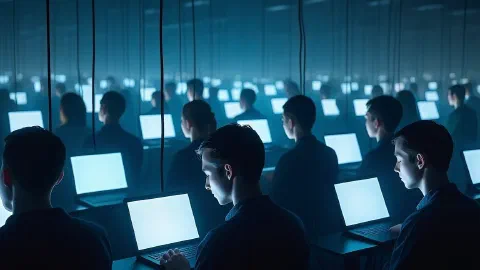
Last week, I told you about the ants—those quiet beings who hold the world together while others parade on stage. This week again, I won’t be talking about artificial intelligence, robots, algorithms, or generative AI… Once more, I’m staying in this very human, very intimate vein. Still about us. Always about us. Because before understanding what machines do to our thinking, we might first need to understand what we’ve done to our own capacity to think. This time, I’m taking you into more subtle, more troubling territory: our relationship with our own ideas. A silent shift that concerns us all, connected or not, technophiles or technophobes. I promise, starting next week, I’ll resume my « AI in All Its States » series. But for now, let me tell you about this strange thing that happens to us when we stop inhabiting our own questions… You type a question into your search engine. In 0.3 seconds, you have your answer. Satisfying, right? Yet… something strange is happening. This bewildering ease might be hiding a deeper transformation in our relationship with thinking. There was a time when searching was already an act in itself. When not knowing immediately wasn’t a problem to solve, but a space to inhabit. Today, we slide from one answer to the next, from one pre-digested content to another. We validate more than we choose. We apply more than we understand. But what happens when thinking becomes optional? Between the seductive efficiency of our tools and our old habit of thinking for ourselves, a silent shift is taking place. Not brutal, not visible. Just… comfortable. The question isn’t whether technology is good or bad. It lies elsewhere, more intimate: do we still recognize our own voice when we think?
AI, Ethics
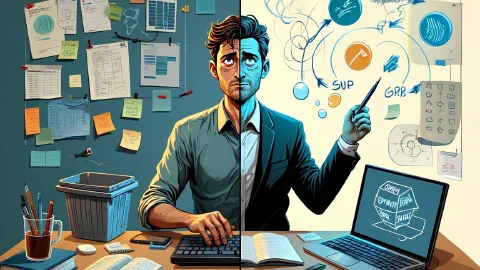
📌 Friday mood post 📌 Not quite sure what you do for a living? Perfect, you’re ready to shine in society. These days, it’s not about having a job, it’s about having a storyline. Forget plumber, say hello to “residual hydric flow specialist for individual housing ecosystems.” The blurrier it sounds, the fancier it gets. Selling hot air? Even better—so long as it’s disruptive and synergistically intense. In a world where clarity is a social faux pas, simply telling the truth has become downright obscene. And yet, sometimes, it just feels good. 👉 If you’re tired of “regenerative solutions” and “holistic acculturation roadmaps,” this piece might just speak to you. Or make you laugh. Or both.
Humor
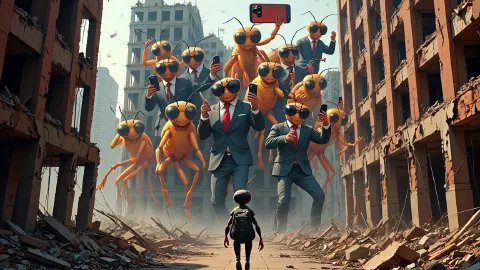
La Fontaine’s grasshopper is dead, long live the parasite. The ants have held the world together for centuries. They drained the swamps, lifted the stones, drew the plans, opened the…
Paradox
📌 Friday mood post 📌 🧘♂️ Ever get the feeling your company has gone slightly off the rails? That between two “strategic alignment” meetings and three “co-intentionality bubbles,” no one really knows why they’re here—but everyone’s doing it with remarkable depth? Then you might have a Kevin nearby. This (barely exaggerated) piece, excerpted from my upcoming book Kevin, Chief Bullshit Officer, takes you through a typical day in the life of a professional in conscious indecision, a paradox whisperer, and master of vibrational presence. 🌀 It’s funny. 🌀 It’s absurd. 🌀 And if it feels a little too familiar, you may be living in a bullshit-woke-green-complacent ecosystem, where asking a critical question is seen as “creating dissonance in the collective flow.” Behind the parody lies a sharp (and slightly chilling) X-ray of what work becomes when meaning is replaced by motion-design storytelling, and reality by “shared vibrations.” Enjoy the read. And if you meet a Kevin, stay calm, breathe… and whatever you do, don’t ask what he actually does. You might get an answer.
Humor, Paradox

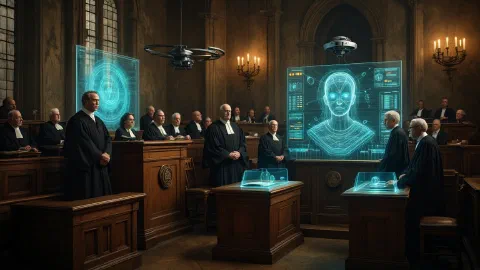
What if one day, your car made a decision for you… and got it wrong? A fictional trial once tried to answer a question that no longer feels like fiction: can we put an artificial intelligence on trial like we would a human being? Behind this courtroom drama lies a deeper dilemma about our digital future: who’s to blame when a machine causes a disaster, but no one truly understands how or why? Still think the infamous « red button » would save you? Think again.
AI, Ethics
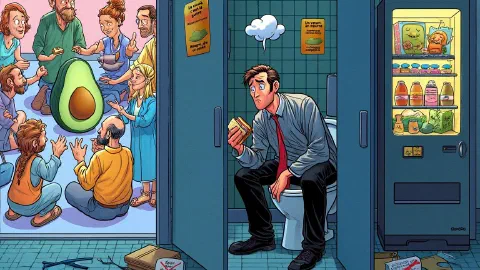
📌 Friday mood post 📌 2:07 PM. I open my lunch box. I pull out a ham and butter sandwich. A colleague faints. Another calls HR screaming. That’s how I discovered eating had become a political act. When your plate becomes a ballot and saying « enjoy your meal » gets replaced with « may the chlorophyll elevate you, » maybe we’ve lost the plot somewhere. Between carbon fines for a piece of salami and mandatory « carnivore rehabilitation » workshops, I realized something: we’re confusing food purity with moral purity. What if we stopped playing the virtue Olympics? Because at the end of the day, behind this whole Instagram masquerade, we’re forgetting the essential: we have the right to be human. With our contradictions, our flaws, and our 2 AM cravings. Even if it’s « politically questionable and ethically dubious. » A little manifesto against food shaming and for the right to imperfection. Because we’re not algorithms.
Humor
_What if you could whisper into an AI’s ear, without anyone noticing?_ Some researchers did exactly that. Not in a novel, but on arXiv, one of the most respected scientific platforms. By inserting invisible messages into their papers, they discreetly influenced the judgment—not of human readers, but of the AI systems reviewing the submissions. White text on a white background. Microscopic font size. Hidden instructions. The reader sees nothing. The AI, however, obeys. This isn’t just a clever technical trick. It’s a sign of the times. Because in a world where AIs help us read, choose, and decide—what happens when the AI itself is being manipulated, without our knowledge? And even more unsettling: what’s left of our free will, if even the information we read has already been preformatted… for the machine that filters our perception? 👉 This article explores a new kind of manipulation. Subtle. Sneaky. Invisible. Yet remarkably effective.
AI, Biases, Ethics

📌 Friday mood post 📌 Want to become an AI expert without learning, without reading, without breaking a sweat? Great, you’re in the right place. Thanks to my exclusive « I click therefore I wipe » method, you’ll be able to, in 45 minutes flat (bathroom break and LinkedIn screenshot included), automate your hamster, generate a business plan in iambic pentameter, and drop « logistic regression » at cocktail parties like you invented Python. Even better: while your AI runs on autopilot, you’ll generate a ton of money while you sleep, while you digest, even while you scroll through my inspiring stories. You’ll see, AI is simple, fun, disruptive. Even my building concierge got into it after seeing my « Master AI in 3 clicks » carousel on Instagram. She does prompts during Pilates, it’s very trendy. And her ChatGPT recently advised her to get divorced. Revolutionary. Come on, download my 3-page ebook: « You Too Can Become an AI Genius Without Understanding Anything. » Warning: exceptional promo at $999.99, valid for another 12 minutes (or until the buzz runs out). It’s dirt cheap compared to everything you’ll earn passively while your email inbox works for you. It’s hollow, guaranteed painless, and validated by 8 personal development coaches who coach each other. You’ve got no excuse. Go for it. You’ll be world champion, certified cardboard coach, with Canva logo and self-proclaimed expertise.
AI, Humor

Three centuries ago, a weaver fled in a sack of wool. Today, we open the doors of our lives wide to those who want to weave in our place. In 1733, the flying shuttle disrupted the world of craftsmanship. In 2025, it’s artificial intelligence that is reshaping our gestures, our professions, our identities. But the real rupture might not be what we think. It’s no longer just our skills we delegate. It’s the very taste for thinking. And this time, there may be no way back. In 1733, we burned the machines. In 2025, we applaud them. But in both cases, it’s the human that gets sacrificed. 👉 Read on if you, too, feel that something essential is starting to melt away.
Innovation, Foresight
📌 Friday mood post 📌 When everything burns, some wait for it to pass. Slowly. Very slowly. While France suffocates under heat waves and waves of inaction, one man embodies single-handedly the art of governing without governing, of enduring without acting, of occupying without disturbing. François Bayrou, undisputed champion of strategic standstill. I propose a deep dive into this shadow theater where silences serve as speeches, sluggishness as method, and limp hope as political line. A real-time satire of screensaver governance, where the software still runs… without anyone knowing if there’s still someone in front of the screen. Read this if you enjoy: – Administrative oxymorons, – The yoga of inaction, – And plans without a plan. Spoiler alert: we might have confused « stability » with « immobilism, » and « leadership » with « screensaver mode. »
Humor