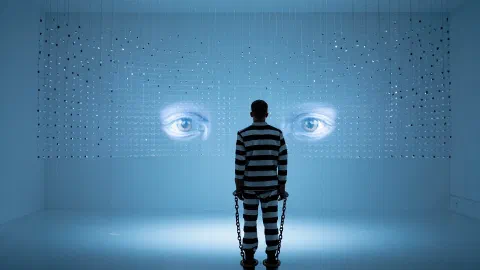
We believe we navigate freely, but we move through a strange bestiary of revisited myths. Like Narcissus, we lean over the digital mirror, fascinated by a reflection that ends up engulfing us. Like Sisyphus, we bear the burden of a memory without forgetting: each piece of data adds to the rock that crushes us without ever rolling back down. Like Prometheus, we offer our traces to a system that feasts on us endlessly. As in the Panopticon, we live under an invisible gaze, but worse still: we have learned to anticipate it, becoming our own jailers. We are not only losing data; we are losing essential dimensions of the human: the interiority that allows thinking without witness, the forgetting that makes rebirth possible, the autonomy to be oneself, the heteronomy to be several. Digital servitude needs no chains; it imposes itself through fluidity, seduction, habit. So the real question is no longer: « do I have something to hide? », but: « how much longer will I remain capable of preserving what makes me a free being? »
AI, Ethics, Privacy
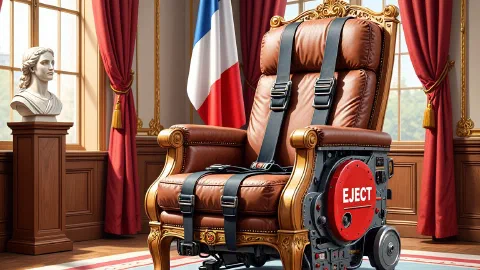
📌 Friday opinion column, brought forward to Thursday due to current events 📌 Since 2022, France has managed to chew through five Prime Ministers. This suggests two things: first, that Matignon isn’t an office but a revolving door fitted with an ejector seat. Second, that running France is rather like reforming the railways during a strike: the timetable looks splendid on paper, but the train never leaves the station. Some optimists still dream of a stable government. Statistically, however, it is far more likely to encounter a goldfish fluent in Moldovan than a French Prime Minister who survives long enough to unpack his boxes. As a mathematician, I have taken the liberty of modelling this phenomenon with equations. The findings, of impeccable academic rigour, are detailed in the Universal Treatise on Ministerial Selection, the French Way. Disclaimer: this is not a political analysis, but a piece of humor in the style of Pierre Dac and Francis Blanche.
Humor
How many times have you said this phrase while mindlessly accepting cookies on a website? Yesterday morning, I watched my daughter checking her phone. A simple, innocent gesture. Yet in just a few seconds, she had just revealed her current mood, her sleep patterns, her location, and even her evening plans. Without knowing it, she was feeding her « invisible digital portrait » – that silhouette made up of thousands of micro-traces we scatter every day. The problem? This portrait no longer belongs to you. It circulates, gets sold, grows richer. It can predict your desires before you even feel them. And in the wrong hands, it becomes a formidable weapon. The real question isn’t « What are you hiding? » But « Why should you give up your privacy? » In a world where forgetting becomes impossible, where every click shapes your future, protecting your data is no longer an individual luxury: it’s the very condition of your freedom.
Digital sovereignty, Ethics
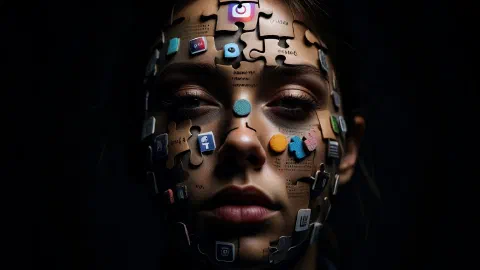
What if the rise of AI in medicine did not mark the end of doctors, but the beginning of a new era of care? Since Hippocrates, physicians have drawn their legitimacy from knowledge. Yet, for the first time in modern history, they are no longer necessarily the ones who know the most. AI diagnoses faster, sees what the human eye cannot, and sometimes even drafts responses that patients find more reassuring than those of a professional. So, should we fear the disappearance of doctors? Or should we rethink their place, their role, their unique value in a world where expertise is shared between human and machine?
AI, Ethics, Medicine
Last week, I talked about a point that’s often misunderstood: for AI, truth doesn’t exist. Today, I’m taking the reasoning one step further. Because there’s an even deeper misconception: believing that an LLM is a knowledge base. It’s not. A language model generates probable word sequences, not verified facts. In other words, it recites with ease, but it never cites. That’s exactly what I explore in my new article: why this confusion persists, and how to clearly distinguish between parametric memory and explicit memory, so we can finally combine them the right way.
AI, Biases
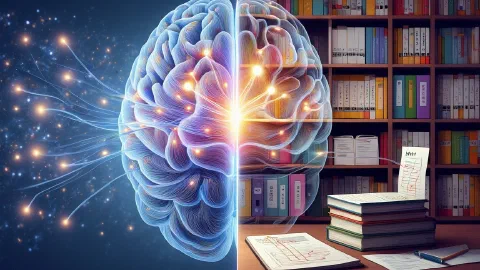
We’ve painted the word kindness in so many pastel colors that it’s become unrecognizable. Today, it’s more often a smokescreen than a value, a cover-up to justify inaction, weakness, even cowardice. Saying NO is now suspicious, setting boundaries is seen as toxic, demanding effort is considered violent. The result? Empty papers get applause, nothingness is celebrated as brilliance, and we dare to call it kindness. But if protecting, loving, educating, and working together still mean anything, then it’s time to remember that real kindness doesn’t always stroke in the right direction. It protects by being clear-eyed, it builds by being demanding.
Biases, Humor

An AI doesn’t lie. But it doesn’t tell the truth either. It doesn’t know what is true or false — it only calculates probabilities. Its “reasoning” boils down to predicting which word is most likely to follow the previous one, based on the billions of sentences it has been trained on. The result can be dazzling: fluid, elegant, convincing. Yet this fluency is nothing more than an illusion. What we read is not verified knowledge, but a sequence of words that “fit.” Sometimes accurate, sometimes wrong, sometimes neither — without the machine ever being aware of it. The real danger is not the AI itself, but our very human reflex: confusing coherence with truth. In other words, mistaking the appearance of knowledge for knowledge itself. It’s this subtle, almost invisible shift that opens the door to confusion, born of ignorance about how it works, and of overconfidence in what merely “sounds right.”
AI, Biases

📌 Friday mood post 📌 BREAKTHROUGH: I’ve Discovered the Holy Grail of Disruptive Eco-Responsibility My friends, we’re living in MAGICAL times. I just witnessed a company that received the « Climatically Transcended Enterprise » label because they replaced plastic cups with… recycled cardboard cups… imported from Japan. By plane. In plastic packaging. But wait, it gets BRILLIANT: Their « Chief Happiness & Carbon Offset Officer » (yes, that’s a real title) explains that their 3D printer running 24/7 is now « carbon neutral » thanks to a « Symbiotic Impact Partnership » with a Bolivian farmer who promised NOT to cut down a tree. Which one? We don’t know. Where? Trade secret. And the cherry on top: their upcoming 47-person meeting in Dubai to discuss « Digital Sobriety » will be offset by purchasing « 3.7 square meters of Amazonian forest benevolence. » Via a mobile app, naturally.
Ecological transition, Humor

I’m fed up. Fed up with reading nonsense served lukewarm as if it were revelations. You’d think the trend of self-proclaimed experts would eventually run out of steam, but no,…
AI
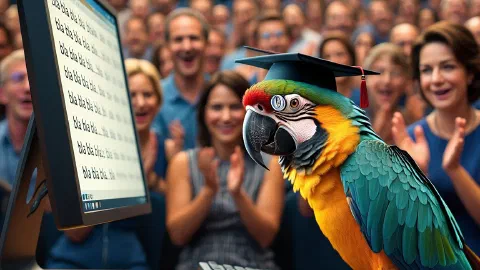
« Il avait tout : un site responsive, une charte graphique couleur lavande, et une bio écrite en Figma. Et pourtant… il s’est fait ghoster plus vite qu’un stagiaire en fin de période d’essai. » À 23h12, pendant que vous dormez paisiblement, un inconnu Googlera votre nom. Et là, tout peut s’effondrer. Pas à cause de votre travail… À cause de votre profil Viadeo oublié de 2013 où vous vous disiez “expert en synergies transversales”. Bienvenue dans le monde merveilleux de la crédibilité numérique passive-agressive, où un silence en ligne est plus suspect qu’un chat qui fait la vaisselle. Parce que ce n’est pas votre site qui fait vendre. C’est votre trace. Même bancale. Surtout bancale.
Humor