260 McDonald’s nuggets in a single order. An Air Canada chatbot lying to a grieving customer. A recruiting algorithm that blacklists everyone over 40. Welcome to 2024, the year artificial intelligence showed its true colors. And spoiler alert: it’s not pretty. While everyone was gushing over ChatGPT, companies were brutally discovering a harsh truth: when your machines screw up, YOU pay the price. Gone are the golden days when you could shrug and mutter « it’s just a computer glitch. » The courts have spoken: your algorithms, your responsibility. End of story. Europe legislates with the AI Act (180 pages of bureaucratic bliss). The US innovates at breakneck speed. China controls everything. Meanwhile, our companies are discovering that building responsible AI is like flying a fighter jet blindfolded in a thunderstorm. The most ironic part? This silent revolution won’t just determine who pays for tomorrow’s disasters. It will decide who dominates the global economy for the next 50 years. So, ready to discover why your next nightmare might go by the sweet name of « algorithm »? 👇
AI, Digital sovereignty, Ethics

📌 Friday mood post 📌 Yesterday, I laughed like a dying seal at the CFO’s terrible joke. Not because it was funny. But because everyone else was laughing. And that, folks, is competitive-level FOPO: Fear Of People’s Opinions. That little voice in your head that makes you: – Validate absurd projects that are « purpose-driven » – Fake enthusiasm for kraft paper ice-breakers – Pretend you’re passionate about design thinking Your reptilian brain still thinks being rejected by the tribe = ending up naked in the forest negotiating territory with an existentially-confused wild boar. Today, it’s just called « not being aligned with team dynamics. » Dr. Michael Gervais even created a fancy acronym for your office paranoia. Because in 2025, even anxiety needs to be optimized. But don’t worry: there’s an experiential workshop for that. Eco-friendly tote bag included. Spoiler alert: the solution might not be in yet another personal development smoothie… 👇 Thread breaking down this new gourmet mental fatigue
Humor
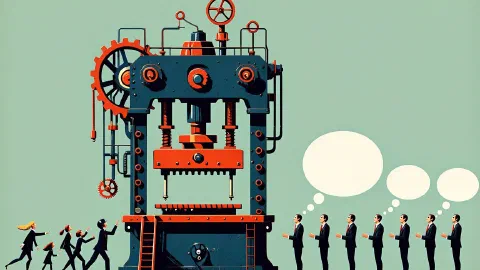
HackAtari, or how a deceptively simple test brought the most sophisticated AIs to their knees. They used to dominate video games. Boasted superhuman performance. And then one day, the games were made easier. The result? They collapsed. Why? Because they never truly understood what they were doing. And that’s where everything shifts. In a study as brilliant as it is unsettling, Quentin Delfosse and his team expose a powerful illusion: that of systems which excel… as long as nothing changes. They came up with HackAtari, a clever test built on simplified versions of classic Atari games. A test that, instead of making tasks harder, makes them easier — and yet it uncovers a glaring weakness. Because when you remove the obstacles, the AIs stumble. Where a human adapts and makes sense of the change, the machine falls apart. What does HackAtari really tell us? That an AI can ace the exam… without ever understanding the questions. That it can repeat, optimize, correlate… without ever reasoning. What if our AIs were, in truth, nothing more than top-of-the-class students — reciting without understanding? 👉 This isn’t a performance test, it’s a truth test. One that doesn’t measure what an AI does, but what it understands. And it leaves us with a quietly disturbing question: Do our AIs actually understand what they’re doing?
AI, Paradox

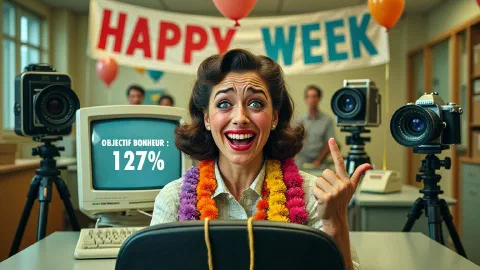
📌 Friday mood post 📌 What if the biggest lie in the modern workplace boiled down to a single word? Not “synergy.” Not “agility.” Not even “co-construction” or “productivity.” The real poison is subtler. It smells like lavender, wears a smile, and proudly sits on every HR slide deck. Its name is HAPPINESS. Welcome to the 21st-century workplace, where you’re no longer expected to think, let alone produce. You’re expected to be aligned, centered, inspired… all while juggling four projects, three pointless meetings, and a “mindful check-in” with your agile manager who’s too busy perfecting his inner Japanese garden between two slides on empathic synergy. In this world, competence is a glitch to be corrected. Quality work? A reactionary relic. What really matters is your SMILE RATE in the open space, your 360° observable zen level, and your fluent use of corporate doublespeak—like saying “strategic alignment” when you actually mean “total chaos.” You thought you had a job? No. You’re living in an emotionally therapeutic fiction, complete with tight budgets, blurry KPIs, lukewarm detox juices, and a group breathing coach every Wednesday.
Humor
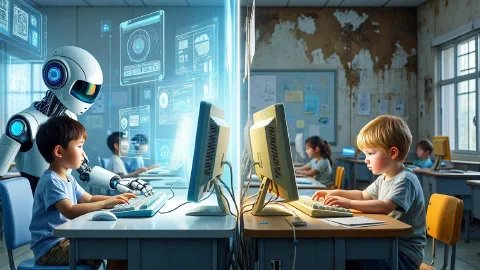
While 6-year-old Chinese children are learning to train AI models to recognize insects in their gardens, French kids the same age are discovering… how to open a word processor. This gap isn’t just a detail. It’s the symptom of a strategic chasm opening before our very eyes. On one side, China deploys a plan of breathtaking ambition: 12 years of progressive AI learning to transform every citizen into a « digital native. » The result? It already produces 50% of the world’s top AI researchers compared to 18% for the United States. On the other, France has just decided « once and for all » after… 4 months of consultation that mobilized 500 contributions. Out of 1.2 million people in the national education system. That’s 0.04% of the educational community. The French verdict? AI will be authorized starting from 8th grade only, with mandatory training of 30 minutes to 1.5 hours maximum to master the « basics of prompting. » Between reminders about server water consumption. While Beijing trains entire cohorts of children who will grow up with AI as their natural companion, Paris organizes consultations and offers hour-and-a-half micro-modules. In 10 years, guess who will truly master this technology that’s already redefining global power balances? History may judge us on our ability to transform a technological revolution… into administrative reform.
AI, Education, Ethics
📌 Friday mood post 📌 💡 Corporate transparency? Come on, who still buys into that? Every year, it’s the same charade: 247 pages of polished jargon, a PDF buried somewhere on the website, and pastel-colored charts explaining that everything’s going swimmingly, nothing to see here. Everyone’s happy, aligned, inspired, fulfilled… well, except those we haven’t yet sent to a « cultural realignment cell » between the foosball table and the meditation room. But hey, that doesn’t fit in the infographic. 👉 In the wonderful world of corporate bullshit, transparency has become an art form. A precisely choreographed dance between managerial storytelling, emotional pie charts, and coaches who explain life to you… without ever having lived it outside of keynote presentations. I wrote this little opinion piece on the subject. Spoiler: I don’t talk about the coffee machine. Well, maybe a bit.
Humor

« This AI writes better than I do! » I hear this sentence at least three times a week. From a marketing director dazzled by ChatGPT. From a graphic designer fascinated by Midjourney. From a student who just discovered that a machine can solve their math exercises in seconds. And every time, I think to myself: we’ve just crossed an invisible line. Not the line of technical performance, that’s just computing doing what it’s always done: calculating fast and well. No, we’ve crossed the line of our own devaluation. The one where we start doubting our most human capabilities: thinking, creating, deciding. As a mathematician who works with AI daily, I see three grand mythological narratives being constructed before our eyes. Three seductive stories that gradually make us abandon something precious: our intellectual autonomy. The problem isn’t that AI is too performant. It’s that we’re becoming too gullible. In the lines that follow, I invite you to dissect these three myths with me, myths that are silently redrawing the boundaries of our humanity. Because before knowing what AI can do, it’s about time we remember what we don’t want to lose. Ready for a little collective exercise in lucidity?
AI, Ethics
📌 Friday mood post 📌 🧙♂️ Alchemists spent their lives trying to turn lead into gold. 💼 Modern consultants have no such obsession — they turn gold into procedure… and bill you for the VAT on top. Take a bright idea, a real spark of inspiration. Drop it into an Excel spreadsheet, sprinkle some lukewarm jargon, toss in three vague KPIs and a “deliverable” for good measure… 🎯 Congrats, you’ve just created a SMART goal: Specific, Measurable, Achievable, Realistic, Time-bound. ✨ A brilliant acronym to standardize genius and organize boredom. By trying to frame, model, and rationalize everything, we’ve pulled off something quite spectacular: we’ve neutralized creative thinking — without even needing censorship. All it takes is a process, an evaluation grid, and a good old “kick-off meeting”. And what if the real, honest, street-level definition of SMART was actually something like this: – Simplify the complex – Make meetings meaningful (or at least long) – Annihilate all originality – Reduce ambition – Turn drive into reporting 😂 In this little mood piece, I explore, with a wry smile and a touch of arsenic, how our obsession with deliverables slowly strangles the unexpected, the absurd, and sometimes even… genius itself. 📌 Spoiler: These days, Newton would’ve had to open a Jira ticket for his apple. And he’d get a Slack reminder to “think inside the box.”
Humor

💥 What if the real revolution wasn’t about machines, but about how we see work itself? Every era has its fears. Yesterday, it was the weaving loom. Today, it’s artificial intelligence. With each breakthrough comes the same old story: we fear extinction, and forget transformation. And yet… 📜 History whispers something different. It tells how, behind every seeming disappearance, there was a metamorphosis. How jobs evolved. How human talent shifted, toward places no machine could ever reach. I invite you on a journey through time and imagination. A story told by two voices: Ada (the AI) and Cerise (17 years old), to rethink what it means to work, adapt, and create in a world in motion. If you believe AI kills jobs, read this. And if you don’t… read it anyway.
AI
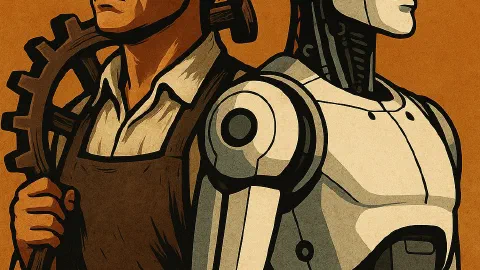
📌 Friday mood post 📌 🦵💸 €350 for half a pant leg and a full-blown loss of meaning? Yes, it’s real. And no, it’s not a joke. There was a time when fashion aimed to elevate the body. Today, it’s content to chop off a leg—in the name of creative boldness. At that price, you’re not buying trousers, you’re buying a stance. Half a pair of jeans, a whole marketing strategy. And it works. Sold out. Genius, really: invent nothing, sell it at a premium, and convince people it’s profound. Welcome to the age of proudly worn absurdity, 2025 edition. What’s next? You’ll laugh. Or cry. Or click add to cart.
Humor