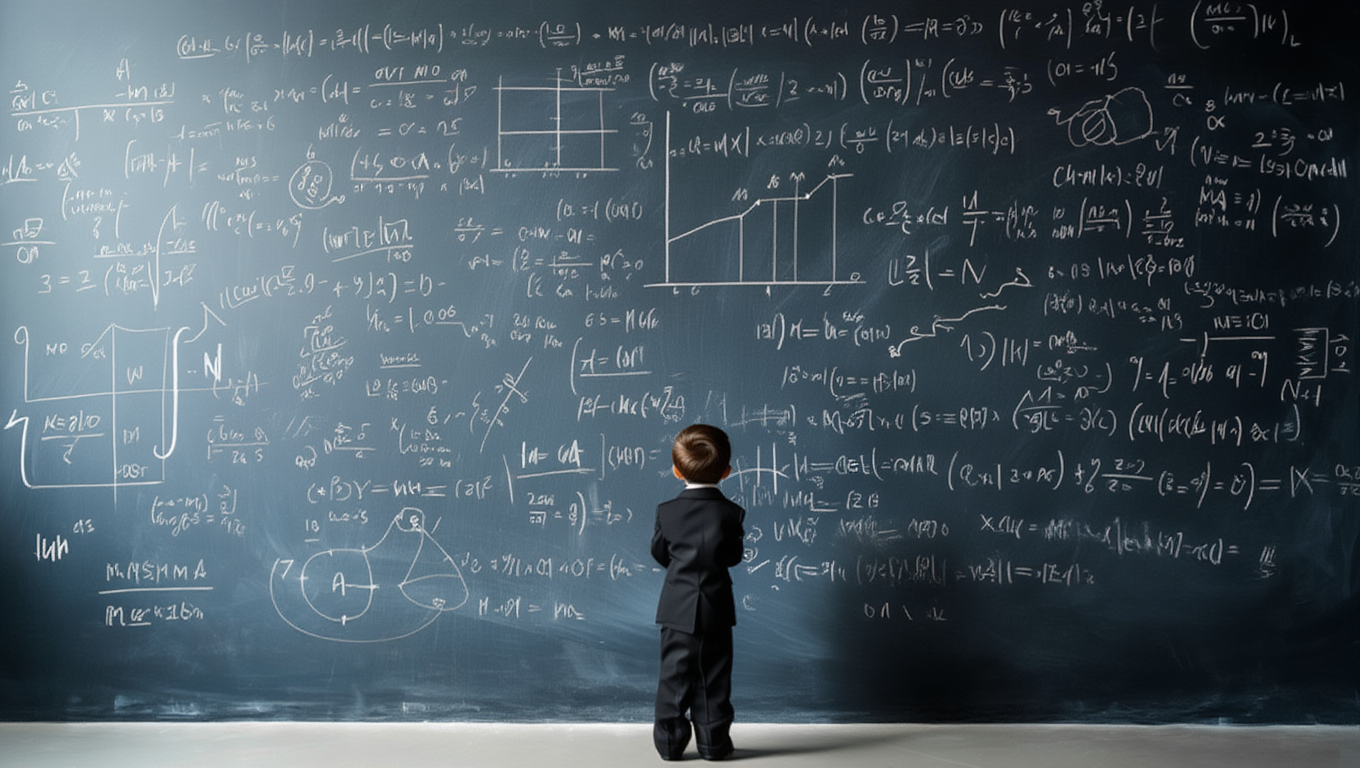
Prefatory note: This short article was born from a conversation, or rather from several. After the publication of “The Missed Appointment with Mathematics,” I received many messages from readers, often those who described themselves as “hopeless at maths,” who had been moved by something in that piece. And among all the questions, there was one that kept coming back more than any other, asked sometimes with curiosity, sometimes with a barely concealed kind of metaphysical unease: “But when it comes down to it, did mathematics exist before mathematicians?” This is not a classroom question. It is a philosopher’s question. And that is precisely why it deserved an article of its own.
The vertigo of a question without an answer
The shadow stretches slowly across the warm sand. We are in Egypt, more than two thousand five hundred years ago. A man is observing the Great Pyramid of Khufu, monumental, overwhelming, its peak seeming to challenge the sky. That man is Thales of Miletus. He has planted his staff vertically in the ground. He waits. He waits for the precise moment when the length of his staff’s shadow is exactly equal to the height of the staff itself. At that moment, he knows, the length of the pyramid’s shadow, added to half its base, will give him the height of the edifice [1].
The scene is fascinating. Without climbing a single step, through the sheer force of a geometric proportionality, a human mind has just captured the dimension of a mountain of stone. But this founding scene raises a question far more vertiginous than the measurement itself. That morning, beneath the Egyptian sun, did Thales invent the theorem that would bear his name, or did he simply see what was already there? Did this proportionality between shadows and objects, dictated by the sun’s rays, exist before humanity appeared?
This question has divided philosophers and mathematicians since antiquity. Are mathematics an invention of our mind, or a discovery of the deep laws of the universe? The most beautiful thing about this question is that it has no definitive answer. And that is precisely why it should be the first thing addressed in a mathematics class.
A theorem that wasn’t waiting for its name
To understand the first camp, that of discovery, one must turn to an idea known as mathematical Platonism. According to this vision, mathematical objects, numbers, perfect circles, equations, genuinely exist. They are not made of matter, one cannot touch them, but they possess an existence independent of human thought [2]. The Pythagorean theorem was true before Pythagoras was born, and it will continue to be true if all of humanity should vanish.
One of the most unsettling arguments in favour of this idea is independent convergence. Thousands of kilometres apart, and at different points in history, civilisations that had never encountered one another discovered the same mathematical truths. The Babylonians, long before the Greeks, knew and used the geometric relationship we today call the Pythagorean theorem [3]. Later, in the seventeenth century, Isaac Newton in England and Gottfried Wilhelm Leibniz in Germany independently, and almost simultaneously, developed the foundations of infinitesimal calculus [4]. How can we explain these coincidences if mathematics were merely an arbitrary creation of the mind? Would we not rather say that these geniuses were exploring the same invisible continent, mapping the same abstract mountain ranges?
But the most powerful argument in favour of discovery was formulated in 1960 by physicist and Nobel laureate Eugene Wigner, in a celebrated article entitled The Unreasonable Effectiveness of Mathematics in the Natural Sciences [5]. Wigner marvelled at an almost mysterious fact: mathematical concepts developed out of pure curiosity, with no concern whatsoever for the real world, often turn out, decades later, to be the exact tool physicists need to describe the universe.
Take complex numbers, those strange numbers involving the square root of negative quantities. They were invented by Renaissance mathematicians to solve abstract equations. They seemed to have no connection to physical reality. Yet in the twentieth century, when physicists began exploring the infinitely small world of atoms, they discovered that quantum mechanics simply could not be formulated without using these very complex numbers [5]. As Wigner writes, this is a miracle we neither understand nor deserve. If mathematics were a purely human invention, how could we explain that they so perfectly conform to the intimate structure of matter?
This picture is seductive. But it leaves one question hanging: if mathematical truths exist independently of us, how do we access them? We have no sense organ to perceive abstract numbers the way we perceive heat or light. Platonism describes a world of eternal truths, but remains silent on how a brain made of flesh could come to know them. It is this difficulty that opens the door to the opposing camp.
The world’s most powerful game of symbols
The camp of invention starts from a radically different idea. This school of thought, often associated with formalism and figures such as David Hilbert, considers mathematics a game. An extremely complex game, with very strict rules called axioms, but a game nonetheless [6]. According to this vision, we invent the rules, then explore the logical consequences of those rules. Mathematics would be nothing more than a coherent language we have constructed, a tool of our mind.
The history of non-Euclidean geometries illustrates this idea perfectly. For more than two thousand years, everyone believed that Euclidean geometry, the kind taught in school, was the only possible one, the only true one. One of its rules stated that through a point outside a line, only one parallel line can be drawn. But in the nineteenth century, mathematicians like Nikolai Lobachevsky and János Bolyai dared to modify this rule, just to see what would happen [7]. They invented new geometries, abstract worlds where multiple parallel lines can pass through a single point, or conversely, none at all.
These geometries seemed to be pure fictions, mental games with no connection to our actual space. And yet, nearly a century later, Albert Einstein used the curved geometry developed by Bernhard Riemann to formulate his theory of general relativity [8]. The space-time of our universe turned out not to be Euclidean. The mathematicians had not discovered the shape of the universe; they had invented a catalogue of possible shapes, and the physicist simply picked from that catalogue the shape that matched his observations.
There is, however, in this camp of invention, an argument one cannot sidestep, and it comes from within mathematics itself. In 1931, a young Austrian logician of twenty-five, Kurt Gödel, published two theorems that would shake Hilbert’s project to its very foundations. What Gödel demonstrated is that any logical system rich enough to contain basic arithmetic necessarily contains true statements that cannot be proved from within that same system [9]. In other words, mathematics cannot guarantee its own coherence by its own means. The building is solid, but it rests on ground it cannot itself probe.
The paradox is that Gödel himself was not in the camp of invention at all. On the contrary, he was deeply Platonist: he saw in his own theorems not a limitation of mathematics, but proof that the human mind escapes all formal mechanism [9]. If our brain can perceive truths that the system cannot demonstrate, it is because we are accessing something that transcends the system. For Gödel, incompleteness was a window opened onto Platonism, not an argument against it. It was other thinkers, however, such as Luitzen Egbertus Jan Brouwer and the intuitionists, who drew the opposite conclusion: a mathematical object exists only if it can be effectively constructed, not merely postulated or deduced by contradiction [11]. For an intuitionist, proving that an object cannot not exist is not enough: one must be able to construct it, show it, produce it. This position cuts with an almost radical sharpness: mathematics discovers nothing and invents nothing beyond what the mind can actually do. They are the reflection of our mental operations, nothing more, nothing less.
When mind and universe meet
Faced with this impasse, where Plato confronts Hilbert and Brouwer without any of them being able to prevail, some thinkers have sought a third way. Not a soft compromise between the two camps, but a deeper hypothesis: what if the question itself were poorly framed? What if inventing and discovering were not two opposing operations, but two faces of the same movement?
This is where Henri Poincaré’s thinking becomes valuable. In Science and Method, published in 1908, Poincaré describes mathematical creation as a process that is neither purely logical nor purely intuitive [10]. He recounts an episode that has since become famous: he had been working for weeks on a problem involving mathematical functions without managing to solve it. One evening, no longer thinking about it, he boarded an omnibus in Coutances. The moment his foot touched the step, the solution appeared to him, complete, obvious, without apparent effort. It was not logic that had been working during that journey, but something else, what Poincaré calls the unconscious self, a subterranean instance that continues to combine ideas in the dark, and delivers to consciousness only those combinations it deems beautiful [10]. Beautiful. The word matters. For Poincaré, the criterion guiding mathematical invention is not usefulness, nor even immediate truth: it is harmony, an aesthetic sensibility that allows one to recognise a correct structure before being able to prove it.
This idea opens an unexpected perspective. If the mathematician is guided by a sense of harmony, and if this sense allows him to find structures that subsequently describe the real world, it may be because this sense is not arbitrary. Our brains were not parachuted into this universe; they were shaped by it. Evolution, over millions of years, has sculpted our neural networks to interact effectively with the physical world. It is therefore perhaps not so surprising that the structures our minds perceive as harmonious turn out to correspond to the structures physics discovers in matter. We are, in a profound sense, made of the same stuff as the stars. The harmony Poincaré feels before a beautiful proof would then be an echo of the harmony of the world, not a coincidence, but a resonance.
This is what one might call the co-emergence thesis: mathematics is neither purely invented nor purely discovered. It emerges from the encounter between the architecture of our mind and the structure of the universe. It is the language that this encounter produced. To test this idea, one can push the question to its extreme: what would happen with an extraterrestrial civilisation, endowed with a radically different biology, sensory organs without equivalent, perhaps a logic with three values rather than two? Its mathematics would certainly take another form, with different notations, different starting points. But it is reasonable to think that the fundamental relationships it would describe, proportionality, conservation, symmetry, would remain the same, because these relationships are inscribed in the structure of physical reality that any intelligence, whatever its nature, must confront in order to survive.
But the co-emergence thesis runs into a challenge that cannot be ignored. What do we make of mathematical structures that seem to escape any grounding in the physical world, and indeed any possibility of mental construction? In 1905, mathematician Giuseppe Vitali demonstrated the existence of sets of real numbers that cannot be measured in the ordinary sense of the term, objects whose logical existence can be proved, but which it is rigorously impossible to construct or visualise [12]. These non-measurable sets have no equivalent in the physical world. No experiment reveals them, no intuition brings them forth. They exist because the rules of the logical game permit them, and for no other reason. Are they discovered or invented? Neither, one might say: they are deduced, produced by the sole force of the system’s internal coherence. And it is precisely here that co-emergence finds its limit: it accounts well for mathematics that engage in dialogue with the world, but struggles to explain those that deliberately move away from it, those abstract regions where the human mind ventures beyond all resonance with sensible reality.
The September question
This is why this question should open every first mathematics class of the year. Imagine for a moment eleven-year-olds sitting down at their desks in early September. Their school bags still smell of newness, the pages of their notebooks are blank. Instead of immediately launching into calculation rules or arid definitions, the teacher would write a single sentence on the board: “Were mathematics invented or discovered?” And let the silence do its work.
That silence would be precious. Because in that silence, something would happen that formulas cannot provoke: the students would start thinking for themselves. Some would say invented, because they are learned from books written by men. Others would say discovered, because two and two make four even when nobody says so. And a few, the most troubled, would remain silent, vaguely sensing that the question touches on something greater than any answer. These last ones would perhaps have the most accurate instinct. Because this question does not lead to an answer. It leads further.
There is something vertiginous about the fact that a discipline so rigorous, so precise, so apparently impervious to ambiguity, is the one that most reliably brings us back to these bottomless questions. Pythagoras was looking for ratios between numbers and believed he could hear the music of the spheres. Gödel sought to found logic upon itself and discovered that it carried within it an irreducible gap. Wigner tried to understand why equations worked so well and confessed he did not understand at all. Each time, rigour led not to closure, but to opening. As though mathematics were a door one believes one has passed through, which reveals, once crossed, a corridor that is longer still.
That may be their greatest secret. Mathematics alone is a language without a speaker, perfect and silent, turning in on itself like an empty cathedral whose doors no one has ever pushed open. Physics alone is a listening without words, attentive and mute, capable of perceiving the trembling of the real but incapable of giving it exact form. But when one becomes the voice of the other, when the rigour of the symbol marries the stubbornness of observation, something unique arises in the history of human thought: the capacity to put a question to the universe and receive an exact answer. Not an approximation. Not a metaphor. An answer.
The ancients had sensed this alliance without being able to name it in our words. They understood, long before science existed, that the apparent chaos of the world was only a surface. That beneath the disorder of the visible, beneath the tumult of the waters and the movement of the stars, there was an order, immutable, silent, waiting to be read. They called sacred that which, in the proportion of numbers and the perfection of geometric forms, seemed at once produced by man and infinitely greater than him. Not a technique. A revelation. The revelation that the universe is not chaos, but architecture. That behind the veil of the visible, a structure watches. And that this structure, for those who know how to look, can be read. Ordo ab chao: order arises from chaos, not as a miracle, but as a truth that was always waiting for someone to take the trouble to seek it.
We know today that this premonition was not an illusion. Mathematics and physics together may be the only language the universe consents to speak to those who know how to listen. The most powerful, the most universal, and the most humble too: for the more it reveals, the more it shows the extent of what remains to be understood. What this language will still tell us about the universe, and perhaps about ourselves, we do not know. That is the subject of another conversation.
In trying to understand the shadow of the pyramid, we end up questioning the very nature of light.
References
For meticulous minds, lovers of footnotes and sleepless nights spent verifying sources, here are the references that fed this article. They recall one simple thing: information still exists, provided one takes the time to read it, compare it, and understand it. But in the near future, this simple gesture may perhaps become a luxury, for as texts generated entirely by AI continue to multiply, the real risk is no longer disinformation, but the dilution of the real in an ocean of merely plausible content.
[1] “Some Original Sources for Modern Tales of Thales”, Mathematical Association of America, Convergence.
[2] Linnebo, Øystein, “Platonism in the Philosophy of Mathematics”, The Stanford Encyclopedia of Philosophy, 2023 edition.
[3] “Pythagorean Theorem: historical aspects”, Zeste de Savoir, November 2024.
[4] “History of infinitesimal calculus”, Wikipedia.
[5] Wigner, Eugene P., “The Unreasonable Effectiveness of Mathematics in the Natural Sciences”, Communications in Pure and Applied Mathematics, Vol. 13, No. I, 1960.
[6] Weir, Alan, “Formalism in the Philosophy of Mathematics”, The Stanford Encyclopedia of Philosophy, 2022 edition.
[7] “Lobachevsky-Bolyai geometry”, Tangente Magazine, March 2026.
[8] “Riemann and relativity”, Pour la Science, August 2002.
[9] “Gödel’s incompleteness theorems”, Wikipedia.
[10] Poincaré, Henri, Science and Method, Flammarion, 1908. Passage read by Étienne Ghys, Petites histoires de science, Académie des sciences / Institut de France, 7 August 2025.
[11] “Intuitionism”, Wikipedia; see also Mancosu, Paolo, From Brouwer to Hilbert: The Debate on the Foundations of Mathematics in the 1920s, Oxford University Press, 1998.
[12] Vitali, Giuseppe, “Sul problema della misura dei gruppi di punti di una retta”, Tip. Gamberini e Parmeggiani, 1905. See also “Vitali set”, Wikipedia.