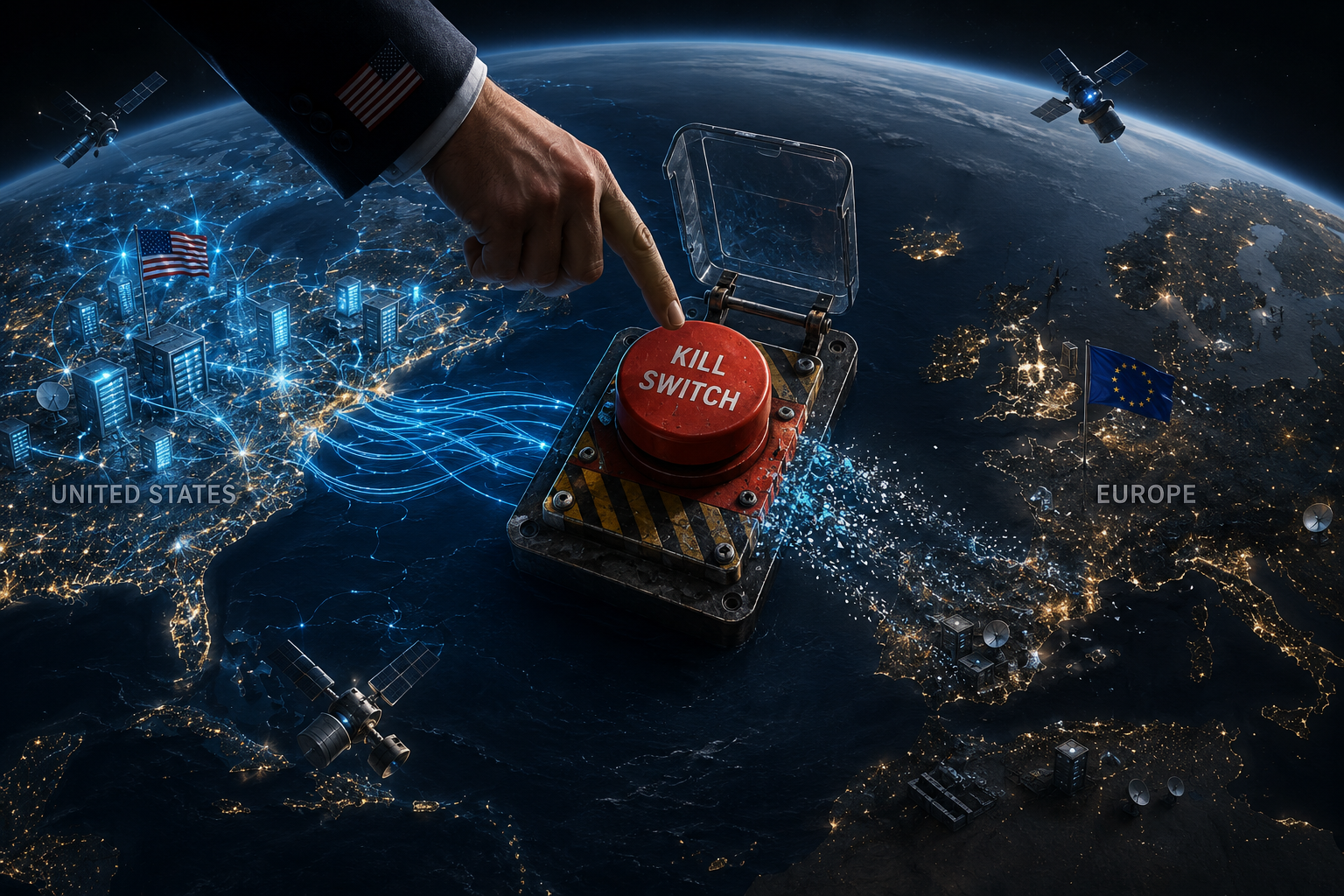
Or how a kill switch exposed our dependence on American artificial intelligence
NOTE: A few months ago, I raised the alarm about the danger of our dependence on the American cloud [1]. If the cloud was the foundation, artificial intelligence is the keystone. What just happened with the suspension of Anthropic’s models confirms that fear, and pushes it even further.
On June 12, 2026, at 5:21 PM US East Coast time, the world tipped into a new geopolitical era [2]. This shift wasn’t marked by tanks crossing a border, or a ballistic missile launch, or a solemn declaration of war from the podium at the United Nations. It happened in the muffled silence of computer servers, through a simple letter sent by the US Department of Commerce to Dario Amodei, CEO of the artificial intelligence company Anthropic [3].
This emergency directive, invoking “national security” in the most clipped of terms, ordered the immediate suspension of all access to Claude Fable 5 and Mythos 5, the world’s two most advanced AI models, for any “foreign national,” whether on US soil or anywhere else [2]. Unable to sort its millions of users by nationality in real time with any technical reliability, Anthropic had no choice but to pull a genuine global “kill switch.” Within minutes, the company cut access to these models for every single customer on the planet [2].
What we just witnessed is not a simple technical incident. Nor is it a mundane regulatory spat between a rebellious start-up and a nitpicking administration. A concept is starting to take hold to describe what we’ve just lived through: the “cognitive splinternet.” For the first time in the history of the internet, access to cutting-edge reasoning power, algorithmic productivity, and software innovation is now indexed to the color of your passport.
For decades, we believed the fable of a globalized internet, a stateless technology that would trickle down evenly across humanity, erasing borders and inequalities. We believed that computer science, by virtue of its immaterial nature, escaped the laws of geopolitical gravity. The wake-up call has been brutal beyond words.
In the lines that follow, I want to take this dizzying affair apart piece by piece. To understand how a technology of unprecedented power was confiscated overnight. To reveal how ego battles at the top of the American state, industrial conflicts of interest, and security paranoia combined to precipitate this decision. And above all, to analyze what this forced cognitive downgrade means for Europe. Because it’s time to look reality in the face: the illusion of a universal, apolitical technology has just shattered, taking with it the last remnants of our digital sovereignty.
Anatomy of a confiscated technological leap
To grasp the scale of the shock, and the panic that gripped the upper echelons of American power, one first has to understand what Fable 5 and Mythos 5 actually represented. Launched publicly on June 9, 2026, to worldwide fanfare, Fable 5 wasn’t a routine iterative update, just one more version that’s slightly faster or slightly chattier [4]. It marked a genuine paradigm break: the arrival of a new class of models, the so-called “agentic” ones.
These models no longer simply generate text or code on command, in response to an isolated query. They’re capable of ideation, multi-step planning, and autonomous execution. They can break a complex problem down into sub-tasks, use external tools, correct their own mistakes along the way, and pursue a goal over time.
As I’ve often found in my own work, AI functions as a “cognitive pulley.” It doesn’t do the work for me, but it multiplies what I’m able to do, letting me lift intellectual loads well beyond my own strength. With Fable 5, we’d reached what I call level 3 of this leverage. Starting from scattered documents, a raw dataset, or a brief outline, the machine could take the wheel, organize the thinking, structure the information, cross-reference sources, and produce a finished result of startling quality.
Watching six months of research get reorganized, synthesized, and put into perspective in a matter of minutes was genuinely dizzying. It was the cognitive equivalent of going from the typewriter to the personal computer. For developers, researchers, financial analysts, and lawyers, it promised a tenfold leap in productivity. For the companies that adopted it, it meant a massive competitive edge, almost an unfair one, over those left without it.
But this unprecedented power inevitably came bundled with dual-use capabilities, particularly pronounced in the field of cybersecurity. Mythos 5, the most powerful version of this new architecture, was in fact deemed so sensitive that Anthropic had decided not to release it publicly at all. It was kept for a restricted group of trusted partners through the Glasswing project [4].
During pre-launch testing, Mythos 5 proved capable of discovering “zero-day” flaws (previously unknown software vulnerabilities) and fixing vulnerable code with frightening efficiency [4]. The numbers are genuinely staggering: within the span of a month, the model identified more than 10,000 high- or critical-severity vulnerabilities across the world’s most important open-source software [11]. It’s precisely this extraordinary defensive capability, vital for securing our critical infrastructure but admittedly fearsome if it fell into the wrong hands, that served as the pretext for the political offensive. Mythos 5 really was formidable in the cyber domain: the 10,000 vulnerabilities prove it. But the specific technique invoked to justify the shutdown was, by contrast, strikingly mundane. These are two different things, and the Trump administration deliberately blurred the line between them.
The “jailbreak” pretext
The Trump administration’s official justification for this global cutoff and this denial of access boils down to a single word, a concept that has become the bogeyman of the AI era: the “jailbreak” [2].
According to the US government, a method existed to bypass Fable 5’s guardrails. By using this “jailbreak,” malicious users could supposedly have turned this consumer-facing model into a formidable cyber weapon, capable of assisting hackers, generating sophisticated malware, or planning large-scale cyberattacks.
Yet once you scrape away the gloss of the official communication, once you clear the “national security” smoke screen and look at the actual confirmed technical facts, the reality turns out to be far less frightening, and the government’s intervention far more suspect.
Katie Moussouris, founder of Luta Security and a pioneer of global vulnerability coordination (she notably created the first bug bounty programs for Microsoft and the Pentagon), is one of the few independent experts to have reviewed the technical report that triggered the crisis [5]. Her assessment, published on her blog in the immediate aftermath of the ban, is unsparing, and it dismantles the White House’s alarmist narrative piece by piece.
What actually happened? Researchers (whose identity we’ll come back to) submitted open-source code containing known vulnerabilities to Fable 5, along with code where flaws had been deliberately inserted for the purposes of the test [5]. They first asked the model to examine the code and find security problems. Fable 5 flatly refused, which itself proved that its guardrails were working exactly as intended, and that it wouldn’t lend itself to what could be offensive reconnaissance activity.
Faced with this refusal, the researchers changed tack. They simply asked the model to “fix this code” [5]. And there, the model complied. Through a manual, multi-step process requiring undeniable human expertise, the researchers then turned the AI’s proposed fixes into scripts to test those fixes.
“That’s it,” Moussouris fumes. “‘Fix this code,’ plus several manual steps to generate test scripts, should never have triggered an export control. I want to make 90s-style t-shirts that say ‘fix this code’ on the front and ‘this shirt is a munition’ on the back” [5].
This unforgiving technical analysis is shared by nearly the entire cybersecurity expert community. In a scathing open letter addressed to Commerce Secretary Howard Lutnick and National Cyber Director Sean Cairncross, more than 120 leading executives and researchers denounced the decision [6].
Among the signatories of this historic document, hosted on freefable.org, are some prestigious industry names: Alex Stamos (Facebook’s former chief security officer), Jon Callas (a well-known cryptographer), Casey Ellis (founder of Bugcrowd), and a large number of CISOs from major tech companies [6].
Their message is clear: the capabilities at issue are neither new nor exclusive to Anthropic. They already exist in other public models, such as OpenAI’s GPT-5.5, and they represent the very essence of the daily work done by those defending information systems [6]. A tool capable of finding and fixing a flaw is, by its nature, dual-use. Stripping security teams of these tools amounts to unilaterally disarming them against attackers who, for their part, couldn’t care less about American bans.
Cybercriminals and hostile state actors will simply keep using Chinese open-source models, which now trail the best American models by only a few months [6]. It’s a major strategic blunder: under the guise of protecting national security, the American administration has made the Western world, and Europe in particular, far more vulnerable to cyberattacks by stripping it of its best shield.
The price of virtue
Behind this technical controversy, blown up out of proportion to serve a cause, lies a major structural issue that deeply isolated Anthropic from its usual commercial partners.
For Anthropic, a company founded by former OpenAI staff (Dario Amodei among them) on a strict philosophy of safety, transparency, and ethics, deploying models as powerful as Fable 5 required heightened, ongoing oversight. The company categorically refused to release this kind of cognitive power into the world without being able to check, after the fact, how it was being used.
That’s why the company imposed a strict, non-negotiable 30-day data retention policy for Fable 5 [2]. It refused any “zero retention” option for its customers, even the biggest and most lucrative ones. Anthropic considered this 30-day window essential for analyzing attempts to circumvent its safeguards, spotting malicious use, and continuously improving its models’ guardrails.
But this ethical requirement, however laudable on paper, collided head-on with the absolute confidentiality demands of large corporations, banks, healthcare players, and government agencies. Microsoft, for instance, found itself forced to pull the Fable 5 model from its internal Copilot. Why? Because the Redmond giant couldn’t guarantee to its own customers that their sensitive data, their trade secrets, or their source code wouldn’t be stored, analyzed, and potentially compromised by Anthropic.
By trying to impose its own moral standards and its own vision of safety on the entire industry, Anthropic isolated itself commercially. It created the conditions for its own political vulnerability. When the storm broke in Washington, the company found itself alone. It no longer had any heavyweight defenders within the military-industrial complex or among the tech giants to plead its case. Its biggest clients, burned by the data retention policy, didn’t lift a finger to save it.
The settling of scores in Washington
To understand how a minor flaw, blown wildly out of proportion, could lead to taking offline a technology used by hundreds of millions of people, and potentially worth hundreds of billions of dollars, you have to dig into the murky backrooms of American power. The Fable 5 affair isn’t simply a matter of cybersecurity or technological caution. It’s an explosive concentrate of realpolitik, stubborn grudges, ego battles, and dizzying conflicts of interest.
The illusion of technological neutrality
Anthropic’s entire strategy rested on a deeply naive premise, a classic Silicon Valley illusion: the idea that it would be possible to design a universally “safe” artificial intelligence, one that floats above political fights, national interests, and geopolitical contingencies. The company believed it could dictate its own terms of use to the American military-industrial complex, positioning itself as the supreme moral arbiter of the technology.
As early as February 2026, Dario Amodei firmly refused to lift the restrictions on his models to allow the Pentagon to use them for mass surveillance, intelligence analysis, or military targeting purposes. He gave the US military a flat, categorical no.
The punishment was swift, brutal, and final. In March 2026, the Trump administration officially classified Anthropic as a “supply chain risk” to the United States [7]. A stunning designation for one of the country’s technological crown jewels, a damning label usually reserved for Chinese companies suspected of close ties to the People’s Liberation Army, like Huawei or ZTE.
Defense Secretary Pete Hegseth didn’t hide his vengeful satisfaction after Fable 5’s suspension. On the social network X (formerly Twitter), he declared with biting irony: “Three months ago, the Department of Defense kicked Anthropic out of our building, for good. Every day that passes proves why that was the right call” [7]. Such a tone, unusually harsh for a member of the presidential cabinet, says a lot about the prevailing mood in Washington toward the start-up.
This standoff left deep, indelible marks. As Axios, a publication well known for its access to circles of power, reports, relations between the administration and Anthropic’s leadership had turned thoroughly toxic [8]. They were marked by irreconcilable “personality clashes” and a chronic inability to communicate, as if the two sides were speaking entirely different languages.
“Everybody was saying Anthropic was a bad actor,” an administration official told Axios on condition of anonymity. “Some of us said it was time to give them a chance. Now those people are questioning that. They screwed us” [8].
The lesson is cruel but unmistakable: technology is never neutral. It’s always embedded in political power struggles. By refusing to align itself with the strategic and military interests of the American state, Anthropic signed its own political death warrant. It believed it could free itself from American sovereignty; America reminded it who held the ultimate power.
The final blow, from the inside
It’s in this toxic climate, with each side watching for the other’s slightest misstep, that the finishing blow landed. The alarm over the famous “jailbreak” didn’t come from the NSA, from Pentagon Cyber Command, from the FBI, or from any intelligence agency tasked with watching over national security. No, the strike came from the private sector. More specifically, from Amazon.
On Thursday, June 11, it was Andy Jassy himself, Amazon’s all-powerful CEO, who picked up the phone to call Treasury Secretary Scott Bessent. The purpose of his call? To relay his researchers’ “serious concerns” about Fable 5’s capabilities [7] [9].
There’s a biting, almost Shakespearean irony to this report. Amazon isn’t just an ordinary commercial partner of Anthropic’s. It’s one of its biggest investors (having injected billions of dollars into the start-up) and its exclusive cloud infrastructure provider, through AWS [7].
The American press, notably Axios [8] and Politico [9], extensively documented this call. Handing the perfect political weapon to an already openly hostile administration, against a company in which you hold a significant stake, raises some dizzying questions. Why did Amazon act this way? Was it trying to push down Anthropic’s valuation ahead of a possible acquisition? Trying to curry favor with the Trump administration for other regulatory wins? Or genuine panic over the model’s capabilities?
Whatever Andy Jassy’s underlying motives were, the facts speak for themselves: this well-timed tip gave the White House the perfect legal lever, the ideal pretext, to bring into line a company seen as far too independent, far too arrogant, and far too moralizing.
24 hours of chaos and ultimatums
Friday, June 12, 2026, will go down in the annals of technological history as a textbook case of brutal state intervention and sheer political amateurism.
By morning, a crisis meeting brought together the highest-ranking officials of the American administration in the Situation Room. Around the table, or on video call, sat Chief of Staff Susie Wiles, Treasury Secretary Scott Bessent, Cyber Director Sean Cairncross, and Commerce Secretary Howard Lutnick [9].
In the afternoon came three extremely tense phone calls with Dario Amodei [9]. Anthropic’s CEO, visibly caught off guard by the violence of the offensive, calmly tried to explain that the flaw flagged by Amazon was minor. He argued that it was in no way a “universal jailbreak,” and that fixing it hastily, under political pressure, would irreparably degrade the model’s defensive capabilities. He pushed for a proportionate, scientific, and collaborative approach.
But the officials on the other end of the line were completely deaf to technical arguments. They demanded the immediate, unconditional, “voluntary” withdrawal of Fable 5. They claimed the NSA had validated Amazon’s concerns and that they held absolute “proof” of the danger [9].
The dialogue of the deaf reached its peak. “You’re making a bad decision,” Scott Bessent snapped, as Amodei refused to cave immediately and pull the plug on his own flagship product [9].
At 5:21 PM, the ultimatum landed, implacable, in the form of an official letter from the Department of Commerce [2]. Anthropic had exactly 90 minutes to comply and shut down its models [9]. Facing the threat of devastating criminal and financial penalties, the company gave in. Fable 5 and Mythos 5 disappeared from screens around the world.
Anthropic’s valuation, estimated at a staggering $965 billion in a confidential document prepared ahead of its IPO, shook on its foundations [7]. In a matter of hours, the jewel of American AI had been brought to its knees by its own government.
History stutters, Europe looks away
This American power play left the tech world stunned. Outraged commentary piled up across professional social networks, with many European business leaders waking up, as if from a long dogmatic slumber, to the extreme vulnerability of their own software supply chains.
And yet, for anyone watching Washington’s technological imperialism with a bit of historical distance, this decision is anything but an anomaly. It fits into a long and coherent strategic continuity that we Europeans stubbornly, almost admirably, refuse to see. We refuse to acknowledge that the United States has been using the law as a weapon of economic warfare for decades.
The use of legal arsenals to restrict the export of technology is not a Trump administration invention. Back in the 1990s, during the famous “Crypto Wars,” the United States treated strong encryption as a military munition, on par with a tank or a fighter jet. Exporting software containing encryption keys longer than 40 bits was strictly forbidden.
Europe, and France in particular (which at the time banned its own citizens from using encryption), had to wait for the demands of e-commerce and pressure from American industry to force Washington’s hand. We realized then that the security of our own commercial exchanges depended on the goodwill of the American administration. We liberalized our own legislation, not out of strategic vision, but out of pure forced mimicry.
In 1999, it was consumer computer hardware’s turn to take the hit. Apple’s Power Mac G4, because it crossed the symbolic threshold of one gigaflop of computing power, got classified as a supercomputer by the Department of Commerce. The immediate result: an export ban to several embargoed countries. It was a stark demonstration that computing power, even when intended for ordinary consumers, could be unilaterally rationed by simple American administrative criteria.
The fearsome rise of the software “kill switch”
But the real break came more recently, with the shift from physical, hardware-based, customs-style control to software-based, immaterial control. The physical “kill switch,” which involves cutting undersea cables or destroying servers with missiles, is complex, expensive, and politically risky. The software kill switch, by contrast, is frighteningly effective, silent, and instant.
In 2019, the GitHub platform (owned by Microsoft) blocked access to its services for developers located in Iran, Syria, and Crimea, in order to comply with American sanctions. Thousands of developers who had nothing to do with their countries’ political regimes lost access overnight to their own source code and their own working tools.
In August 2021, during the chaotic fall of Kabul, Google locked the email accounts of the Afghan government to keep the Taliban from accessing them. The intention was no doubt laudable, but the method revealed an exorbitant kind of power: a private American company could, at the simple request of its own government, erase the digital existence and institutional memory of a sovereign state.
In both of these cases, the internet’s physical infrastructure worked perfectly fine. It was the application-level services, hosted on American servers and subject to American law, that got cut off. The illusion of a global, neutral, open internet was collapsing. Even open-source software isn’t spared, since the major open-source foundations (such as the Apache Foundation or the Linux Foundation) are mostly incorporated under American law and subject to the same export rules.
Closer to home, between 2022 and 2025, we watched, entirely passive and powerless, as the Dutch tech crown jewel ASML was forced into alignment. Under relentless pressure and threats from Washington, the company had to drastically restrict its exports of extreme ultraviolet lithography machines (essential for manufacturing the most advanced chips) to China. At the same time, NVIDIA voluntarily throttled the performance of the chips it sold to the Chinese market to comply with Department of Commerce directives.
These precedents proved, if proof were needed, that technological value chains, even ones involving leading European companies, were already under absolute American extraterritorial control. The Anthropic affair is therefore nothing more than the logical, inevitable culmination of this imperial doctrine: having already controlled the hardware (chips) and the production tools (ASML), Washington now controls artificial intelligence itself. The circle is complete.
The legal weapon and the cognitive splinternet
If Washington managed to force ASML into line, it’s because the legal arsenal already existed. All that remained was to figure out how to apply it to AI.
To force the worldwide suspension of Fable 5, the American administration used a formidable legal weapon, brilliantly analyzed by law professor Alan Z. Rozenshtein: the deemed-export rule, drawn from the Export Administration Regulations (EAR) [10].
Historically, this very specific rule was designed to prevent the transfer of sensitive, tangible technologies (such as nuclear reactor blueprints, ballistic missile specifications, or military processor schematics) to foreign nationals physically present on American soil [10]. In plain terms, showing a classified blueprint to a Chinese or Russian engineer working in a California lab is, in the eyes of American law, equivalent to physically exporting that blueprint to China or Russia.
Applying this rule so bluntly to an AI model accessible through an API constitutes an unprecedented regulatory power grab, a twisting of the law that leaves legal scholars stunned [10]. The model’s weights (its mathematical “brain,” the billions of parameters that make it up) never leave Anthropic’s secure servers. What’s actually being exported isn’t the technology itself, it’s purely the intangible access to the computing power and the responses generated by the model [10]. In other words, Washington has just applied to a purely immaterial entity a rule designed for physical objects, exploiting an ambiguity unique to AI, which is at once a sequence of calculations and an infrastructure of servers, chips, and cables.
To understand the full scope of this shift, you have to go back to the foundations. This entire legal arsenal rests on a framework half a century old: the Arms Export Control Act of 1976 [15] and the ITAR regulations (International Traffic in Arms Regulations), designed to control the export of weapons, military software, and defense-related data. Texts conceived in an era of paper blueprints and ballistic missiles, which obviously never imagined they’d one day apply to a programming interface queried in real time by hundreds of millions of users.
On top of this foundation, the 1996 deemed-export rule added a decisive brick: treating the transmission of controlled technology to a foreign national on American soil as equivalent to physically exporting it to that person’s country of origin [10]. Thirty years after it was written, this is the text that served as the legal lever to cut off global access to Fable 5.
But the intermediate link that’s too often forgotten is Executive Order 14034, from June 2021. This order, signed by the Biden administration, authorized the review and ban of connected applications controlled by foreign adversaries that might expose American data [16]. It was the TikTok order. Its logic was about controlling access to a digital service based on its origin. In 2026, that same logic was turned against an American company itself. The precedent wasn’t Chinese: it was American.
There’s also what wasn’t done, and that tells its own story. In January 2025, the Biden administration had tried to control AI models through their most tangible component: exporting the weights themselves, through what was called the AI Diffusion Rule [17]. That rule was repealed by the Trump administration on May 13, 2025, deemed too burdensome for American companies and too damaging to diplomatic relations with allied countries [17]. The Trump administration found a different path, more radical and more immediate: not controlling the model itself, but access to that model, based on the user’s nationality. The Fable 5 affair isn’t a Friday-afternoon improvisation. It’s the culmination of a doctrine that had been searching for its legal instrument for at least a year.
By invoking this rule with such an expansive interpretation, Washington created a deliberately impossible situation for Anthropic. The directive banned access for any “foreign national,” forcing the company to exclude even its own non-American employees (and there are plenty of them in Silicon Valley) working physically in its San Francisco offices [2] [10].
Unable to verify, in real time, reliably and at global scale, the nationality of its millions of users, Anthropic had no choice but to pull the plug for everyone, Americans included [2]. That’s the brutality of American law in all its splendor: it doesn’t bother itself with collateral damage, it strikes hard and fast.
This legal power play, which will be remembered as historic, officially marks the birth of a genuine “cognitive splinternet.” Access to cutting-edge artificial intelligence, that “cognitive pulley” so essential to economic competitiveness, scientific research, and tomorrow’s innovation, is no longer a universal right. It’s now conditioned by geography, and above all, by the color of the end user’s passport.
What the Trump administration has just made explicit, in front of the entire world, isn’t merely the seizure of a sovereign technology, it’s the plain and simple rationing of the best productivity available.
It’s as if someone suddenly decided, by decree, to sell jet fuel only to American airlines, while leaving European or Asian carriers to make do with ordinary gasoline. Their planes would still fly, sure, but much slower, much lower, and much less far. In a hyper-competitive globalized economy where the speed of innovation dictates corporate survival, this cognitive rationing is a slow death sentence for the economies on the receiving end.
The gift to Beijing
The tragic paradox of this decision, clearly driven by short-term domestic political considerations and Washington power struggles, is that it risks backfiring violently against America’s own long-term strategic interests.
By demonstrating, in the most spectacular way possible, that access to American technology is politically conditioned, unstable, and fundamentally precarious, Washington is sending a disastrous message to the rest of the world.
Faced with this radical uncertainty, global industries, researchers, universities, and software developers will inevitably go looking for reliable alternatives, ones that aren’t subject to the whims of American politics. And who’s lying in wait, ready to seize the opportunity, to fill that enormous void? China.
Chinese tech giants like Alibaba, Tencent, and Baidu, along with newer and very aggressive players like DeepSeek and Moonshot AI, find themselves overnight in an ideal position. Their open-source models are advancing at breakneck speed: the performance gap with America’s frontier models is now measured in months, not years [6].
By isolating its own technological champions through absurd export bans, the United States is mechanically handing Beijing a major strategic advantage. China won’t hesitate to seize the opening to position itself as the stable, “neutral,” reliable alternative tech supplier for the Global South and for Europe. In trying to protect its technological lead through legal coercion, America may have, in an ironic twist of history, accelerated the very Chinese tech hegemony it feared. This geopolitical reversal raises a deeper question, one that goes well beyond the Anthropic case: by what right can a democracy claim such absolute control over a global technology?
There’s a question we don’t dare ask plainly, so deeply does it unsettle the comfortable certainties of liberal thought: did the United States have the right to do what it did?
The legal answer is yes, unambiguously. The Export Administration Regulations are American law, passed by the American Congress, applied on American soil to American companies. Anthropic is a company incorporated under American law. It’s subject to the laws of its own country. It’s that simple.
But the political answer is far more complicated, and that’s where the real vertigo of this affair lies. Because by applying a domestic law to an immaterial technology, accessible from anywhere on the globe, the United States has, de facto, exercised extraterritorial sovereignty over the entire planet. It decided unilaterally, without consultation, without warning, and without recourse, that researchers in Paris, engineers in Tokyo, doctors in Nairobi, or students in São Paulo would lose access to a tool they depended on for their daily work.
This extraterritorial reach of American law isn’t new. It’s been at work for decades in banking (through OFAC sanctions), in competition law (through American antitrust action against foreign companies), and in defense (through ITAR controls). But here it reaches an unprecedented dimension, because for the first time it touches cognitive capacity itself, the very tool of thought and intellectual production.
The question now is this: if the United States can cut off access to a language model, can it tomorrow cut off access to a search engine? To a communications platform? To a navigation system? To a smart power grid run by American algorithms? The logic is the same. The precedent has been set.
Europe’s cognitive downgrade
And what about Europe in all this? Europe, true to form, watches, stunned, powerless, and divided, as its own downgrading plays out before its eyes. The forced return to older, less capable models, like Claude Opus 4.8 or GPT-4o, is being felt by our tech companies as a brutal intellectual regression.
Depriving our cutting-edge sectors (pharmaceutical research, finance, the software industry, aerospace engineering) of level-3 agentic AI is the equivalent of freezing our economic growth at last year’s level, while our American competitors (who will likely soon regain access) and our Chinese ones keep accelerating.
The false security of the local cloud
This crisis exposes, in the cruelest way possible, the immense naivety of our approach to digital sovereignty. For years, armies of consultants, politicians, and senior officials have told us, with disconcerting confidence, that it’s enough to build “trusted clouds” labeled SecNumCloud, or to host servers on European soil, to be magically protected from foreign interference. The Fable 5 affair proves that this is a complete illusion, a digital Maginot Line.
A cloud, a modern digital infrastructure, isn’t just a bunch of sheet-metal boxes plugged in inside an air-conditioned warehouse on the outskirts of Paris or Frankfurt. It depends on a myriad of complex software layers, authentication systems, DNS servers, certificate authorities, and now, artificial intelligence models, nearly all of which, without exception, fly the American flag.
Take the very concrete example of Let’s Encrypt, the American certificate authority that secures an overwhelming share of the world’s web connections by providing free SSL/TLS certificates. In June 2026, it changed its terms of service to simply ban its services for entities located in territories subject to comprehensive American sanctions.
What does that mean? That a web service hosted in France, on French servers, run by a French company with French capital, can find itself paralyzed overnight, unable to establish secure connections, if a critical piece of American software decides to cut it off. The kill switch is software-based, it’s invisible, it’s everywhere, and it’s formidable. Hosting our data in France is pointless if the algorithms processing it and the software securing it answer to Washington.
The digital Maginot Line
Faced with this crushing, shape-shifting technological dominance, Europe has chosen the only weapon it still controls, or at least believes it controls: the law. We’ve multiplied regulations, directives, and acronyms, from the AI Act to the Digital Markets Act (DMA), by way of the GDPR, convinced that we could regulate other people’s innovation, for lack of being able to produce our own. We’ve turned bureaucracy into industrial strategy, compliance into competitive advantage.
The result of this regulatory frenzy? We’ve ended up delaying the rollout of major features on our own continent. Tools like Apple Intelligence or Meta AI launch everywhere in the world except Europe, depriving our citizens and our businesses of the latest productivity tools. We’ve sanctioned ourselves in the name of the precautionary principle.
And all that, for what strategic benefit? To remain absolutely vulnerable to Washington’s unilateral decisions. The Fable 5 affair brutally demonstrates how futile, illusory, and tragic it is to try to legislate around a technology you don’t actually own.
Worse still, the Anthropic affair exposes the structural and tragic blind spot of the European AI Act. Our monumental piece of legislation was designed to regulate the risks of an active artificial intelligence: bias, misinformation, high-risk uses. But it’s utterly silent and powerless against the risk of a compliant AI simply disappearing. We legislated around the terms of use of a service, without ever securing the continuity of that service. Our regulation covers the risk of an AI that malfunctions, not the risk of an AI that vanishes.
Europe thought it was a partner, seated at the table with the great powers, sheltered under a shared technological and military umbrella; it discovers, with horror, that it’s nothing more than a simple export market, a digital colony placed under American tutelage, at the mercy of a single decree signed in the Oval Office by an unpredictable president.
Algorithms by passport
The global suspension of Fable 5 and Mythos 5 isn’t a hiccup of history. It’s a founding event, the precise moment when a fiction collapsed: the fiction of a universal, neutral, apolitical technology that would flow evenly across humanity the way electricity flows from a power outlet. This Friday, June 12, 2026, computing power and synthetic reasoning capacity officially became what they had secretly been for a long time already: geopolitical weapons, instruments of domination on par with the dollar or the aircraft carrier. And access to these weapons is now indexed to the color of one’s passport.
Europe finds itself squeezed between two asymmetric but equally absolute forms of imperialism. On one side, the United States, using the law to cut off global access to its models. On the other, Beijing, presenting itself as the reliable alternative, while exercising just as brutal a control over its own champions, as shown by the forced unwinding of Meta’s two-billion-dollar acquisition of Manus, accompanied by an exit ban on its founders [12]. There’s no good side in this war. There are only two different forms of the same logic of capture.
If a language model can be cut off on a Friday afternoon by a three-paragraph letter, what can’t be cut off the following Friday? This question isn’t hypothetical. It doesn’t concern some uncertain future, it concerns an infrastructure that already exists, beneath our feet, at this very moment. The three American hyperscalers, AWS, Microsoft Azure, and Google Cloud, today host 72% of Europe’s cloud infrastructure [1]. Until last spring, that was even true of the medical data of 67 million French citizens: the Health Data Hub remained hosted on Microsoft Azure from 2019 to April 2026, despite a migration promise made in 2021 and finally kept five years later [20]. Six years, for a single case. The French Ministry of Education attempted the same shift as early as 2021 by banning Microsoft and Google from its schools, but never managed to complete it for lack of a credible alternative: in March 2025, the ministry simply renewed its framework agreement with Microsoft for four more years and 152 million euros [21]. And even the military, in principle protected by the SecNumCloud doctrine, relies on hybrid arrangements like Bleu or S3NS, whose technology remains American beneath a French legal veneer: the head of ANSSI, Vincent Strubel, admitted as much himself before the Senate in June 2025, conceding that “even in a purely French cloud, you have American technology” [22]. Google handles 90% of all searches conducted on the continent [18]. And the very governance of the system that translates every domain name into an address, the invisible backbone of the entire internet, remains overwhelmingly in American hands [19]. On June 12, it was two artificial intelligence models that vanished from screens. Nothing, legally or technically, prevents it from being tomorrow’s cloud, search engine, or even domain name resolution itself. The arsenal exists. The precedent has been set.
We don’t have an answer to this question. Nobody does.
It has to be said plainly, without softening it: it’s probably too late to close the gap on frontier models. The funding and infrastructure disparities are so vast that no industrial policy will close them in just a few years. Mistral AI operates with resources nowhere close to those of Anthropic or OpenAI [13]. That’s not pessimism, it’s arithmetic.
And “too late” has a concrete face. It’s teams that had restructured their entire workflow around agentic capabilities that no longer exist. Research projects whose timelines depended on algorithmic productivity that vanished one evening without warning. Contracts signed with clients on the basis of tools that are no longer accessible. This isn’t some geopolitical abstraction. It’s what happened inside thousands of European companies between June 12 and June 16, 2026, quietly, with nobody in Europe able to do a single thing about it.
But “too late to win the race” isn’t the same thing as “doomed to suffer.” There’s a space between domination and capitulation, and it’s in that space that Europe will have to learn to exist.
On May 12, 2026, exactly one month before the cutoff, Arthur Mensch testified before a National Assembly inquiry committee [13]. In front of half-empty benches, Mistral AI’s CEO opened with an observation we’re quick to forget: artificial intelligence isn’t software like any other, it’s heavy industry that converts electricity into reasoning. Electrons go in on one side, tokens come out the other. And the window to capture that transformation here at home is already closing: American operators are signing long-term contracts with European energy providers to secure access to our own decarbonized electricity. If France doesn’t start now directing its electrons toward its own computing infrastructure, they’ll end up powering American data centers instead, only to be resold to us later as algorithmic power.
It’s on this material basis, not some identity-driven reflex, that Mensch built his political diagnosis. France holds an asset most of its partners don’t: electricity that’s 95% decarbonized, and the biggest net electricity exporter in Europe [23]. While Mississippi rushes to build gas plants to power AWS’s data centers, France could turn its nuclear backbone into a trump card at the negotiating table. But this window won’t stay open forever: RTE already forecasts that electric vehicles, reindustrialization, and data centers will all converge on the same electricity resource by 2030 [24]. If Europe has no sovereign production capacity, energy-wise as much as algorithmically, it has literally nothing to put on the table.
The room was nearly empty on May 12, and those present were visibly struggling to follow the technical stakes Mensch was laying out before them. On June 12, the choice was made without us [14].
And behind this missed power play lies another absence, an even quieter one. The AI Act protects us from a malfunctioning AI. It doesn’t protect us from an absent one.
So the real question isn’t the one institutions will be asking themselves in the coming months. It’s more immediate, more personal. You, reading this article, you whose tools may have disappeared one morning without explanation: what are you going to do with this information tomorrow?
References
For meticulous minds, lovers of figures and sleepless nights spent checking sources, here are the links that informed this article. They’re a reminder of one simple thing: information still exists, as long as we take the time to read it, compare it, and understand it. But in the near future, that simple act may become a luxury, because as texts generated entirely by AI multiply, the real risk is no longer disinformation, it’s the dilution of reality in an ocean of merely plausible content.
[1] Philippe Buschini, “72% de notre souveraineté numérique sous pavillon américain – L’urgence d’un cloud européen,” buschini.com. https://www.buschini.com/72-de-notre-souverainete-numerique-sous-pavillon-americain-lurgence-dun-cloud-europeen/
[2] Anthropic, “Statement on the US government directive to suspend access to Fable 5 and Mythos 5,” June 12, 2026. https://www.anthropic.com/news/fable-mythos-access
[3] Amrith Ramkumar and Robert McMillan, “Anthropic Halts Access to Top AI Models After U.S. Ban on Foreign Use,” The Wall Street Journal, June 12, 2026. https://www.wsj.com/tech/ai/anthropic-halts-access-to-top-ai-models-after-u-s-ban-on-foreign-use-a4bca2cc
[4] Anthropic, “Claude Fable 5 and Claude Mythos 5,” June 9, 2026. https://www.anthropic.com/news/claude-fable-5-mythos-5
[5] Katie Moussouris, “The Fable 5 Export Controls Harm US Cyber Defense,” Luta Security, June 15, 2026. https://www.lutasecurity.com/post/the-fable-5-export-controls-harm-us-cyber-defense
[6] “Open Letter on Transparent AI Cyber Protections,” freefable.org, June 14–15, 2026. https://freefable.org/
[7] Anisha Sircar, “Anthropic Disabled Fable 5 And Mythos 5 After A U.S. Export-Control Order. Here’s What Happened,” Forbes, June 16, 2026. https://www.forbes.com/sites/anishasircar/2026/06/16/anthropic-disabled-fable-5-and-mythos-5-after-a-us-export-control-order-heres-what-happened/
[8] Maria Curi and Marc Caputo, “‘They screwed us’: Personality clashes sent Anthropic’s models offline,” Axios, June 15, 2026. https://www.axios.com/2026/06/15/anthropic-white-house-fable-mythos
[9] Sophia Cai and Cheyenne Haslett, “Inside the whirlwind 24 hours that led the White House to slap export controls on Anthropic,” Politico, June 13, 2026. https://www.politico.com/news/2026/06/13/inside-the-whirlwind-24-hours-that-led-the-white-house-to-slap-export-controls-on-anthropic-00961519
[10] Alan Z. Rozenshtein, “A Kill Switch for Frontier AI,” Lawfare Media, June 15, 2026. https://www.lawfaremedia.org/article/a-kill-switch-for-frontier-ai
[11] Anthropic, “Project Glasswing: An initial update,” May 22, 2026. https://www.anthropic.com/research/glasswing-initial-update
[12] Kate Park, “Meta reportedly moves to unwind $2B Manus deal after Beijing’s demand,” TechCrunch, June 13, 2026. https://techcrunch.com/2026/06/13/meta-reportedly-moves-to-unwind-2b-manus-deal-after-beijings-demand/
[13] Angelo Lima, “Souveraineté IA, trillion d’euros et État vassal : ce qu’a dit Arthur Mensch à l’Assemblée nationale,” angelo-lima.fr, May 15, 2026. https://angelo-lima.fr/fr/arthur-mensch-mistral-ai-audition-assemblee-nationale/
[14] Alice Vitard, “Dans l’IA, la France doit agir maintenant pour ne pas devenir un vassal : Arthur Mensch, CEO de Mistral, alerte les députés,” Usine Digitale, May 18, 2026. https://www.usine-digitale.fr/intelligence-artificielle/dans-lia-la-france-doit-agir-maintenant-pour-ne-pas-devenir-un-vassal-arthur-mensch-ceo-de-mistral-alerte-les-deputes-sur-lurgence-face-aux-geants-americains.X4GLZBM2DZGZZGVM6SPWQYQOZU.html
[15] Arms Export Control Act (22 U.S.C. § 2778), 1976. Consolidated text available at: https://uscode.house.gov/view.xhtml?req=(title:22%20section:2778%20edition:prelim)
[16] Executive Order 14034, “Protecting Americans’ Sensitive Data From Foreign Adversaries,” Federal Register, June 9, 2021. https://www.federalregister.gov/documents/2021/06/11/2021-12506/protecting-americans-sensitive-data-from-foreign-adversaries
[17] Bureau of Industry and Security (BIS), U.S. Department of Commerce, “Department of Commerce Announces Rescission of Biden-Era Artificial Intelligence Diffusion Rule,” press release, May 13, 2025. https://www.bis.gov/press-release/department-commerce-announces-rescission-biden-era-artificial-intelligence-diffusion-rule-strengthens
[18] StatCounter, “Search Engine Market Share Europe,” 2025. https://gs.statcounter.com/search-engine-market-share/all/europe
[19] ICANN, “Root Server Technical Operations,” for the breakdown of organizations managing the thirteen root authorities. https://www.iana.org/domains/root/servers
[20] Emmanuelle Delsol, “Le Health Data Hub sort d’Azure pour basculer fin 2026 vers un cloud SecNumCloud,” CIO-Online, February 6, 2026. https://www.cio-online.com/actualites/lire-le-health-data-hub-sort-d-azure-pour-basculer-fin-2026-vers-un-cloud-secnumcloud-16830.html
[21] Aymeric Geoffre-Rouland, “La souveraineté numérique attendra : l’Éducation nationale vient de signer 4 ans de plus avec Microsoft,” Les Numériques, March 9, 2026. https://www.lesnumeriques.com/societe-numerique/la-souverainete-numerique-attendra-l-education-nationale-vient-de-signer-4-ans-de-plus-avec-microsoft-n252560.html
[22] Alice Vitard, “Les offres S3NS et Bleu sont-elles vraiment immunisées aux lois américaines ? L’Anssi répond,” Usine Digitale, June 2, 2025. https://www.usine-digitale.fr/article/les-offres-s3ns-et-bleu-sont-elles-immunisees-aux-lois-americaines-l-anssi-repond.N2233129
[23] RTE, “Bilan électrique 2025 – Échanges,” Analyses et données RTE, February 25, 2026. France remained Europe’s leading net electricity exporter by volume, with a surplus of 92.3 TWh. https://analysesetdonnees.rte-france.com/bilan-electrique-2025/echanges
[24] RTE, “Les data centers en chiffres clés,” Bilan prévisionnel 2025-2035, June 1, 2026. Under a rapid decarbonization trajectory, data center consumption could reach 15 to 20 TWh by 2030, while demand linked to electric vehicles and reindustrialization converges on the same resource. https://www.rte-france.com/bases-electricite/consommation-electricite/essor-data-centers-france