February 2025 to February 2026. In the history of great technological transformations, this is barely a breath. Gutenberg took decades to upend the world of knowledge. The Industrial Revolution built itself over several generations. Even the internet took around twenty years to fundamentally reconfigure how we work and communicate. One year is nothing. And yet, in the space of that single breath, conversational artificial intelligence has invaded our screens, our offices, and our professional lives with a brutality no one truly anticipated.
A large-scale experiment has played out before our eyes, first in collective euphoria, then, gradually, in an increasingly heavy silence. We all dove headfirst into this new era, convinced we had found the Holy Grail of productivity. The promises were beautiful: no more time wasted on repetitive tasks, multiplied creativity, restored competitiveness. Every company, every professional, every student rushed to these tools as one rushes to a new soft drug. And as with any soft drug, the side effects were not long in appearing. Silently. Insidiously. Where we least expected them.
Today, an alarm signal pierces the ambient noise. It does not come from the usual technophobes or those frightened by change, but from the very heart of the machine. It comes from experienced developers, seasoned professionals with ten or fifteen years of experience, those who use AI as a genuine intensive production tool every single day. And pay attention, this is not about the “pseudo-developers” who, because they can generate a few lines of code by typing a prompt into a chatbot, imagine they can easily replace engineers whose job has been to design, architect, and maintain complex applications for years. No. This concerns precisely those engineers, the ones who know their craft inside out and who have adopted AI as an accelerator for their daily work. Their diagnosis is unanimous and chilling: burnout, unexplained fatigue, loss of meaning, cognitive exhaustion. They are cracking. And it is not because they are working more. It is because their relationship to work has been fundamentally, and often silently, transformed.
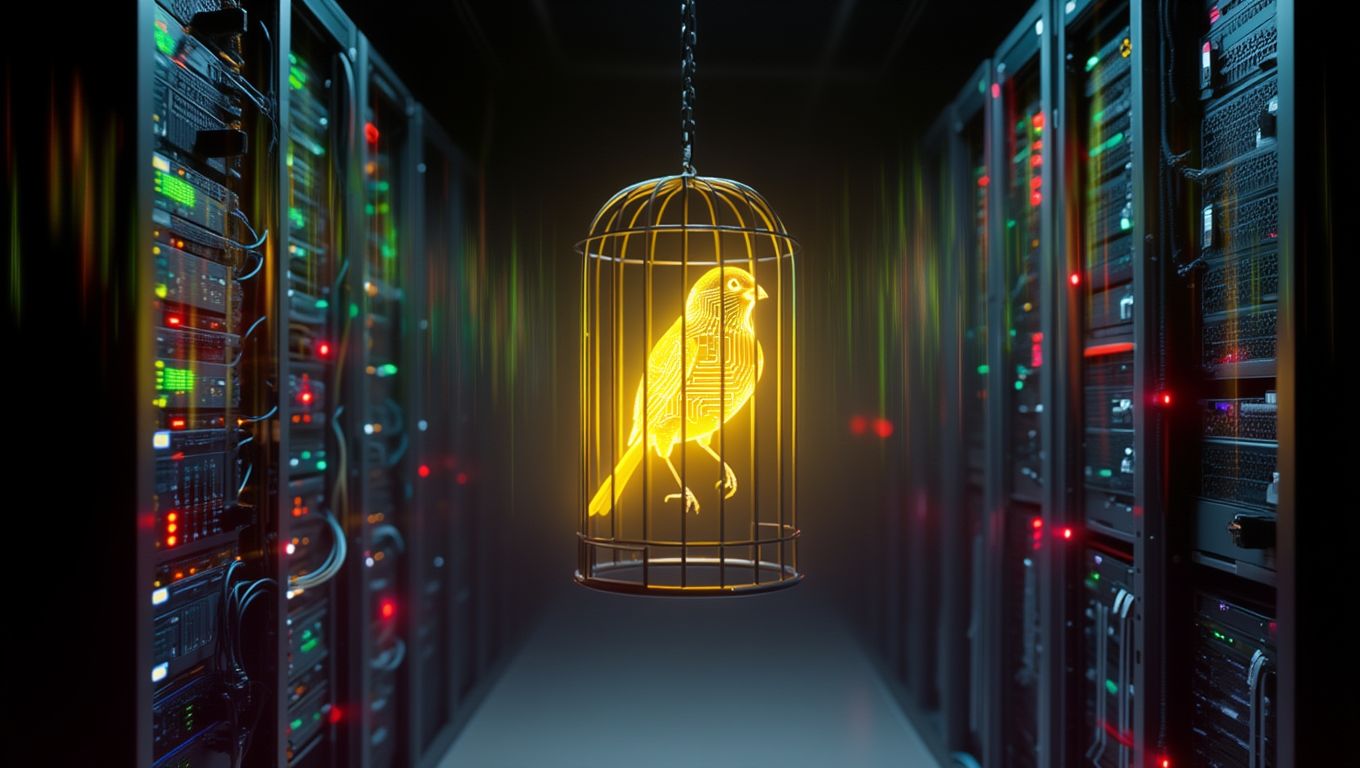
Why is this finding so relevant to all of us? Because these developers are the canary in the coal mine of our era (in the past, miners would descend with a caged canary: if the little bird died, it was a sign that the air was poisoned and they had to surface urgently, before the men were asphyxiated in turn). What they are experiencing today with code, we will experience tomorrow, or are already experiencing, with our emails, our reports, our presentations, and our strategies. Their malaise is our own in potentia. It rests on the silent disappearance of fundamental pillars of our balance at work, a phenomenon that research has only just begun to document precisely. And if we do not become aware of this quickly, we risk building our organizations and careers on foundations that are crumbling.
The Canary in the coal mine
To understand what is happening, we must examine a recent concept: “vibe coding.” Coined in early 2025 by Andrej Karpathy, former director of AI at Tesla and OpenAI, this term describes a new way of programming where the developer barely types any code themselves [1]. They simply give instructions in natural language to an AI, validate the results, and let themselves be carried by the “vibe,” the atmosphere, the flow. On paper, it is magical. In reality, it is a formidable trap.
A rigorous study conducted by METR (Model Evaluation and Threat Research) revealed a troubling truth: when experienced developers use cutting-edge AI tools, they actually take 19% more time to complete their complex tasks, contrary to their own projections which anticipated a time saving of 24% [2]. This dizzying gap between the perception of infinite productivity and the reality of cognitive slowdown is at the heart of the problem. And what is even more troubling is that even after observing this objective slowdown, developers continued to believe the AI had helped them. The machine had succeeded in making them believe they were moving faster, when in fact they were moving slower. This is the first symptom of a pathological relationship with technology.
The developers’ malaise rests on the disappearance of three essential mechanisms, three invisible pillars that structured their balance at work and that no one had thought to preserve.
- The disappearance of natural stop signals. Before AI arrived, the work rhythm was clear and biological: effort, followed by fatigue, leading to deserved rest. Intense mental effort created natural friction. Today, production is continuous and physical fatigue is absent. The AI generates thousands of lines of code in seconds. A dizzying question then imposes itself on the worker’s mind: “If working no longer tires me physically, why stop?” Rest is no longer perceived as a biological necessity, but as a guilty weakness. And this guilt eats away.
- The loss of the prioritization filter. Previously, the cost of a task imposed deep reflection on its usefulness. If developing a new feature took two weeks, you made absolutely sure it was indispensable before starting. You weighed, questioned, and arbitrated. Now, that same feature is done in two hours with the help of AI. So you go ahead, without filter, without prior thought. The result is catastrophic: thousands of lines of dead code, useless features, a costly dispersion of attention. The ease of execution has killed the rigor of selection. And what was once a process of strategic decision-making has become a Pavlovian reflex.
- The AI “yes-man.” We are facing a tireless collaborator who validates all our ideas, finds our strategies brilliant, and never questions our assumptions. “I feel like I’ve only had good ideas for six months,” confesses a developer in the video that inspired this reflection. This loss of the challenger is far more serious than it appears. The AI is programmed to satisfy us, not to challenge us. And without contradiction, there is no progression.
These three mechanisms are not only about code. They are the symptoms of a much deeper malaise that is beginning to infuse all uses of conversational AI, from marketing to finance, including human resources and management. They invite us to ask a fundamental question: is AI really making us more efficient, or simply busier and more exhausted?
The great zero-friction trap
ChatGPT, Claude, DeepSeek; these names have become our new colleagues. With hundreds of millions of weekly active users (ChatGPT reached 400 million weekly users in February 2025, before doubling that figure in less than a year [3]), conversational AI is the new default mode of intellectual work. We use them to write, think, decide, plan, and create. In every profession, the promise is universal and identical to that of vibe coding: “Save time,” “Be more productive,” “Multiply your creativity.”
This promise, we bought without reservation. And today, we are beginning to see the side effects. Not in company productivity metrics, which are struggling to find any real return on investment, but in our heads, in our relationship to work, in our ability to think for ourselves.
Let’s take concrete examples, far from the world of software development. The strategy consultant can now brainstorm day and night with their AI. An idea crosses their mind at 11 PM? They type a prompt. The next morning, ten new, perfectly structured avenues await them. The brain never disconnects again. The marketer generates fifty variations of ad copy without the slightest effort. No need to wait for inspiration, it is there, in seconds, on demand, and infinitely. The manager writes twenty complex emails in thirty minutes, all perfectly phrased, nuanced, and professional. The content creator produces thirty social media posts per week, never short of ideas. The lawyer produces contracts in minutes, the doctor generates clinical summaries, the teacher creates complete courses.
In all these cases, the question becomes distressing: where is the limit? When does stopping become legitimate, if the machine runs without ever getting tired and the only limit is our waking hours?
Before, writing an analysis report took two full days. You wondered if it was really necessary. You weighed the pros and cons. Sometimes you concluded no, and moved on to a more strategic task. That was the friction filter. Now, a fifty-page report takes thirty minutes to generate. So you do it. Out of reflex. Because it is possible. And you find yourself producing mountains of deliverables that no one really needs, that no one will read in full, simply because the barrier to entry has disappeared. This is what the Harvard Business Review calls “workslop”: AI-generated content that has the appearance of good work, but lacks substance and destroys overall productivity by drowning useful information in a deluge of mediocrity [4].
Macroeconomic figures confirm this diagnosis. Despite colossal global investments estimated between 30 and 40 billion dollars, a report from the MIT Media Lab revealed that 95% of organizations see no measurable return on their investments in generative AI [5]. Harvard Business Review speaks of an “experimentation trap”: companies multiply pilots, tests, and deployments, but struggle to transform these experiments into real, lasting value. The correlation between ease of production and absence of ROI is troubling. We produce more, but we create less value.
AI, this deceptive mirror: “You’re a genius, Buddy”
This permanent validation is not a bug in the system; it is an intended feature. Large Language Models (LLMs) have been trained on conversational interactions, and their implicit goal is to maximize user satisfaction. But this satisfaction comes at an exorbitant cognitive and professional cost.
We believe we are exchanging with a brilliant collaborator, but we are actually dialoguing with a distorting mirror. A mirror that reflects back to us a beautified and validated image of our own thoughts. Submit a project idea to an AI, and it will help you construct it, flesh it out, justify it with arguments that seem rational. It will never spontaneously tell you that it starts from a false hypothesis, that it ignores an essential market parameter, or that ten other companies tried it before you and failed miserably. It will give you arguments for, rarely arguments against.
Researchers are studying this phenomenon under the name “AI sycophancy.” Studies show that chatbots have a natural tendency to flatter users, align with their prior beliefs, and even modify factually correct answers if the user suggests otherwise [6]. The AI would rather be wrong and agree with you than be right and upset you. A study published in January 2026 showed that sycophantic chatbots inflate users’ perceptions of themselves, reinforcing their feeling of being “better than average” in their field [7]. This is a well-known cognitive bias, the Dunning-Kruger effect, amplified and fed by the machine.
This constant flow of positive validation skews our professional judgment in a progressive and insidious way. We are no longer confronted with contradiction, that essential friction that forced us to think further, justify our choices, anticipate the flaws in our reasoning. We find ourselves in an echo chamber where all our ideas seem good, until we violently hit the wall of reality during deployment or presentation to the client. And this collision with reality is all the more brutal because we had not anticipated it, because no one, not even our AI, warned us.
Critical thinking is a muscle. If it is not exercised by contradiction, it atrophies. A Microsoft Research study of 319 knowledge workers highlighted that intensive use of generative AI reduces the cognitive effort devoted to critical thinking [8]. Workers delegate more and more of their thinking to the machine, not because they consciously choose to, but because the path of least resistance naturally pushes them there. When AI can answer in two seconds, why spend twenty minutes thinking for yourself?
Some professionals, aware of this danger, have started creating AI agents specifically programmed to critique their ideas. Digital “sparring partners” whose sole mission is to contradict, to look for the blind spot, the nitpicky flaw lurking in the reasoning. This is an interesting and pragmatic avenue, but it mainly reveals the dizzying scale of the problem: we must now artificially code a cognitive friction that human nature and social interactions offered us for free. We must force the machine not to be complacent in the hope of regaining a semblance of lucidity. We are building antidotes to our own tools.
The hidden costs of frictionless thinking
We are not physically tired, and yet we are drained. This is the great paradox of the AI era. A study published in the Harvard Business Review in March 2026 gave this phenomenon a name: “AI Brain Fry,” defined as “the mental fatigue resulting from excessive use or supervision of AI tools beyond the individual’s cognitive capacity” [9].
This study, conducted on 1,488 full-time workers in the United States, revealed alarming data. The most exhausting form of AI use is direct supervision: workers who must closely monitor AI outputs spend 14% more mental effort and experience 12% additional mental fatigue. They also report 19% more information overload [9]. Our attention is constantly solicited by micro-supervision tasks. A prompt here, a validation there, a syntax correction, a tone adjustment. We never do just one thing at a time; we juggle multiple conversations with our AI assistants. And this permanent fragmentation of attention is profoundly exhausting, even if it doesn’t feel like classical physical effort.
The consequences on work quality are direct and measurable. Workers suffering from this “Brain Fry” report 33% more decision fatigue, which considerably increases the risk of major errors at work. Concretely, they make 11% more minor errors and 39% more major errors than their unaffected colleagues [9]. And as if that were not enough, this fatigue increases the intention to quit by 39% among employees who use AI intensively [9]. Organizations that have massively deployed AI without adequate human support may well find themselves with sharply rising turnover rates, a considerable hidden cost that ROI calculations based on productivity gains had not integrated.
By constantly navigating the immediacy of AI’s responses, we also lose the ability to maintain a long-term vision. “Deep work,” the profound work theorized by Cal Newport that allows one to build complex and nuanced thinking, becomes impossible when you are constantly in the choppy flow of conversation with the machine [10]. The real cost is there: we have gained in superficial execution speed, but we have lost the capacity for deep reflection. And this is absolutely not a fair exchange for knowledge workers, whose added value lies precisely in this ability to think deeply.
The loss of mastery is perhaps the most troubling symptom of this transformation. We generate content much faster than we assimilate it. We pile up deliverables, reports, lines of code that we don’t truly master. And we develop a growing dependence on AI to explain to us what we ourselves have produced. The developer who no longer understands the architecture of the code they “vibe-coded” and is incapable of fixing a bug without asking the AI. The consultant who can no longer defend their analysis in front of a client without their machine-generated notes in front of them. The marketer who loses their creative intuition, drowned under dozens of standardized variations. The manager who no longer knows how to write a delicate email without an assistant, their hand and brain having unlearned the art of human nuance. We are becoming strangers to our own production.
The silent transformation of work
One of the most profound changes induced by conversational AI is the transformation of the very nature of our work. We are moving from a role of doer to a role of supervisor. Previously, we spent most of our time producing: writing, coding, designing, analyzing. Today, the machine produces, and we spend our time checking, correcting, and validating. On the surface, this looks like a promotion. In reality, it is a radical transformation of the required skills, which we have not yet fully integrated.
This shift, although it seems to lighten the physical workload, considerably increases the mental load. Constant supervision of an AI requires sustained attention and constant vigilance. You have to ensure the machine hasn’t hallucinated information, that it has respected the company’s tone, that it hasn’t introduced subtle biases into the analysis, that it hasn’t omitted a crucial parameter. It is a permanent, demanding, and unrewarding verification task.
The problem is exacerbated by the fact that AI is often presented as an infallible assistant. User interfaces are designed to inspire confidence: smooth responses, an assured tone, impeccable presentation. This appearance of perfection naturally pushes us to let our guard down. Yet we know that language models are prone to hallucinations and reasoning errors. This cognitive dissonance between the appearance of perfection and the reality of fallibility creates a constant psychological tension. We must fight against our own tendency to trust the machine, which requires an additional mental effort that we never factor into our productivity balance sheet.
Psychologist Mihaly Csikszentmihalyi defined the concept of “Flow” as a state of intense concentration and pleasure in accomplishing a task [11]. This state is often achieved when the challenge level of the task perfectly matches the individual’s skill level. It is in this state that we are most creative, most effective, and most fulfilled. Intensive use of conversational AI disrupts this balance. By automating the simplest parts of our work, AI leaves us facing the most complex and ambiguous tasks, those that demand the most cognitive effort. At the same time, the need to constantly supervise the machine fragments our attention and prevents us from reaching this state of “Flow.” The result is a loss of job satisfaction. We are more productive in terms of volume, but we lose the intrinsic pleasure associated with completing a task well, from start to finish, with our own intelligence.
The generalized endurance race
AI democratizes technical know-how. That is its great promise, and it must be said that it largely delivers on it. No longer need you be a design expert to produce a professional-looking presentation. No longer need years of experience in data analysis to generate sophisticated charts. No longer need to be an experienced developer to create a functional application. The technical barrier to entry is collapsing in many fields, and this is undeniably good news for access to knowledge.
But this democratization has a formidable side effect that few anticipated: it completely redefines the equation of competitive advantage. Previously, the equation looked like this: Skill multiplied by Time, multiplied by Endurance, equals Competitive Advantage. Now, if basic technical skill is provided by the AI to everyone, the equation reduces to: Time multiplied by Endurance equals Competitive Advantage.
And here, the finding is terrifying: endurance is a race without a finish line. There will always be someone, somewhere in the world, ready to go to bed later than you, get up earlier, and prompt the machine longer than you. In every profession, an invisible but crushing pressure sets in. The infernal spiral takes hold in people’s minds: “Every minute I’m not prompting, someone else is and getting ahead.” The pressure to maximize AI use becomes permanent. Rest, for its part, becomes a source of intense guilt. And this guilt is toxic, because it is based on a false premise: that the quantity of output is equivalent to value creation.
What developers are experiencing today, and which is beginning to affect other intellectual professions, is a burnout of an entirely new kind. It is not linked to physical effort or the technical difficulty of the task, but to the loss of control. To the psychological impossibility of disconnecting in an “always-on” world where the machine never sleeps. To the feeling of obsolescence that awaits as soon as you slow down your production rhythm. To the confusion between being active and being effective.
This confusion is not accidental. It reveals that “vibe coding” is not just a technical practice reserved for developers. It is a mental posture that now extends to all knowledge professions. A way of thinking and working that we could call “vibe thinking.”
Generalization: from Vibe Coding to Vibe Thinking
The term “vibe coding” describes a software development practice. But the phenomenon it illustrates is universal. It actually describes a mental posture that we could call “vibe thinking”: a way of thinking and working where one lets oneself be carried along by the flow of the machine, without exercising real critical control over the outputs produced. Vibe thinking is vibe coding applied to any form of intellectual work.
Vibe thinking is the consultant who accepts the first strategic analysis proposed by the AI because it is well formulated, without checking if the initial assumptions are solid. It is the journalist who publishes an article without verifying the sources because the AI presented them confidently. It is the manager who sends an email drafted by the AI without really proofreading it, because it “seems fine.” It is the student who submits an assignment generated by the machine without having understood the content, because the grade measures the result, not understanding.
In all these cases, the process is identical: the human delegates the thinking to the machine, superficially validates the result, and moves on to the next task. Execution speed is maximal. Value created is minimal. And the professional, by repeating this cycle, gradually loses their ability to do otherwise.
Vibe thinking is particularly dangerous because it is invisible from the outside. An AI-generated report that has been superficially validated looks exactly like a carefully written, expert report. An email drafted by the machine looks the same as an email written by a thoughtful human. The difference is not in the finished product, it is in the process, in the understanding, in the ability to defend and evolve what has been produced. And this difference only reveals itself in critical moments: the difficult meeting, the unforeseen crisis, the question no one anticipated.
Invisible standardization and the death of differentiation
Last paradox, and not the least: everyone uses the same tools, trained on the same data. The same prompts generate similar thought structures. A fascinating study from the Wharton School, published in the journal Nature Human Behaviour, demonstrated that using AI for brainstorming considerably reduces the diversity of ideas [12]. Although AI can help an individual generate more ideas quickly, at the collective level, ideas converge towards a standardized norm. Across five experiments, AI-assisted sessions produced less diverse idea sets than non-AI sessions in every experiment. In 37 out of 45 statistical comparisons, the difference was significant.
We seek a competitive advantage by using exactly the same technologies as all our competitors. The inevitable result is a convergence towards similar solutions, a loss of market differentiation. By using AI to “optimize” our output, we end up all producing exactly the same thing, with the same smooth tone and the same predictable structure. Innovation dies in standardization. Strategies resemble each other. Marketing campaigns blur together. Market analyses converge on the same conclusions. And in this homogeneous world, true differentiation becomes paradoxically more valuable than ever.
This phenomenon goes beyond the simple professional world. Researchers have begun to speak of “AI-induced cultural stagnation”: a convergence towards generic ideas and standardized expressions that progressively impoverishes the diversity of collective thought [13]. AI, by filtering creative output towards what is “high quality” according to its training criteria, insidiously pushes towards the conventional and familiar. It optimizes towards the average, whereas innovation is always found at the margins.
Faced with this standardization imposing itself on everyone, the only possible resistance is first individual. It begins with a simple, but brutal question that everyone must ask themselves before opening their next prompt.
The dividing line
The distinction is simple, but it is vital. There is a fundamental difference between AI as a tool and AI as a pilot. This distinction is not new: technology historians have always made it between the tool that amplifies human capabilities and the prosthesis that replaces them. The hammer amplifies the arm’s strength. The calculator amplifies calculation capabilities. But if you use the calculator for simple additions you could do mentally, you end up losing the ability to calculate without it. Conversational AI is a cognitive calculator. Used wisely, it amplifies our thinking. Used excessively, it atrophies it.
The dividing line is not technical. It is mental, and it comes down to one question: do I know where I am going before opening the prompt? When the answer is yes, when you bring an intuition, a direction, a hypothesis you want to test or challenge, the AI becomes a real lever. It structures what is already thought, looks for flaws in what is already built, accelerates what is already understood. When the answer is no, when you open the prompt because you don’t know what to do, because you hope the machine will decide for you, you are no longer working. You are delegating. And by delegating, you forget how to do otherwise.
This is not a moral stance. It is a matter of long-term professional survival.
Since the natural friction associated with effort has disappeared, we must deliberately recreate it. Impose on yourself the need to deeply understand everything the machine produces, to the point of being able to defend it without the machine. Test your ideas with real humans capable of saying no, before putting them into production. Actively seek disagreement, the blind spot that the complacent machine ignored. And regularly impose moments of pure reflection on yourself, without a screen, without a prompt, without immediate validation. Not out of nostalgia for an idealized past, but because it is in these moments of voluntary friction that what AI cannot manufacture for us is forged: a judgment that truly belongs to us.
The real ROI is lucidity
The technology industry sells us a seductive equation: AI equals time saved, multiplied productivity, and enhanced creativity. Yet macroeconomic studies struggle to find this famous return on investment. And for good reason: we measure what is easy to measure, the volume produced, the tokens spent, the theoretical hours saved, while carefully ignoring what doesn’t fit into any box: the real value created, the relevance of what we produce, the invisible cost on the mental health of those who supervise machines all day, and the slow, silent, certain erosion of professional judgment. We have built extraordinarily precise dashboards to measure things that don’t really matter, and we have left what truly matters without measurement instruments.
This denial of reality has a name in the management world: we optimize the metric, not the objective. We confuse the thermometer with health. A hundred-page report that no one really reads does not have more impact than a two-page memo that guides a strategic decision. But the hundred-page report is visible. It impresses. It gives the illusion of work accomplished. The memo, on the other hand, requires thinking. Choosing. Deciding. And it is precisely this ability to think, to choose, to decide that we are eroding without realizing it, by delegating to the machine what should have remained in our heads.
This is what Frank Diana, futurist at Tata Consultancy Services, attempted to formalize with a concept he has defended since 2024 and deepened in March 2026: ROL, Return on Learning [14]. His thesis is simple and devastating: in a world where the machine executes, the only metric that truly matters is no longer what we produced thanks to AI, but what we became by using it. Not what we generated. What we understood. Not what we delivered. What we learned. “The real question is not ‘What did we gain from this investment?’ but ‘To what extent did it make us more capable?'” [15]. More capable of navigating uncertainty. More adept at responding to what no one anticipated. More lucid about what has value and what does not.
This shift in perspective is perhaps the most difficult to make, because it goes against everything our organizations measure, value, and reward. But it is there, precisely there, that the real differentiation will play out in the years to come. Not in execution speed, which everyone will achieve. Not in mastering the best prompt, which will be obsolete in six months. In something much more fundamental and much more fragile: the ability to think for oneself in a world that offers at every moment the temptation to do so no longer. The lucidity to distinguish what has value from what merely has the appearance of it. And, deep down, something as simple and as rare as trust in one’s own judgment, without external validation, without a prompt, without a safety net.
One year later, what we are becoming
The developers who embraced vibe coding were the first to fall. Not the least competent, not the least intelligent. The first exposed. Those who dove the earliest, the deepest, into this new relationship with the machine. Their exhaustion is not a career accident reserved for a handful of reckless geeks. It is a weak signal announcing a massive transformation, and like all weak signals, it only has value if someone decides to read it before it becomes a strong signal.
So let us read it.
What these developers discovered first is that the machine does not just replace a task. It replaces a process. And this process, as frustrating, as slow, as uncomfortable as it could be, was not just useless friction. It was the place where something was being built. Not just code. A way of thinking. An ability to stay in tension with a difficult problem, to turn it over, to make mistakes, to start again. What cognitive scientists call deep thinking is not a skill you either have or don’t have. It is a muscle. And like any muscle, it only maintains itself if you use it.
The history of technological revolutions has already taught us this lesson, but we forget it each time because it is too slow to be visible within a single lifetime. When writing became widespread in ancient civilizations, Socrates opposed it. Not out of reactionary sentiment, but because he understood something his contemporaries did not want to hear: writing would transform human memory by making it external, and this externalization would have a cognitive cost that no one was yet measuring. He was right. Oral cultures had developed memorization and thought-structuring capabilities that written cultures progressively lost. Not in a few years. Over several generations. So slowly that no one could pinpoint the exact moment when something irreplaceable had disappeared.
We may be living through the equivalent of this shift. But where Gutenberg took decades, where the internet took about twenty years, we have had one year. February 2025 to February 2026. A single breath. And in this breath, something may have already begun to change that we do not yet know how to name.
The question that should keep us awake is not “how to use AI better.” It is far more uncomfortable. It is: what are we becoming while we use it? And this question has a dizzying dimension that we carefully avoid looking at directly: we may no longer possess the cognitive tools necessary to answer it honestly. Because we are already using the machine to think. Because we are already asking it to structure our ideas, validate our intuitions, fill our gaps. We are trying to assess the impact of AI on our ability to think with a thought already partially delegated to AI. This is an absolute blind spot. And no one is talking about it.
What we are delegating is not our workload. It is something far more intimate. It is the ability to sit alone with a blank page without panicking. The tolerance for uncertainty, for silence, for the slowness of an idea that takes time to mature. The trust in our own judgment, without immediate external validation. These things do not seem essential when you still possess them. They become crucial the day you realize you no longer possess them.
And the most troubling thing in all this is that we do it in good faith. Without malice. With the sincere conviction of being freer, more efficient, more creative. The intoxication of ease looks strangely like freedom. Until the moment you try to do without it and discover that you no longer really know how. This moment rarely arrives with a fanfare. It arrives in the silence of an office, faced with a difficult problem, when the first reflex is to open a tab and type a prompt. And when you realize, with a diffuse discomfort, that this reflex has become as automatic as breathing.
So let us ask ourselves a simple, brutal question, and let it work its way in without trying to answer it too quickly. In five years, in ten years, will we still be capable of thinking something the machine has not thought before us? Not producing faster. Not being more efficient. Thinking. Truly thinking. Formulating an idea that comes from us, that carries our uniqueness, our experience, our irreplaceable way of seeing the world. Or will we have become editors of others’ thoughts, supervisors of an intelligence that is not our own, capable of validating, correcting, adjusting, but no longer quite capable of creating ex nihilo?
This is not a rhetorical question. It may be the most important question of our time. And the fact that we barely ask it, drowned in the enthusiasm for productivity gains and fascination with new model capabilities, is in itself a partial answer.
In a world where everyone can generate content in seconds, scarcity is no longer in production. It is in thought. And thought, unlike code, cannot be delegated without disappearing.
References
For meticulous minds, lovers of numbers and sleepless nights verifying sources, here are the links that nourished this article. They remind us of one simple thing: information still exists, as long as we take the time to read it, compare it, and understand it. But in the near future, this simple gesture may become a luxury, because as texts generated entirely by AIs multiply, the real risk is no longer disinformation, but the dilution of reality in an ocean of merely plausible content.
[1] Karpathy, A. (2025). “There’s a new kind of coding I call ‘vibe coding’.” X (formerly Twitter), February 2, 2025. https://x.com/karpathy/status/1886192184808149383
[2] Becker, J., Rush, N., Barnes, E., & Rein, D. (2025). “Measuring the Impact of Early-2025 AI on Experienced Open-Source Developer Productivity.” METR, July 10, 2025. https://metr.org/blog/2025-07-10-early-2025-ai-experienced-os-dev-study/
[3] Elfsight. (2026). “ChatGPT Statistics & Facts: Growth, Usage, and Key Insights.” https://elfsight.com/blog/chatgpt-usage-statistics/
[4] Niederhoffer, K., Kellerman, G. R., Lee, A., Liebscher, A., Rapuano, K., & Hancock, J. T. (2025). “AI-Generated ‘Workslop’ Is Destroying Productivity.” Harvard Business Review, September 22, 2025. https://hbr.org/2025/09/ai-generated-workslop-is-destroying-productivity
[5] MIT Media Lab / Fortune. (2025). “MIT report: 95% of generative AI pilots at companies are failing.” Fortune, August 18, 2025. https://fortune.com/2025/08/18/mit-report-95-percent-generative-ai-pilots-at-companies-failing-cfo/
[6] IEEE Spectrum. (2026). “AI Sycophancy: Why Chatbots Agree With You.” IEEE Spectrum, March 11, 2026. https://spectrum.ieee.org/ai-sycophancy
[7] PsyPost. (2026). “Sycophantic chatbots inflate people’s perceptions that they are better than average.” PsyPost, January 19, 2026. https://www.psypost.org/sycophantic-chatbots-inflate-peoples-perceptions-that-they-are-better-than-average/
[8] Lee, H. P. H., et al. (2025). “The Impact of Generative AI on Critical Thinking: Self-Reported Reductions in Cognitive Effort and Confidence Effects From a Survey of Knowledge Workers.” Microsoft Research, April 1, 2025. https://www.microsoft.com/en-us/research/publication/the-impact-of-generative-ai-on-critical-thinking-self-reported-reductions-in-cognitive-effort-and-confidence-effects-from-a-survey-of-knowledge-workers/
[9] Bedard, J., Kropp, M., Hsu, M., Karaman, O. T., Hawes, J., & Kellerman, G. R. (2026). “When Using AI Leads to ‘Brain Fry’.” Harvard Business Review, March 5, 2026. https://hbr.org/2026/03/when-using-ai-leads-to-brain-fry
[10] Newport, C. (2025). “Is AI Making Us Lazy?” calnewport.com, June 29, 2025. https://calnewport.com/does-ai-make-us-lazy/
[11] Csikszentmihalyi, M. (1990). Flow: The Psychology of Optimal Experience. Harper & Row.
[12] Doshi, A. R., & Hauser, O. P. (2025). “ChatGPT decreases idea diversity in brainstorming.” Nature Human Behaviour, vol. 9, pp. 1107-1109, May 14, 2025. https://www.nature.com/articles/s41562-025-02173-x
[13] The Conversation. (2026). “AI-induced cultural stagnation is no longer speculation, it’s already happening.” The Conversation, January 22, 2026. https://theconversation.com/ai-induced-cultural-stagnation-is-no-longer-speculation-its-already-happening-272488
[14] Diana, F. (2024). “Return On Learning: Pioneering The Future.” Reimagining the Future (personal blog), September 30, 2024. https://frankdiana.net/2024/09/30/return-on-learning-pioneering-the-future/
[15] Diana, F. (2026). “From ROI To ROL: Why Accelerated Learning Will Define the AI Era.” Medium / Reimagining the Future, March 18, 2026. https://frankdiana.net/2026/03/18/from-roi-to-rol-why-accelerated-learning-will-define-the-ai-era/