We have spent 50 years preparing people for a world that no longer exists.
This article is deliberately long. The subject deserves it. To avoid overwhelming you, it will be published in three parts, one per week. You are reading the first. The next two will follow in the coming days.
Just 4 seconds
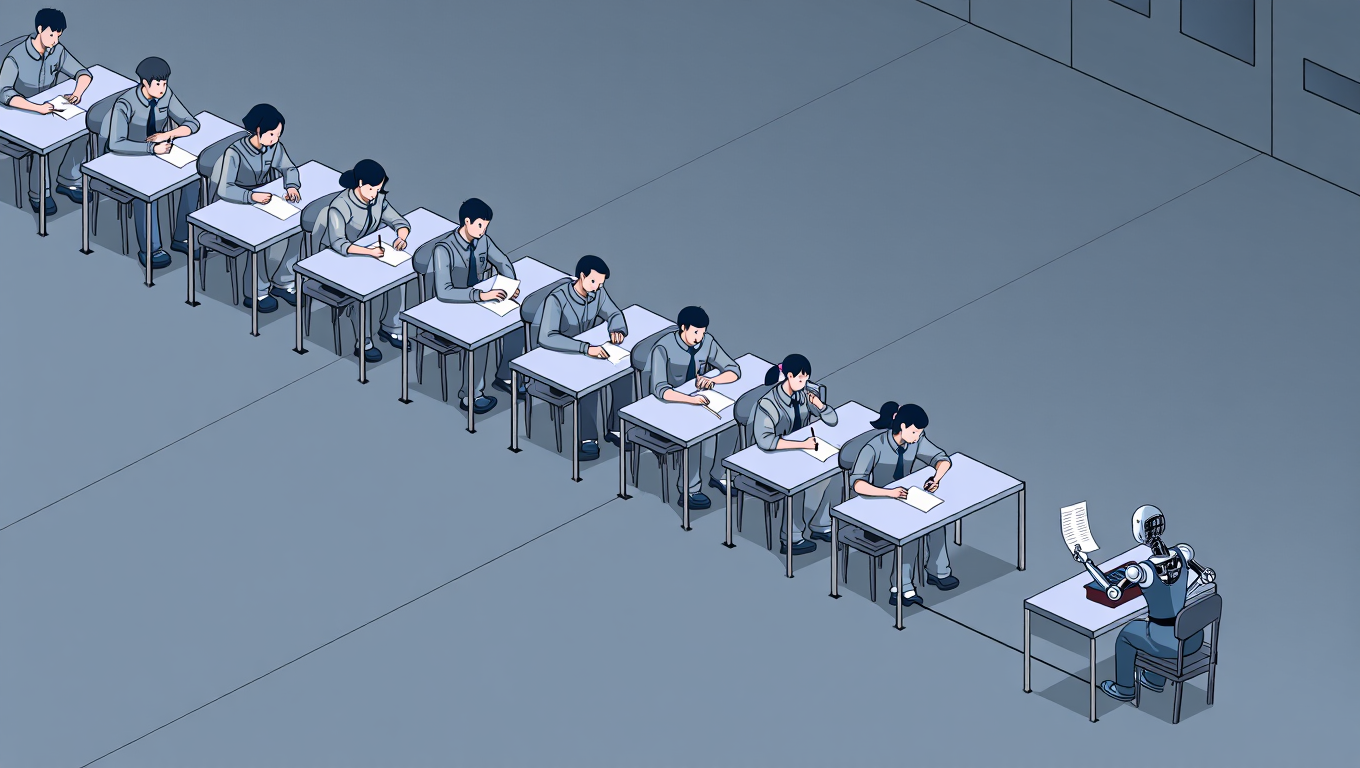
A classroom, spring 2026. A student has been sweating over his philosophy paper for an hour. His pen scratches across the page, he crosses things out, starts again, desperately trying to articulate a coherent line of thought on the assigned topic. His neighbor, meanwhile, put his pen down a long time ago. In fact, he only needed 4 seconds to produce a perfect essay, structured, argued, with a compelling introduction and a nuanced conclusion. This neighbor is not named Albert Einstein or Jean-Paul Sartre. His name is ChatGPT.
This is not a dystopian science fiction scene, it is the daily reality of our current education systems. Nearly 90% of students already admit to using generative AI to complete their homework [1]. Faced with this massive shift, institutions often react first with panic, closely followed by repression. Access to tools is restricted, increasingly sophisticated plagiarism detection software is deployed, and offenders are punished harshly. But this reflex response completely misses the point. We are not facing a technological problem, we are facing a fundamental misunderstanding of what learning actually is. Collectively, we have confused knowledge with storage.
For decades, school has been designed as a vast intellectual assembly line. Its primary goal was not so much to teach people how to think for themselves, but to train them to retain information and reproduce it identically. We have evaluated the ability of the human brain to function like a hard drive, long before hard drives even existed in our computers. Today, a machine performs that task in seconds, and it does so far better than 99% of even the brightest students.
This sudden and brutal shift forces us to confront an uncomfortable truth. If an artificial intelligence can achieve a perfect score on an exam designed to assess humans, the problem is not that the machine has become too intelligent. The problem is the exam itself, which is fundamentally unfit for purpose. For half a century, we have been training individuals for a world of repetitive tasks, memorization, and obedient execution, a world that, under the pressure of automation and artificial intelligence, is simply disappearing before our eyes.
The library and the librarian
To understand the scale of the misunderstanding we have trapped ourselves in, we need to take a clear look at what we have actually been evaluating for the past fifty years in our schools, middle schools, high schools, and universities. The traditional education system rests on three fundamental pillars that have barely evolved since the post-war period: reproducing a memorized lesson, translating a piece of text from one language to another by applying strict grammatical rules, or selecting the correct answer in a multiple-choice test without any need to justify the reasoning.
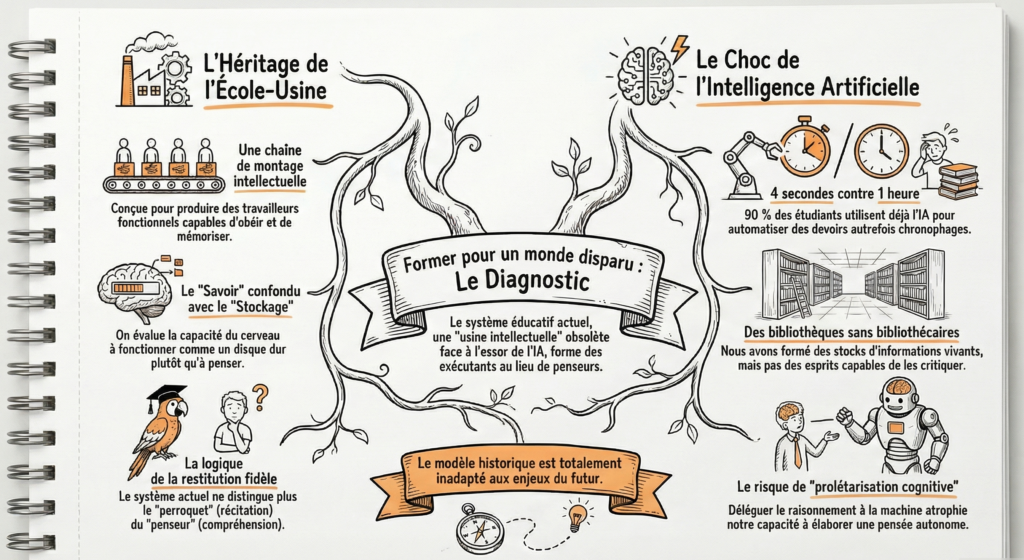
These three pillars share a common underlying logic: they measure the fidelity of reproduction, not the quality of thought. A student who perfectly recites a lesson without understanding a single word receives the same grade as one who has truly grasped the concept. A student who translates a text word for word without capturing its cultural nuance is rewarded in the same way as one who understands its irony. This system does not distinguish the parrot from the thinker.
The physicist Richard Feynman, Nobel Prize winner and exceptional educator known for his ability to explain complex ideas simply, had a striking analogy to illustrate this drift in education. He pointed out that there is a fundamental difference, a conceptual gap, between knowing the name of something and truly understanding it. “You can know the name of a bird in all the languages of the world,” he said, “but when you’re finished, you will know absolutely nothing about the bird. You will only know what people call it” [2]. For 50 years, school has graded, evaluated, and ranked our ability to remember the name of the bird, while carefully neglecting to teach us how it flies, why it sings, or how it interacts with its ecosystem.
This tragic confusion between superficial memorization and deep learning has had severe consequences on intellectual development. By focusing almost exclusively on memory and faithful reproduction, school has progressively externalized reasoning and critical thinking. The philosopher Bernard Stiegler referred to this as “cognitive proletarianization” [3]. According to him, when we delegate a skill or knowledge to a machine, we do not free the human mind for higher tasks, we simply lose that ability. This is not Marx applied to the worker deprived of his tools, it is Marx applied directly to the human mind, stripped of its capacity to develop autonomous thought.
Until now, we had delegated mental calculation to calculators and spatial navigation to GPS systems on our smartphones. Neuroscientific studies show that frequent and exclusive use of GPS weakens spatial memory and even alters the structure of the hippocampus, the brain region responsible for navigation and memory [4]. Researchers Louisa Dahmani and Véronique Bohbot studied drivers accustomed to relying on GPS and measured their ability to memorize routes without assistance. The longer the GPS usage, the weaker the spatial memory became. The brain only preserves what it uses. This is the principle of neuroplasticity: connections that are used are strengthened, those that are neglected fade away.
But with generative artificial intelligence, we are crossing a new threshold. The machine is no longer just handling storage, it is also taking over synthesis, structuring, and fluent language production. If we remove all of this from our current evaluation system, what remains to assess in a student? Very little, if anything.
We have tirelessly trained living libraries, individuals capable of storing information on neatly organized mental shelves. But we have neglected to train librarians, minds capable of connecting information, questioning it, doubting its relevance, contextualizing it, and creating new knowledge from it. In a digital world where information is infinite, omnipresent, and instantly accessible to anyone with an internet connection, the library as a storage space has no added value. Only the librarian, through discernment and critical thinking, truly matters.
School as a factory: a forgotten history
There is a question almost no one really asks, because the answer is somewhat uncomfortable: why does school look like a factory?
Rows of aligned desks. The bell ringing. Mandatory silence. Standardized curricula. Uniform grading. This is not an accident or a historical oversight. It is a deliberate choice, one that made perfect sense at the time.
In the 19th century, industrialized nations urgently needed workers who could read instructions, count parts, and show up on time. Jules Ferry did not create the republican school system out of pure idealism, he was also responding to a specific economic demand [16]. Yes, to educate citizens, but above all to train functional workers for rapidly expanding factories.
Frederick Taylor, the father of “scientific management,” was optimizing workers’ movements with a stopwatch at the same time [17]. Measure, standardize, reproduce identically. These same principles quietly made their way into classrooms. The ideal student, like the ideal worker, was the one who executed quickly, accurately, and without questioning.
This model made sense in its time. In a world where information was scarce and access to knowledge was a privilege, memorization was a valuable skill. A doctor who memorized hundreds of diseases saved lives. An engineer who knew formulas by heart built bridges. Memory had real, tangible, vital value.
The problem is that this world began to change long before ChatGPT. Industrial automation has been eliminating repetitive production jobs since the 1970s. Robotics has turned factories into near-empty spaces. Computing has absorbed the simplest administrative tasks. With each technological wave, the most routine jobs disappeared first. And each time, school took decades to notice, continuing to train generations for professions that were vanishing.
This delay was not negligence. It was systemic inertia. Institutions do not change direction overnight, they resist, they delay, they adapt marginally. But with generative artificial intelligence, the time for gradual adaptation is over. The wave no longer allows us to step back.
If school was designed as a factory to produce executors, what happens when the machine becomes the best executor possible? This is the central paradox of our time, and it is what we will explore next week in part two of this article: why we have systematically made optional everything that enables us to think.
References
The perfect storm is now in place. The physical foundations of our digital world are shaking under the weight of geopolitics, scarcity, and technological hubris. But concretely, what will this disastrous alignment change in your life starting tomorrow morning? That is what we will explore next week in part two of this investigation, where we will dive into the shock of reality: rising costs, the Androidcalypse, and the end of technological globalization.
[1] Forbes (2023). “Educators Battle Plagiarism As 89% Of Students Admit To Using Open AI’s ChatGPT For Homework”. Disponible sur : https://www.forbes.com/sites/chriswestfall/2023/01/28/educators-battle-plagiarism-as-89-of-students-admit-to-using-open-ais-chatgpt-for-homework-assignments/
[2] Feynman, R. P. (1966). “What is Science?”. Présentation à la National Science Teachers Association, New York. Texte reproduit dans The Physics Teacher, vol. 7, n° 6, 1969.
[3] Stiegler, B. (2010). “Pour une nouvelle critique de l’économie politique”. Éditions Galilée, Paris.
[4] Dahmani, L., & Bohbot, V. D. (2020). “Habitual use of GPS negatively impacts spatial memory during self-guided navigation”. Scientific Reports, 10(1), 6310. https://doi.org/10.1038/s41598-020-62877-0
[16] Prost, A. (1968). “Histoire de l’enseignement en France, 1800-1967”. Armand Colin, Paris.
[17] Taylor, F. W. (1911). “The Principles of Scientific Management”. Harper & Brothers, New York.