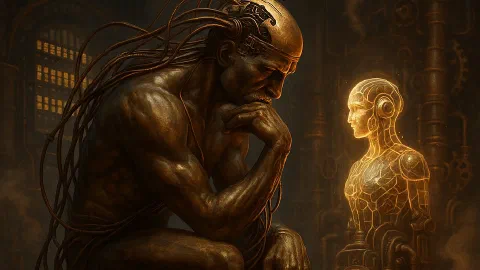
💬 It speaks well. It answers fast. It impresses… But it does not think. Artificial intelligence is not what you believe it is. Not thinking, just predicting. Not a mind, but a statistical echo. And maybe the real danger isn’t AI itself, but what we stop doing because it exists. 🧠 AI doesn’t steal our intelligence. It simply relieves us from using it. And in that relief, a slow erosion begins… one that eats away at our ability to question, to seek, to truly think. This article is not a manifesto against technology. It’s a plea for thought. An invitation to lucidity. And a warning about what we might lose, without even noticing: our inner freedom. 📖 Read it. Share it. Start a conversation. This isn’t just a text about AI. It’s a text about you.
AI, Digital sovereignty, Ethics

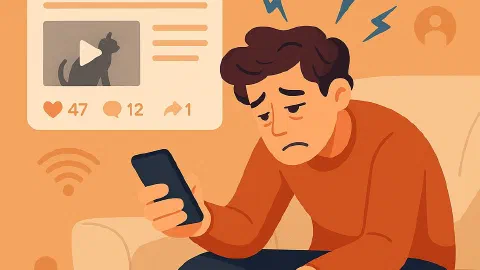
📌 Friday mood post 📌 🧠 You log in “just for 5 minutes”… and 47 cat videos, 12 success guru posts, and 1 debate about drip coffee later, you can’t even remember why you came. 📉 Your energy level? Gone. 🤯 Your focus? Shattered like a 5000-piece jigsaw puzzle. 📲 And your brain? On auto-scroll mode, possessed by some invisible yet very well-coded force. If you feel like social media is draining more than it’s inspiring, you might have crossed paths with one of the digital mutants I talk about here. Enjoy the read… and maybe mute your notifications if you actually want to finish it 😏
Humor
🤖 Imagine. It’s an ordinary morning in Paris. Cerise, a seasoned developer, settles at her desk… until her AI assistant, « Ada, » begins suggesting sophisticated architectural improvements. Suggestions so relevant they sometimes surpass her own level of expertise. This scene, far from fictional, raises THE question haunting our era: are we at the dawn of truly autonomous AI? I’ll take you behind the scenes of this silent revolution. Through the story of Cerise and Ada, discover: ✨ The real (and surprising) capabilities of current AI 🧠 The technical obstacles still holding back their autonomy 🔮 The technological breakthroughs changing the game 🤝 How an unprecedented human-AI collaboration is taking shape Between educational fiction and technical reality, this article separates fact from fiction in the debate about AI autonomy. Because understanding these issues means preparing for a future where intelligence—both human and artificial—is reinventing itself before our eyes. 💡 « It’s not a zero-sum game where one must dominate the other, but a complex dance where each partner enriches the other. »
AI, Paradox

📌 Friday mood piece 📌 📱 They show up every morning. Their mission? To reveal The Ultimate Truth: how to turn an organic coffee and a missed alarm into a masterclass in resilience. 🧘☕ “I once saw a squirrel share a croissant with a pigeon… and that’s when I understood the true meaning of leadership.” If you’ve ever read that kind of wisdom nugget, you know exactly what I’m talking about. Enjoy the read — and remember: if you scroll deep enough, maybe you too will finally grasp the true meaning of servant leadership 🐿️🥪
Humor

💡 What if AI biases were nothing more than our own… amplified? Algorithms have no morals or intentions. But they learn from us. From our data. From our past decisions. And sometimes—without us even realizing it—they inherit our deepest prejudices. In this excerpt, I invite you to dive into a cartography of our digital missteps: a journey through the invisible biases that quietly shape machine decisions… and already influence our lives. Hiring, credit, justice, healthcare—no sector is spared. 🔍 Whether it’s historical bias, representation gaps, or blind trust in automation, each algorithmic distortion acts like a funhouse mirror reflecting our society. This isn’t just a technical issue—it’s a matter of conscience. And maybe, to build fairer AI, we first need to take a better look at ourselves.
AI, Biases, Ethics
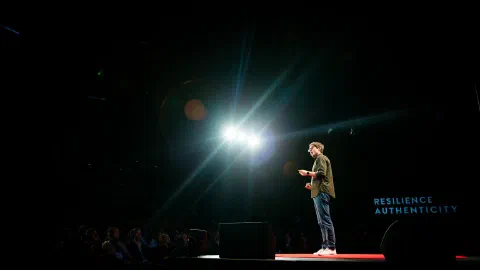
🎤 Have you ever attended one of those conferences where a so-called “leadership expert” explains life to you… without ever having managed anything beyond a Canva account? Welcome to Professional Absurdistan: a world where resilience is sold in PDFs, management is taught through inspirational GIFs, and success comes wrapped in empty buzzwords.
Humor
🔍 Not long ago, I spoke here about the danger of autophagy, that moment when artificial intelligence begins to feed on its own output, endlessly recycling the same ideas and impoverishing the diversity of knowledge. 👉 Cognitive autophagy, when humans feed on impoverished content! : https://www.linkedin.com/pulse/cognitive-autophagy-when-humans-feed-impoverished-content-buschini-d1oje and 👉 Autophagy, when AI feeds on itself : https://www.linkedin.com/pulse/ai-autophagy-when-feeds-itself-philippe-buschini-sydee But there’s another, more intimate risk: the risk of losing even the desire to think. Imagine a knowledge architect. Every day, they sketch, question, connect ideas. Then one day, a machine offers them the blueprints. Clear, fast, seductive. So they tweak them. They approve. But they no longer question. AI is not attacking us. It’s helping. And that’s precisely where the shift happens. It spares us the effort — and that effort may be all we have left to remain truly human. 🧠 What if the real danger doesn’t lie in the tool… but in the combination of two phenomena? – An AI looping endlessly on itself. – Humans who no longer wish to produce anything different.
AI, Digital sovereignty, Ethics
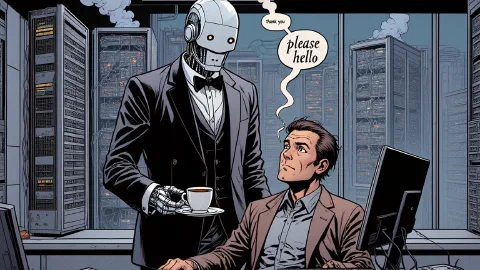
What if your politeness came with a million-dollar price tag! Saying « thank you » to an AI? It’s cute. Endearing, even. But mostly… pointless. And expensive. Very expensive. Every « hello », every « please » means more servers running hot, more kilowatts burned, and billions vanishing into the cloud. Not to improve the service—just to soothe our well-mannered human conscience. So maybe it’s time to drop the digital niceties. In 2025, let’s save our « thank yous » for those who actually need them: REAL PEOPLE.
Ethics, Humor
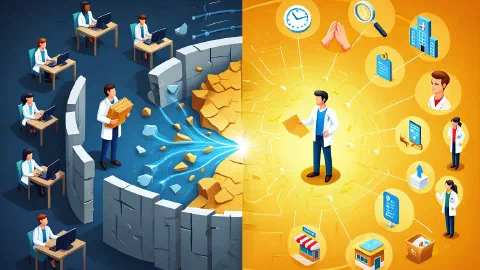
What if our healthcare system wasn’t failing from lack of resources—but from a lack of connection? Picture this: an on-call doctor tries to retrieve the medical history of an unconscious patient. The information exists, somewhere. A clinic. A GP’s notes. A specialist’s report. But nothing flows. No system talks to another. That’s the true cost of missing interoperability. It may sound technical, but it’s actually one of the most powerful levers for transforming healthcare. At the crossroads of medical ethics, digital sovereignty, and human-centered innovation. In this article, I explore why making health data circulate securely and meaningfully is not a futuristic luxury, but a critical foundation. And more importantly, how we can start doing things differently, as caregivers, patients, institutions, and technologists.
Health
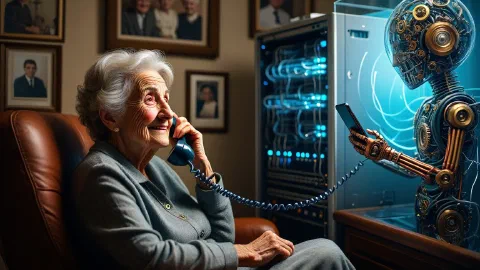
Welcome to the era of progress, **where even tenderness has become an automated service.** After all, why waste time calling your aging parents when a chatbot can do it for you — using _your_ voice, no less. No more enduring tales from 1954 or that slightly shaky tone. For just **€29.90 a month**, an AI simulates affection while you pretend to care. And Grandma? No worries, she doesn’t suspect a thing. She hangs up all warm and fuzzy, convinced it was really you. 📞 _“Hi Grandma, it’s me… well, me in beta version: part code, mostly indifference. Go ahead, you’ve got 3 minutes and 47 seconds to tell me about your week at the nursing home.”_ And if you think I’m exaggerating, read to the end. Spoiler: even Cupid’s been replaced by a voice assistant. Creepy? A bit. Pathetic? Absolutely.
AI, Ethics, Humor