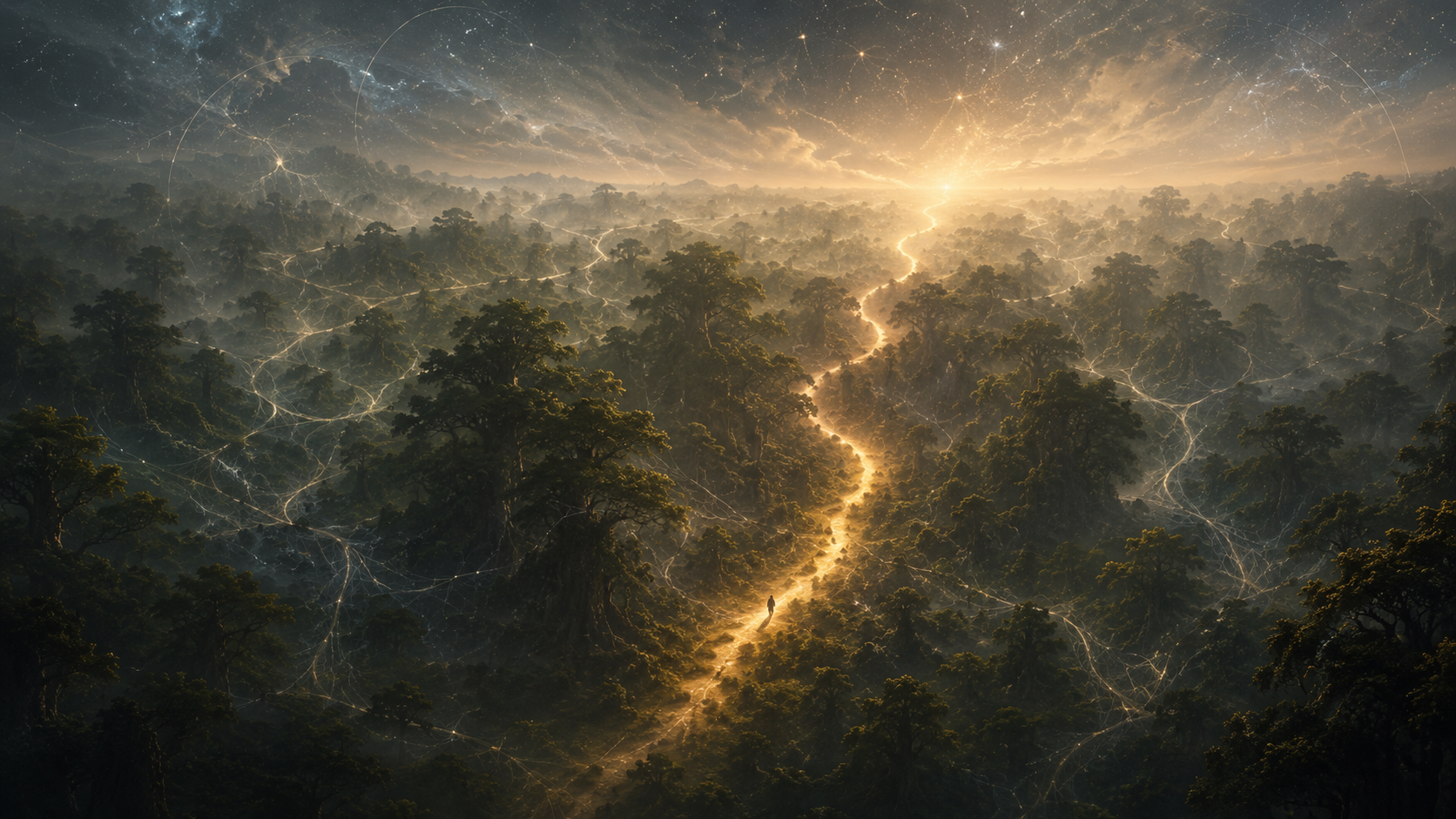
Everything is contained within the one … the one-that-is-all
Every morning, without thinking about it, we cast ourselves forward. Into the day that is beginning, into the week ahead, into what we are going to do, decide, build. This movement toward the future is so natural, so constant, that we no longer even notice it. It is the air our consciousness breathes. And yet, buried deep inside so ordinary a gesture, there hides a certainty we have almost never examined: the certainty that the future does not yet exist. What if it were precisely the opposite that were true?
This certainty of an empty future sits so deeply within our way of thinking that it has ended up shaping our very grammar. In French, the future is literally named what is to come. What is lacking. An absent thing we wait for, and that we build second after second, like a mason laying one stone after another to raise his edifice. Since childhood we have lived inside this image without questioning it: a past that is over, a fleeting present, a future open before us like an empty space waiting to be filled.
Now it is precisely this certainty that contemporary thought, at the crossroads of physics and philosophy, has begun to shake loose.
Not in order to replace it with a cold determinism where everything would be written in advance, frozen in a machinery with no way out. But in order to propose something stranger and, in some respects, more dizzying: the idea that the real is not a line we trace but a landscape we cross. A landscape whose entire structure already exists, and inside which our existence unfolds one of the countless trajectories that structure makes possible.
In this vision, the many is not opposed to the one. It is its consequence. The diversity of possible becomings would not be an opening onto nothingness, but the expression of a deeper unity: that of the laws, the structures, the fundamental coherences out of which everything unfolds. What physicists call spacetime. What philosophers have sometimes sensed under the name of Being, or the Absolute. What this article calls, more simply, the One.
This is the question I cannot manage to let go of. Not: is the future open or closed? That formulation forces a choice that nothing, neither physics nor philosophy, seems willing to settle. But: in what sense can it be, at once, the one and the other? Put that way, it stops calling for a dogmatic answer. It calls for an exploration.
Einstein and the time that does not pass
In 1905, Albert Einstein published his theory of special relativity [1]. The academic world was gripped. Not only because the equations were elegant. But because what they implied is almost unbearable for ordinary intuition.
Time, Einstein says, is not universal. Two observers in motion relative to one another do not live the same present. What is simultaneous for one is not simultaneous for the other. The very notion of “now” becomes relative, dependent on the state of motion of whoever utters it.
This result, known as the relativity of simultaneity, is no anecdotal curiosity. It shakes the foundation of our conception of time. If two events can be simultaneous for me and not simultaneous for you, then the “present” is not a universal slice of the world. It is a subjective view, dependent on a frame of reference.
Ten years later, with general relativity in 1915, Einstein goes further still. Space and time merge into a single entity: spacetime. A four-dimensional block in which past, present and future coexist as regions, exactly as north, south and east coexist in geographic space. No one would say that “the north does not yet exist” or that “the south has vanished.” Yet this is precisely what we say about the future and the past.
Physicists have given this conception a name: the block universe. In this vision, the future is not something to be built. It is there, somewhere in the geometry of spacetime, as real as the past.
The mathematician and philosopher Hermann Weyl, a contemporary of Einstein and one of his privileged interlocutors, had put it with an almost troubling clarity in his book Philosophy of Mathematics and Natural Science: “The objective world simply is, it does not happen. Only to the gaze of my consciousness, crawling upward along the life line of my body, does a section of this world come to life as a fleeting image in space which continuously changes in time.” [2]
Think of a film. The reel exists whole before the first frame is ever projected. Every scene, every resolution, every ending is already inscribed on it. What the viewer experiences as a story in the making, as a tension toward an unknown future, is only the passing of a light over images that all exist together, outside the time of the theater. Einstein’s block universe resembles this: the film is there, complete. We are the light passing through it.
We do not create the future. We discover it.
If that formula holds for Einstein’s universe, it will prove insufficient for what comes next …
Quantum mechanics, the block that branches
But relativity does not say everything. It describes the geometric structure of time. It says little about what happens inside that structure, at the level of elementary particles.
And here, something decisive is at play. For Einstein himself refused to follow quantum mechanics to its conclusions. He was the architect of a deterministic block universe: a fixed structure, where each event is the necessary consequence of those preceding it. “God does not play dice,” he said, contesting the idea that chance could be inscribed at the heart of the real.
Quantum mechanics says exactly the opposite. And this disagreement is no small matter. It radically changes the nature of the block universe. For if Einstein was right, the block is a monolith: a single trajectory, fixed for all eternity. But if quantum mechanics is right, the block looks more like a tree: a structure unique at its base, branching progressively into an infinity of branches.
It is this difference that lies at the heart of our reflection. Let us take it up again from the beginning.
Since the 1920s, physicists have discovered that quantum objects (electrons, photons, atoms) do not behave like marbles whose trajectory could be known with precision. Before being measured, they exist in superposed states: they are neither here nor there, neither in one state nor another. The mathematical formulation of the theory describes them as a superposition of several coexisting states, each weighted by a probability amplitude.
This is the famous Schrödinger’s cat, imagined in 1935 by the Austrian physicist Erwin Schrödinger [3]. A cat shut in a box with a quantum device is, according to the equations, in a superposed state of being both alive and dead, as long as the box remains closed. What is worth knowing is that Schrödinger devised this thought experiment precisely to mock the theory, to show how absurd its implications seemed if taken at face value. The irony is that physics, ever since, has largely proven him wrong: quantum superpositions are real, measurable, and not confined to microscopic scales.
In 1948, the American physicist Richard Feynman developed a way of calculating the trajectories of quantum particles that he called the path integral [4]. The idea is staggering. To calculate the probability that a particle goes from a point A to a point B, Feynman shows that one must consider all possible trajectories between A and B, even the most improbable, even the most bizarre, even those passing through the far end of the universe. Each one contributes to the final result, weighted by its amplitude.
Nature does not follow a single path. It explores all its possibilities at once, and the observed result is the sum of that exploration. This is not a metaphor. It is the mathematical structure of the theory.
There are several ways of interpreting this reality. The Copenhagen interpretation, the most widespread in the textbooks, says that the superposition collapses at the moment of measurement: the particle “chooses” a definite state. Before measurement, there would be no objective reality to describe.
But another interpretation, proposed in 1957 by Hugh Everett III in his doctoral thesis at Princeton, refuses this collapse [5]. In what we now call the many-worlds interpretation, the superposition never disappears. Each time a measurement is made, the universe itself branches: all the branches coexist, in sectors of spacetime that can no longer interact with one another. Each possible future is not merely a probability calculation. It is a real branch, one that actually unfolds.
This is where Einstein’s block universe and Everett’s quantum mechanics meet in a unified image. The block exists, whole. But it is not a single corridor. It is a tree-like structure, all of whose branches are real, and of which our consciousness perceives only one trajectory at a time. No longer a film whose reel is fixed, but a film all of whose alternative cuts exist simultaneously, and of which we watch only one version.
This interpretation is a minority view among practicing physicists. It is nonetheless taken very seriously by some of the greatest theorists, among them David Deutsch, a pioneer of quantum computing at Oxford [6]. And above all, it raises a philosophical question of dizzying depth: if all the branches exist, what does “to choose” mean?
Leibniz was perhaps right
Physics did not invent this question. It rediscovered it. And in rediscovering it, it gave it an answer Leibniz himself would probably not have accepted.
At the start of the eighteenth century, the philosopher and mathematician Gottfried Wilhelm Leibniz worked out a theory of possible worlds that anticipates, in a troubling way, certain intuitions of contemporary physics. In his Essays of Theodicy (1710), he holds that, before creation, an infinity of possible worlds exist in the divine understanding: coherent sets of events, all compatible with the laws of logic, yet distinct from one another [7]. The real world would be only one of them, one of them alone, actualized among an infinity of others that remained in the state of pure possibilities.
We can set the theology aside. What remains is philosophically crucial: the space of possibilities precedes the real. It does not reduce to it. The futures that did not take place are not nothing. They possess a logical consistency, a reality in principle, even if they never acquired a reality in fact.
In 1986, the American analytic philosopher David Lewis radicalized this intuition to a point Leibniz would not have crossed. In On the Plurality of Worlds, he holds that possible worlds are not mere logical abstractions in a divine understanding [8]. They are concrete entities, as real as our world, existing somewhere in a parallel reality with which we have no causal contact. What we call “our world” is only one among an infinity of others, all equally real, all equally existing. Lewis calls this position modal realism. Few philosophers follow him all the way. But its radicality has the merit of posing the question without adornment: if possible worlds are only abstractions, how is it that they exert a constraint on our reasoning? Why does what could have happened weigh so heavily in our deliberations, our regrets, our hopes?
What Leibniz and Lewis have in common, despite their differences, is the idea that the possible is not a mere lack of existence. It is a form of being in its own right.
Now it is precisely here that quantum mechanics collides with this philosophical tradition, and not where one would expect. For it does not say, as Leibniz did, that a single world was actualized among all the possibilities. It says, with Everett, that all the possibilities are actualized. Every branch of the superposition becomes real. There is no divine selection, no sorting, no single world prevailing over the others. Everything unfolds, everything exists, in sectors of spacetime that can no longer communicate with one another.
This is not a nuance. It is a complete reversal. Leibniz radically separated the possible and the real: the possible is what could have been, the real is what actually is. Everett erases this frontier: everything that can happen happens, somewhere, in a branch of the real. Lewis, for his part, finds himself oddly closer to Everett than to Leibniz: both affirm that possible worlds are concrete and real. The difference is that Lewis posits them as universes causally separate from the outset, whereas Everett has them come into being progressively, by branching at each quantum interaction.
But there is more. Quantum mechanics does not merely postulate real branches we cannot see. It shows that the possibilities not actualized in our branch have a measurable physical efficacy in ours. The double-slit experiment is decisive here: an electron sent toward two slits produces an interference pattern on the screen, as if two waves were crossing. Now, if there were only a single real trajectory, a single slit taken, no interference would be possible. The very fact that interference exists proves that both paths, both possibilities, contribute to the final result. The trajectories not taken are not simply absent. They participate in what happens.
In other words: the possible, in quantum mechanics, is not a mental projection. It is not in the head of the physicist calculating probabilities. It is in the world. It acts on the world. It produces measurable, verifiable, reproducible effects.
Leibniz had sensed that the space of possibilities was real. He thought a single world came out of it. Quantum physics suggests that it is stranger still: they all came out of it, each real in its own way, and even those that are not “ours” leave their imprint on what we observe.
Bergson had sensed the problem
Before going further, we must pause on an objection that is no minor one. It touches the heart of everything that precedes. And it comes from a man who, in 1922, dared to tell Einstein to his face that he was perhaps mistaken.
Henri Bergson is no rearguard thinker resisting scientific modernity out of nostalgia. He is a philosopher who built, from his Essay on the Immediate Data of Consciousness (1889) to Creative Evolution (1907), a meticulous analysis of what time means from the inside [9]. And what he says, in substance, is this: the time physics speaks of is not the time life speaks of.
The time of physics is measurable, divisible, spatialized. Its instants can be represented by points on a line. But lived time, what Bergson calls duration, does not resemble that.
Duration is not time passing along a line. It is what you feel when you wait for someone who is late: the minutes do not add up, they thicken. It is what you experience listening to a melody: the notes do not coexist, they melt into one another to form something that exists only in that flow. Cut the melody into separate instants, and you no longer have music. You have sounds. Duration is what resists being cut apart.
Now Einstein’s block universe, and even more so Everett’s tree-like universe, are structures in which all instants coexist equally. Past, present, future: the same ontological status, the same reality, the same existence. What we call the “now” is only an arbitrary cross-section of that geometry, different for each observer, with no particular privilege.
Bergson refuses this conclusion. Not because it is false on the physical plane, but because it leaves something essential unexplained: why is this present being lived? Why, if all instants are equally real, is there one and only one that imposes itself on consciousness as now? The block universe can describe the structure of time. It says nothing about what philosophers and physicists call the problem of the Now: that radical asymmetry between the instant lived and all the others, which physics fails to explain and tends to ignore.
This is not a matter of detail. The German philosopher and physicist Hans Reichenbach had already noted it: the fact that we have a sense of the direction of time, that we remember the past and anticipate the future, that we feel the present as an active threshold between what has been and what is to come, all of this exceeds what the equations of physics can formalize [10]. The fundamental laws of physics are almost all reversible in time: they would work just as well running backward. Yet our experience of time is profoundly irreversible.
Let us take up the film metaphor again. The reel exists whole. All the frames are there, simultaneously present on the film stock. But the viewer’s experience, the emotion, the tension, the surprise, is not in the reel. It is in the movement of the light over the image, frame after frame, in an irreversible order. No one comes out of a film having lived all the scenes at once, in an eternal present. One comes out with an experience that had a beginning, a middle, an end. And that experience is irreducible to the physical structure of the medium.
What the physicist calls “the time of spacetime” is the reel. What the living being calls “lived time” is the light passing through it. And the light is not in the reel.
The debate between Bergson and Einstein, which took place in 1922 at the French Society of Philosophy, has no winner in the ordinary sense of the term [11]. But it would be inaccurate to conclude that they simply contradict one another because they speak of different things. Bergson poses a demand physics cannot ignore without mutilating itself: any description of time that leaves unexplained the very fact of being in the midst of living it is an incomplete description. Einstein’s block universe says what time is in the structure of the real. Bergson’s duration says what time does to the one who crosses it. These two truths do not contradict one another, but they do not overlap either. Each without the other leaves a blind spot.
That blind spot, contemporary physics has not filled. It has even widened it. For if the block universe raises the problem of the Now, Everett’s tree-like universe radicalizes it still further: not only do all instants coexist, but all branches coexist. Consciousness, within this framework, perceives only one thread in an immense fabric. Which raises a question physics alone cannot resolve: what makes a consciousness perceive this thread rather than another? What makes it perceive something rather than nothing?
Now it is precisely the form of this question, as Bergson posed it, that lets us understand why cognitive neuroscience is the natural extension of this debate. Not because it answers the philosophical question, but because it reformulates it from within the living being: if lived time is irreducible to physical time, what is the organ that produces this irreducibility? What is the mechanism by which a consciousness extracts a present from a universe where all instants coexist?
The brain as an instrument of navigation
The answer neuroscience brings to this question is not definitive. But it is precious in a way Bergson himself might not have anticipated: it shows that the brain is not a spectator of time but its active producer.
For a long time, the brain was conceived as a reactive organ. The world sends signals, the brain receives them, processes them, and produces a response. Vision, hearing, decision: so many reactions to an environment imposing itself from outside. This image is intuitive. It is also, for the most part, false.
What cognitive neuroscience has progressively discovered, notably through the work of the physicist and physiologist Hermann von Helmholtz in the nineteenth century and its contemporary extension under the name of predictive processing, is that the brain works the opposite way to what we believed. It does not start from sensory signals to build a representation of the world. It starts from a representation of the world, continually built out of past experience, and confronts it with sensory signals in order to correct it.
In other words, what you perceive at each instant is not a faithful photograph of the outside world. It is a prediction your brain has made about what the world ought to be, adjusted at the last moment by what your senses confirm or contradict. Perception is a controlled hallucination, to borrow the formulation of the neuroscientist Anil Seth [12]: an internal construction that reality keeps calibrating, but that remains, fundamentally, a projection outward rather than a reception from outside.
The neuroscientist Karl Friston, of University College London, formalized this framework into a unified theory of the brain that he calls the free energy principle [13]. The idea is more precise than it seems. What Friston calls “free energy” is a measure of the surprise the brain feels when faced with what it perceives, that is, the gap between what it had predicted and what actually happens. All the brain’s work, perceiving, deciding, acting, can be described as a continuous attempt to reduce that gap. Either by updating its predictions to align them with reality. Or by acting on the world so that reality aligns with its predictions.
This second possibility deserves that we pause on it. The brain does not merely correct its models passively. It acts so that the world matches what it anticipated. What we call “intention” or “will,” in this framework, is a prediction about a future state of the world that the body will set about making real. To want to raise one’s arm is to predict that the arm will rise, and to trigger the motor mechanisms that make that prediction true. Decision precedes the perception of the action, not because the will would be mysteriously free, but because the brain first fabricates the future before living it.
The experiments of the neurophysiologist Benjamin Libet, in the 1980s, had already brought to light this troubling lag: the brain activity preceding a voluntary movement begins several hundred milliseconds before the subject is aware of the intention to move [14]. This result, long interpreted as proof against free will, can be read differently within the framework of predictive processing: consciousness is not absent from the decision, it is simply a late stage of it, the moment when the prediction becomes accessible to introspection.
What is philosophically striking, set against everything that precedes, is the very structure of this predictive brain. It never calculates a single future. It continually maintains a distribution of possible futures, weighted by their probability, and it prepares itself simultaneously for several scenarios. It lives, continually, in a space of possibilities that it explores, evaluates and contracts toward an actualized present. This is exactly the structure quantum mechanics describes at the scale of particles: a superposition of possibilities resolving into a definite state at the moment of interaction.
The brain would thus be, on this reading, the organ evolution developed to navigate a universe whose deep structure is precisely that of a space of possibilities. It did not evolve to contemplate the real from a fixed point. It evolved to move through it, by anticipating, adjusting, actualizing. Consciousness, from this perspective, would not be the passive witness of a film already shot. It would be the active process by which a particular trajectory extracts itself, instant after instant, from the superposition of all those that were possible.
This is not an answer to Bergson’s question. It is perhaps something better: a way of showing that the question is well posed, that the gulf between the time of physics and lived time is not an illusion to dissolve, but a reality to inhabit. And that the brain is precisely the instrument that lets us inhabit it.
The blind spot Bergson opened is therefore not closed. It is simply better lit. We now know where it lies, what it contains, and why neither physics nor neuroscience can fill it alone. This is not a failure of thought. It is perhaps the most honest form thought can take: naming with precision what it does not resolve.
The forest and the path
Imagine an ancient forest. Its trees have been there a long time, well before you arrived. Its structure, its clearings, its zones of shadow and light, the streams that run through it, all of this existed independently of you, obeying laws you did not write. Seen from the sky, it forms a whole: a vast, coherent space, crossed by possible paths in near-infinite number. Some are passable, others not. The topography constrains them all but imposes none.
You enter the forest. You cannot see what lies a hundred meters ahead. You do not know what you will find beyond the next ridge. And yet your brain, at each step, anticipates. It predicts the texture of the ground, the height of the roots, the probable direction of the trail. It does not passively discover the terrain. It models it in advance, adjusts at the last instant, and orients your steps in one direction rather than another.
Behind you, a path now exists that no one had yet walked in exactly this way. The grasses are pressed down. The earth, faintly marked. That path is irreversible. It belongs to the real past of the forest, and nothing can erase it.
This simple image contains, all on its own, the essence of what physics, philosophy and neuroscience have each sought to say, with their own languages and their distinct tools.
The whole forest, seen from the sky, with all its dimensions and all its directions simultaneously present, is Einstein’s spacetime. A structure that does not wait to be built. That exists, complete, independently of the walker who crosses it. Past, present and future coexist there as north, south and east coexist in space: regions of one and the same territory, not successive states of a reality in the making.
But the forest is not a single corridor. At each fork, several paths are really walkable. It is not that the others do not exist: they exist, elsewhere in the forest, walked by other walkers you will never see. This is Everett’s branching: not abstract possibilities, but real branches of one and the same tree-like space, each fork of which is a quantum interaction that has actualized somewhere.
The countless paths not taken are not without effect on the one you trace. Quantum physics showed this with the double-slit experiment: the possible trajectories interfere with one another, even those the particle did not follow. The forest you do not cross weighs on the forest you do. This is what Leibniz had sensed in saying that the space of possibilities has a reality of its own, even before actualization.
And your brain is the instrument evolution forged to navigate all of this. Not by photographing the real instant after instant, but by predicting it continually, by maintaining a living model of what is coming, by adjusting at each surprise. You do not perceive the forest. You anticipate the forest, and you correct.
There remains, then, the question this metaphor forces us to pose, and from which we cannot escape: does the walker discover the forest, or create it by crossing it?
John Wheeler, one of the great theoretical physicists of the twentieth century, had an answer that still surprises today. He called his a participatory universe: a universe in which the observer is not external to what he observes [15]. The act of measurement, in quantum mechanics, does not read a pre-existing, frozen state. It participates in actualizing it. The observer is not a spectator seated outside the real. He is an active component of it, whose presence co-determines what comes to pass.
The honest answer is therefore: both, but not in the same way nor at the same scale.
He discovers the structure. The forest was there before him, its laws, its geometry, its possible forks. None of that depends on his passage.
He creates the path. The particular trajectory he traced, this morning, with his own steps, did not exist before him. It now belongs to the irreversible past of the world. It is real with a reality nothing will erase.
And it is precisely this double nature, discovering and creating at once, that makes it so hard to answer the question all of this has implicitly posed from the start: the question of freedom.
The paradox of freedom
This double nature of the walker, who discovers a structure he did not create and traces a path that did not exist before him, forces us to face a question we have felt rising since the start of the article and can no longer defer.
If all possible futures are already contained in the structure of the real, if they existed before my decision, before my choice, before my very existence… in what sense can I still speak of freedom? Am I not simply an actor playing a role in a play already written?
The temptation is strong to answer yes, and to close the debate there. But that answer presupposes a definition of freedom worth examining before accepting it.
If freedom means the total absence of constraints, the capacity to create something out of nothing, against every pre-existing structure, then yes, this vision compromises it. But this conception of freedom has always been philosophically problematic. A wholly arbitrary decision, cut off from all reason, all history, all context, would not be free: it would be random. And the random is not freedom.
Freedom, in a more rigorous vision, is perhaps something else. It is the act by which a conscious subject, crossing a space of possibilities, actualizes one of them by virtue of what he is, of what he has lived, of what he understands. Not outside the structure, but through it.
Take chess. The rules of the game are the laws of physics: they define what is possible and what is not. The board is spacetime: the frame within which the whole game is played. The legal moves at each instant are Everett’s worlds: the set of real branches the position permits. And the player is the conscious agent who, by his choice, actualizes one branch rather than another. The player’s freedom does not lie in his capacity to invent new rules, but in his capacity to navigate intelligently within the existing rules.
Spinoza had put it with a rigor few philosophers have matched. In his Ethics (1677), he holds that everything that happens is necessary with respect to the causes that produce it [16]. Nothing escapes the chain of causes. But freedom, for him, is not the absence of necessity: it is the understanding of necessity. The free being is not the one who escapes the laws. It is the one who understands them and acts from his deepest nature, rather than by external constraint or by ignorance of what determines him.
What Friston’s neuroscience adds to Spinoza, three centuries later, is troubling in its coherence. The brain that acts according to its deepest predictions, according to the model of the world it has built through a whole life of experiences, learnings and adjustments, that brain is not an automaton. It is the most faithful expression of what a being is. To act from one’s most elaborate internal model is precisely what Spinoza called acting according to one’s nature. And it is, in both frameworks, what most resembles freedom.
And yet something resists. Something neither Spinoza nor Friston entirely dissolves.
For what we feel in the act of choosing is not the sensation of navigating a pre-existing space. It is the sensation of being the author of something that would not have existed without us. The poet who writes a line, the scientist who formulates an unexpected hypothesis, the parent who finds the right words at the right moment: none of them has the feeling of having merely selected a branch among others. They have the feeling of having created something. And this sensation is not an illusion to sweep away: it corresponds to something real in human experience.
This is where the question of freedom gives way to a question more fundamental still. If the many is contained in the one, if all possible trajectories were already inscribed in the structure of the real, what then does novelty mean? How is it that something can appear radically new to the one who lives it, even if it was, in a certain sense, already there?
The many is contained in the one
The answer to this question lies in a distinction we too often gloss over: the distinction between what is possible and what has been actualized for the first time.
That something is possible does not imply it has already existed. The laws of physics do not forbid the symphonies of Mozart. But neither did they produce them. They made their emergence compatible with the structure of the real. The first time the variations of Don Giovanni resounded in an empty space, it was an irreducible actualization of a possibility that had never yet been realized in the entire history of the universe. It is a real novelty. Not a creation against the laws, but a first occurrence within them.
Novelty, in this framework, is not the impossible tearing itself from the structure. It is the never-yet-actualized crossing the threshold of existence for the first time. And that crossing can be accomplished only by someone. By a consciousness occupying a particular point in spacetime, with a particular history, a particular sensibility, a particular moment. It is in this sense that the poet is indeed an author: not because he violates the rules of the real, but because he is the only one to have crossed this junction in this direction at this moment.
That said, a deeper question remains. The one this article’s subtitle has posed from the start.
How can a single structure contain such an infinity?
Think of this extraordinary fact, which physicists have progressively brought to light and whose measure we have not yet finished taking. The observable universe, in all its immensity, with its two thousand billion galaxies, its stars, its planets, its ecosystems, its consciousnesses and their individual histories, all of it emerges from a small number of equations. A few lines of mathematics, identically valid everywhere in the universe and since the beginning of time, suffice to account, in principle, for the totality of observable complexity. Theoretical physics has carried this dream since Einstein: to find the theory of everything, the minimal set of laws from which all the rest is deduced.
This is no pious wish. It is an empirical observation: the laws we have found are remarkably simple and remarkably generative. The Schrödinger equation, Maxwell’s equations, Einstein’s equations: each fits on a few symbols and unfolds consequences we have not yet exhausted after a century.
This, at bottom, is what the title of this article seeks to grasp. Everything is contained in the one, not as a mystical truth imported from outside, but as a structural property of the real that physics progressively brings to light. The one is not a separate entity above the world. It is the world, seen from its deep coherence, from the laws that make it a whole. It is that great invisible Architect whose work never ceases to be written.
It is here that Parmenides and Heraclitus stop being adversaries and become the two faces of a single truth.
Parmenides held that Being is One, immutable, eternal. That multiplicity and change are only appearances, illusions produced by the senses. He was right on a point modern physics confirms: the fundamental structure of the real is unique, the laws are identical everywhere and do not change. There is indeed a one beneath the apparent diversity.
Heraclitus held, on the contrary, that everything flows, that nothing repeats, that the fire of becoming consumes all fixity. He too was right: nothing that happens has happened in exactly this way before, each instant is irreducible, each existence traces a unique furrow in the real. Change is real. Novelty is real. Diversity is not an illusion.
Contemporary physics offers them a reconciliation that is not a diplomatic compromise but a real synthesis. The structure is one: the laws, the constants, the geometry of spacetime. And this single structure contains, coiled within its very coherence, an infinity of possible trajectories. The one does not exclude the many. It generates it. It does not crush it into uniformity. It unfolds it into a diversity of which we perhaps see only the first chapters.
The one is that from which everything becomes possible. The many is the set of all that, among the possibilities, has been or will be actualized. And our existence, each of ours, is one of those actualizations: lived from within as a novelty, as a creation, as something irreplaceable, even if it is inscribed in a structure that precedes it and exceeds it on every side.
This is not a consolation. It is a description. The most precise we have, to this day, of what it means to exist.
But a description, however precise, is not an experience.
The future is neither written in advance nor created out of nothing
I must be honest here. Everything I developed in the previous sections, I believe to be true, or at least right in its broad lines. Relativistic physics, quantum mechanics, Leibniz’s possible worlds, Bergson’s duration, Friston’s predictive brain: each piece holds within the whole, and the whole holds. I cannot reread this article without finding that something important is said in it.
And yet.
There are mornings when I look at my wife, the love of my life, and I realize that the entire architecture of this article vanishes in a few seconds. Not because it would be false. But because what I live in that instant does not belong to the same order of reality as what a physicist can describe or a philosopher can formalize. I can know the neurochemistry of attachment, understand the Darwinian evolution of the affective bond, even dress it all up in Spinoza or Bergson. None of that comes close to what it is to love that particular person, in that particular light, at that precise moment.
This is perhaps the heart of the problem.
Kierkegaard had put it in a way that often comes back to me. He distinguished two kinds of truth: objective truth, that of the sciences and the philosophical systems, measurable, transmissible, valid for all, and subjective truth, the truth that engages an existence, that is not proven but lived, that is not understood from outside but crossed from within [17]. And he said, with a radicality that still unsettles today, that objective truth is not enough to lead a life. That one can perfectly understand a system and remain at its door, without ever truly entering it.
I wonder whether this is not precisely what I feel before everything this article has built.
The structure is true. And I remain at its door.
Not because it would be too abstract or too complex. But because life has a texture that objective truth, however rigorous, does not entirely capture. When you lose someone, the continuity of spacetime does not console. When you make an irreparable mistake, knowing that other branches exist where you did not make it changes nothing about the weight of what you have to carry here, in this branch, in this body, with this memory.
Pascal had noted something analogous with a devastating precision: “The heart has its reasons of which reason knows nothing.” [18] Not to invalidate reason. But to point toward a dimension of existence that structurally escapes it. The heart, for Pascal, is not the irrational emotion set against cold thought. It is the site of lived certainty, of direct engagement with the real, where proofs do not precede the act but follow it, when they come at all.
What I live in those instants is something belonging to that order. I do not deliberate. I do not calculate. I sense, in a fraction of a second, what the situation asks, and I answer or do not answer that call. And it is in that minuscule space, in that interval between perception and act, that something is at play I cannot manage to reduce to navigation in a space of possibilities. It is there that the mason cuts his stone, in the silence of his inner self, to fit it to the invisible edifice of his life.
Is this freedom? I no longer quite know what that word means since I wrote this article.
What I do know is that something weighs in those moments. That this weight is real. And that neither Einstein nor Everett nor Spinoza delivers me from it. They teach me something profound about the structure of that within which this weight exists. But the weight itself remains whole.
It is here that the title of this article comes back to me with a new force.
Time is a chimera. This is what contemporary physics and philosophy took a century to demonstrate with growing rigor. Our spontaneous sense of an absolute present, of an empty future waiting to be filled, of an existence being manufactured second after second on a blank canvas: all of this is a construction. An image of time that Einstein’s relativity cracked, that quantum mechanics branched, that Bergson had already questioned from within.
But here is what I had not fully measured when I began writing this article: naming the chimera does not free us from it.
I now know that the future is not empty. I know that the present has no absolute physical privilege. I know that our linear experience of time is a construction our brain maintains because it is indispensable for surviving and navigating the real. I know all of this. And this morning, looking at my wife, I lived exactly as though I did not know it.
Because the chimera cannot be dislodged. Not out of intellectual weakness. But because it is woven into the very structure of consciousness. One cannot step out of lived time the way one steps out of a miscalculation. Friston’s predictive brain cannot function otherwise: it needs a future that does not yet exist in order to orient itself, to act, to hope.
And it is perhaps here that something essential lies, something physics cannot say.
The chimera of linear time, of an open future, of the present as an active threshold between what has been and what is to come: it is this chimera that makes urgency possible. It is this that gives the morning gaze its weight. It is this that makes loss hurt, that makes love binding, that makes regret exist. Without this construction, without this image of time physics has shown to be false, something of human life would fade away.
Wittgenstein, at the end of the Tractatus logico-philosophicus, had written a sentence I find increasingly apt: “Whereof one cannot speak, thereof one must be silent.” [19] Not out of resignation. But because he recognized that there is an edge beyond which language loses its grip. Not because reality stops there. Because our words stop there.
I believe it is to that edge that this article has led me.
Time is a chimera. That is true. And we cannot not inhabit it. That too is true. Between these two truths there is something neither physics nor philosophy entirely fills, and within which every human existence struggles, alone, with the tools it has.
Perhaps that, in the end, is what it means to live. Not to understand where we are. But to keep moving forward inside this necessary chimera, with the stubborn conviction that it is worth moving forward.
References
For the meticulous minds, lovers of figures and of sleepless nights spent checking sources, here are the links that nourished this article. They recall a simple thing: information still exists, provided one takes the time to read it, compare it and understand it. But in the near future, this simple gesture may become a luxury, for as texts generated entirely by AI multiply, the real risk is no longer disinformation, but the dilution of the real in an ocean of merely plausible content.
[1] Albert Einstein, “Zur Elektrodynamik bewegter Körper” (On the Electrodynamics of Moving Bodies), Annalen der Physik (1905).
[2] Hermann Weyl, Philosophy of Mathematics and Natural Science, Princeton University Press (1949). Original quotation: “The objective world simply is, it does not happen. Only to the gaze of my consciousness, crawling upward along the life line of my body, does a section of this world come to life as a fleeting image in space which continuously changes in time.”
[3] Erwin Schrödinger, “Die gegenwärtige Situation in der Quantenmechanik” (The Present Situation in Quantum Mechanics), Naturwissenschaften (1935).
[4] Richard Feynman, “Space-Time Approach to Non-Relativistic Quantum Mechanics”, Reviews of Modern Physics (1948).
[5] Hugh Everett III, “Relative State Formulation of Quantum Mechanics”, Reviews of Modern Physics (1957).
[6] David Deutsch, The Fabric of Reality, Penguin Books (1997).
[7] Gottfried Wilhelm Leibniz, Essays of Theodicy on the Goodness of God, the Freedom of Man and the Origin of Evil (1710).
[8] David Lewis, On the Plurality of Worlds, Blackwell (1986).
[9] Henri Bergson, Essay on the Immediate Data of Consciousness (1889) and Creative Evolution (1907).
[10] Hans Reichenbach, The Direction of Time, University of California Press (1956).
[11] Debate between Henri Bergson and Albert Einstein at the French Society of Philosophy, 6 April 1922. See Henri Bergson, Duration and Simultaneity (1922).
[12] Anil Seth, Being You: A New Science of Consciousness, Faber and Faber (2021).
[13] Karl Friston, “The free-energy principle: a unified brain theory?”, Nature Reviews Neuroscience (2010).
[14] Benjamin Libet et al., “Time of conscious intention to act in relation to onset of cerebral activity (readiness-potential)”, Brain (1983).
[15] John A. Wheeler, “Information, Physics, Quantum: The Search for Links”, Proceedings of the 3rd International Symposium Foundations of Quantum Mechanics in the Light of New Technology (1989).
[16] Baruch Spinoza, Ethics (published posthumously in 1677).
[17] Søren Kierkegaard, Concluding Unscientific Postscript to the Philosophical Fragments (1846).
[18] Blaise Pascal, Pensées, fragment 277 (Brunschvicg edition).
[19] Ludwig Wittgenstein, Tractatus logico-philosophicus, proposition 7 (1921).