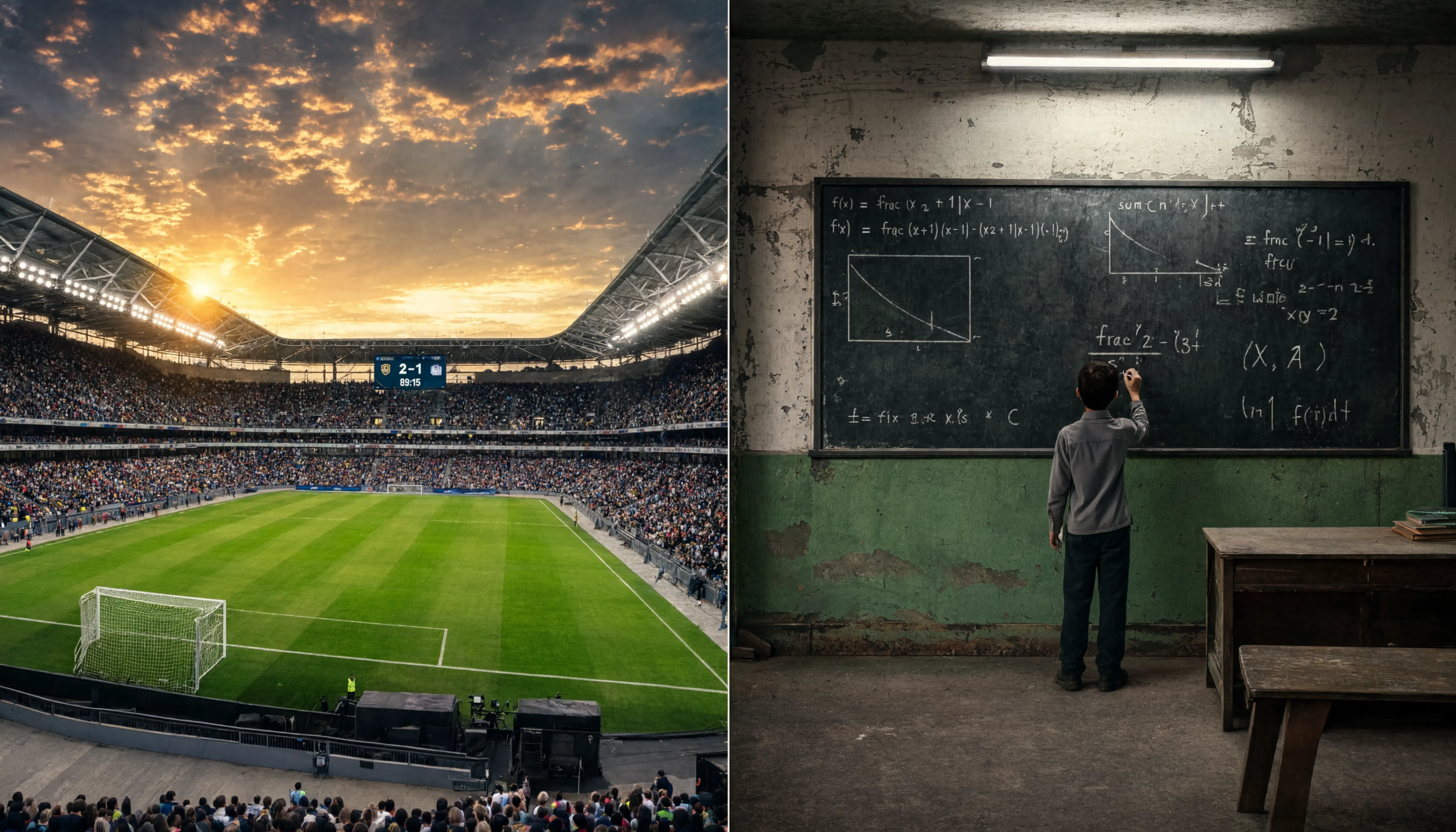
… or how we invented the stigma of intellectual excellence
“You don’t like football? But… why on earth not? Aren’t you patriotic?”
The question lands like an accusation of lèse-majesté. It is June 2026. The FIFA World Cup has just kicked off across the United States, Canada and Mexico, with forty-eight teams instead of thirty-two and one hundred and four matches instead of sixty-four [1]. As it happens, I will not watch a single minute of it. Not as a statement. Not out of fashionable intellectual snobbery. Simply because this sport has never given me the slightest thrill, not since childhood, and I feel absolutely no guilt about that. I genuinely prefer rugby, but that… is another story.
What interests me is not my lack of interest, which is, after all, both ordinary and harmless. What interests me is what happens to the expression on the other person’s face when I admit it. Not the polite bewilderment usually reserved for the mathematician who announces his profession over dinner (see my article on the subject). No, this is something else. A kind of offended disbelief, as though I had just confessed to being indifferent to human rights. People look at me as if I were an eccentric, perhaps even slightly unhinged, simply because I fail to be swept away by eleven men chasing a ball while millions of people scream in unison across different time zones.
And it is precisely in that look of disbelief that the real subject of this essay lies. Not football itself, which deserves neither my contempt nor my admiration. Rather, what football reveals about our time, a society that demands the same emotional devotion from everyone when faced with spectacle, while treating intellectual ambition as a social faux pas. A society that celebrates eleven players with unrestrained passion yet grows uneasy in the presence of a single brilliant mind. A society that has, without ever consciously deciding to do so, turned intellectual excellence into something almost shameful.
For here is the paradox that no parent, no teacher and no newspaper columnist seems willing to confront head on. Spot a ten-year-old child with exceptional football talent, place him in an academy alongside other gifted youngsters, provide him with a dedicated coach, a training schedule worthy of a professional athlete, and regular matches against stronger opponents to accelerate his progress, and everyone applauds. The family talks about him proudly over Sunday lunch. It is seen as proof of “good breeding”, to borrow an expression once reserved for racehorses.
Now propose exactly the same approach for a child gifted in mathematics. Identify him early. Bring him together with other children who think just as quickly. Give him problems worthy of his abilities. Send him to the Mathematical Olympiads to compete against the brightest young minds in the world. Suddenly, the verdict falls, sharp and accusatory: elitism. As though the very same act of identifying talent and nurturing it somehow changed its moral nature simply because it was applied to a brain rather than to a pair of feet. This country embraces excellence of the feet without the slightest hesitation. It is embarrassed by excellence of the mind. The pages that follow will try to understand how we reached that point, and what this embarrassment is costing, in the most concrete sense, an entire nation..
Elitism, the trial of a word
There is something fascinating, almost comical were it not so serious, about the semantic journey of the word elite. Etymologically, it derives from the Latin verb eligere, meaning to choose. An elite is simply a group of people who have been chosen, singled out because they excelled. For centuries, in a France that was by no means an especially egalitarian country, the word carried no negative connotation whatsoever. People spoke without hesitation of the scientific elite, the literary elite, the military elite. The school system of the Third Republic, the one built by the famous Black Hussars of the Republic, embraced its mission without the slightest embarrassment: to identify the brightest children, wherever they happened to be born, and help them rise as far as their abilities could take them. Competitive examinations, those uncompromising moments when candidates were ranked without mercy or excuse, were seen as a promise of equal opportunity, not as a carefully orchestrated humiliation.
Then, within the space of just a few decades, something changed. The word elitism ceased to describe a reality and became a weapon of moral disqualification. We no longer say, this system rewards excellence; we say, this system is elitist. The verdict falls like a guillotine, leaving no need for further argument. Merely uttering the word is enough to end the discussion. In the language of French education and the media, it has become the rhetorical equivalent of accusing someone of racism or sexism: once the label has been applied, the substance of the debate disappears, and only the supposed moral failing of the speaker remains.
This semantic shift did not happen by accident. It was built patiently upon the confusion of two profoundly different realities. The first, which deserves to be fought relentlessly, is elitism by birth: a system that reserves the best opportunities for the children of privileged families regardless of their own abilities. That is a genuine and well-documented injustice, one that deserves every ounce of scrutiny it receives. The second reality, which has gradually been conflated with the first, is the recognition of intellectual merit, the idea that a child who thinks faster, farther and more deeply than his peers has the right to an education commensurate with his abilities, regardless of his social background. These two realities are not merely distinct; they are, in fact, opposites. A genuinely meritocratic society should oppose the first while encouraging the second. By collapsing them into the same word, we have achieved the remarkable feat of discrediting meritocracy in the name of equality, which, upon reflection, is an extraordinary contradiction.
The consequences of this reversal are measurable. Year after year, France stagnates in the OECD’s PISA rankings, slipping to twenty-sixth place in mathematics in the 2022 edition, well behind Singapore, Japan and Estonia [2]. One might expect such a disappointing performance to trigger a nationwide mobilisation, much as an embarrassing sporting defeat would. In reality, it gives rise only to yet another sterile debate about teaching methods, in which every proposal for ability grouping, selective classes or programmes of academic excellence is immediately denounced as a betrayal of the Republican ideal. We have gradually come to prefer a shared failure to an unevenly distributed success. That is, in itself, a perfectly defensible philosophical position. The problem is that no one is willing to defend it in those terms. Instead, it is disguised as pedagogical virtue, when it is in fact a societal choice that we no longer dare to acknowledge.
Because the real issue is not educational. It is psychological and political. To acknowledge that one child thinks faster, farther and more deeply than another of the same age is to accept that inequality exists beyond the parents’ bank accounts, beyond the neighbourhood in which they were born, beyond all the forms of inequality that we have rightly learned to combat. It is to recognise the existence of a more intimate inequality, one rooted in individual ability rather than circumstance, and therefore one that cannot be corrected through redistribution alone. That idea is so profoundly unsettling that we have preferred to invent a shameful word with which to discredit it, rather than learn to live with it and, above all, to nurture it so that it might ultimately benefit everyone, just as the sporting world does without the slightest embarrassment.
Two children, two Frances
Let us now follow our two imaginary children along their respective paths, and see what French society is prepared to offer each of them.
The first, gifted with a football at his feet, is spotted as early as the age of eight or nine by a network of scouts criss-crossing pitches every weekend [3]. By the time he is twelve or thirteen, if his progress continues, he joins one of the training academies accredited by the French Football Federation. There, everything is provided for him: accommodation, meals, tailored schooling, physiotherapists, fitness coaches and a constant renewal of equipment. According to industry estimates, the actual cost borne by the club to develop a single young player is around €35,000 per year [4]. The French Football Federation has announced a major programme to modernise its training centres, and now operates with an annual budget approaching €300 million, including more than €100 million dedicated to supporting amateur football [4]. At no point in this entire process does anyone whisper the word elitism. People speak instead of investment, development and pathways to excellence, and rightly so. This child deserves that support, and if France wishes to produce outstanding footballers, it is perfectly justified in doing so.
The second child, gifted in mathematics, follows a path that seems almost absurd by comparison. If his talent is recognised at all, it is usually thanks to an isolated teacher willing to sacrifice personal time to offer him more challenging problems, or through competitions such as Kangourou or the Coupe Animath, organised at the beginning of the school year. Should he distinguish himself, he may be admitted to the French Mathematical Olympiad Programme (Préparation Olympique Française de Mathématiques, POFM), organised by the Animath association and funded partly by private philanthropy and partly by the Ministry of National Education [5]. Registration for the Coupe Animath, the gateway to this entire pathway, costs between zero and ten euros [6]. Travel, accommodation and coaching for the French delegation competing at the International Mathematical Olympiad are covered by Animath and the Ministry, operating on a budget that has never, at any point in its history, benefited from a multi-year investment plan worth tens of millions of euros [6]. Every year, just six students under the age of twenty represent France, supervised by two delegation leaders who are, more often than not, volunteers or only modestly compensated [7].
The disparity is so striking that it is almost uncomfortable to describe. We are not talking about a modest difference in funding or a gap of a few thousand euros. We are talking about an entirely different order of magnitude, an imbalance in institutional and social recognition that reveals, more clearly than any political speech ever could, what our society truly values, regardless of what it claims to value. Official reports overflow with praise for scientific culture, with declarations about the importance of mathematics for the nation’s future, and with solemn reminders of the need to educate more engineers and researchers. The facts tell a very different story.
The consequences of this imbalance are impossible to ignore. Since 1985, China has won the International Mathematical Olympiad more than twenty times, often with a perfect or near-perfect score across all six problems [8]. France, by contrast, has never surpassed the fifth place it achieved in 1990, when the team included a young Vincent Lafforgue, who would later receive the prestigious Breakthrough Prize, while his brother Laurent would go on to win the Fields Medal in 2002 [9] [10]. Since the year 2000, France’s results have fluctuated between fourteenth and forty-eighth place worldwide, spending most years outside the global top twenty [9]. For a country that likes to present itself as a great scientific nation, heir to Fermat, Galois and Poincaré, such figures ought to be regarded as a national humiliation. They are not. They barely warrant a press release.
France nevertheless boasts an extraordinary record in the Fields Medal, with thirteen laureates, or fourteen depending on how one counts, making it the second most successful nation after the United States [10]. Yet this brilliant legacy conceals a far less flattering reality regarding foundational education and the early identification of talent. These exceptional mathematicians emerged despite the system, or thanks to isolated pockets of resistance, the grandes écoles, the elite preparatory classes, and a handful of outstanding secondary schools, rather than through any coherent national policy designed to detect and nurture gifted children. This is not simply a question of funding, although funding certainly matters. It is a question of perspective. We do not celebrate what we are ashamed to desire. And somewhere along the way, without ever stating it explicitly in any law or official document, France seems to have decided that openly aspiring to the intellectual excellence of its children is somehow embarrassing.
Yet that embarrassment does not prevent the country from celebrating something else with boundless enthusiasm. While it grows suspicious of the child who thinks too quickly, the very same society embraces without hesitation the spectacle that unites, that entertains, that asks nothing more than collective emotion. That spectacle has had the same name for two thousand years.
Bread and circuses, football stadium edition
Two thousand years ago, the Roman poet Juvenal observed, in his Tenth Satire, a people who had stopped demanding political power and had come to ask for only two things: panem et circenses, bread and circuses [11]. He was not condemning entertainment in itself. Rather, he was lamenting a collective surrender: a people who had traded away their sovereignty in exchange for the promise of being fed and entertained, and who seemed, by and large, perfectly content with the bargain.
Twenty centuries later, the phrase has lost none of its diagnostic power, provided we are willing to look honestly at what our modern circuses have become. We have the bread. As for the circuses, we have them in overwhelming abundance, and the 2026 FIFA World Cup is their most spectacular expression: sixteen host cities spread across thousands of miles, packed stadiums spanning an entire continent, and a final scheduled at New York’s MetLife Stadium on 19 July 2026 before tens of thousands of spectators and hundreds of millions of television viewers around the world [12]. It is a spectacle whose power to captivate is unmatched in human history. And like every spectacle of this magnitude, it carries a darker side that we would rather not examine too closely.
That darker side has both a name and official statistics to support it. During the 2024-2025 season, the French Ministry of the Interior recorded sixty-four professional football matches marred by serious incidents, resulting in 627 arrests, an increase of 41% compared with the previous season [13]. Fights outside stadiums, flares thrown onto the pitch, assaults on police officers, pre-arranged clashes between rival supporter groups, discriminatory banners and chants, this has become the now familiar litany surrounding a significant number of matches. On 29 May 2022, following Saint-Étienne’s relegation after a play-off against Auxerre, supporters invaded the Geoffroy-Guichard pitch, causing widespread disorder, extensive damage and injuries, including to police officers [14]. More recently, on 1 November 2024, a violent clash between rival Parisian supporter groups near Stade Charléty left four people stabbed [15]. The list could easily run on for several more pages.
So let us ask the question plainly, without indulging either side. Has France ever witnessed angry mathematicians vandalising public property because the national team finished only thirtieth at the International Mathematical Olympiad? Have there ever been academic “ultras” assaulting police officers because they were disappointed by a ranking? The question is absurd, and that is precisely what should concern us. This kind of collective violence, born not from individual failure but from tribal identification with a result over which the crowd itself has no control, has become such an ordinary social fact that we have accepted it as the normal price to pay for the pleasures of mass entertainment. Meanwhile, we continue to worry that a child who enjoys mathematics a little too much might somehow “struggle to fit into society.”
None of this is an argument for abolishing football, nor even for denying the immense and entirely legitimate pleasure it brings to the overwhelming majority of those who follow it without ever smashing a shop window. The point is simply to name, without hypocrisy, what Juvenal identified two thousand years ago: a society that tolerates, with barely a shrug, organised violence surrounding a game, while displaying extraordinary caution, almost embarrassment, whenever it comes to celebrating a child who thinks faster than everyone else. Somewhere along the way, we have reversed the hierarchy of what we consider scandalous.
“It’s the taking part that counts”, an autopsy of a loser’s motto
There is a phrase that resurfaces at the beginning of every school year, during every tense parent-teacher conference, whenever a parent dares to worry about their child’s academic performance: It’s the taking part that counts. It is most often, and quite mistakenly, attributed to Baron Pierre de Coubertin, who is said to have uttered it at the opening of the 1908 Olympic Games. In reality, the original wording comes from a sermon delivered by the American bishop Ethelbert Talbot of Pennsylvania during those very Games, at a service held in St Paul’s Cathedral in London. Coubertin merely repeated and popularised the idea in his own writings, where it carried a rather different meaning from the one we give it today. Its original purpose was to defend the amateur ideal against the growing professionalisation of sport, not to comfort those who had lost [16].
Its precise origin ultimately matters very little. What is striking is where this phrase has ended up taking root: nowhere in elite sport, and almost everywhere in the discourse surrounding education. Try telling a national football manager, moments after losing a World Cup final, that what really mattered was taking part. He would look at you as though you had arrived from another planet. No professional club celebrates relegation. No Olympic athlete proudly tells their family they finished last but that being there was what truly mattered. Competitive sport, wherever glory and money are at stake, rests upon a ruthless hierarchy that is openly embraced and celebrated. There are winners, and there is everyone else, and nobody finds that remotely shocking.
Yet it is precisely this same phrase, It’s the taking part that counts, that has become the unspoken doctrine governing part of the French education system whenever the hierarchy concerns minds rather than muscles. Numerical grades are replaced by broad assessments of “competencies”, simply marked as achieved or not achieved, with little meaningful distinction. Schools hesitate to publish class rankings. Kindness is invoked to justify a refusal to assess pupils with genuine precision. School reports are carefully worded so as never to tell a child outright that they are exceptional, for fear that the pupil sitting next to them, who is not, might feel diminished.
The inconsistency is breathtaking, and yet almost no one seems troubled by it. We maintain, without the slightest hesitation, an unforgiving and heavily publicised ranking system to separate eleven footballers from another eleven. At the same time, we worry with almost pathological concern that an academic ranking might somehow “damage a child’s self-esteem.” The famous consolation offered to losers has never, in truth, comforted a single defeated athlete. Its only enduring casualty over the past few decades has been the child who desperately needed someone to tell him, plainly and without embarrassment, that he was the best mathematics student in his class, and that he had every right to be proud of it.
Before concluding that sport has nothing to teach us, however, intellectual honesty demands a concession. The opposing argument is not without merit. When people say that sport is a school of life, they are not speaking nonsense. On the contrary, they are saying something profoundly true. The real question is whether that truth justifies forgetting everything else.
Sport as a school of life, no really
There is, however, something profoundly true in the claim that sport is a school of life, and it would be foolish to dismiss it out of hand. Competitive sport, when pursued seriously, teaches lessons that traditional schooling often struggles to impart. It teaches defeat, first and foremost. Not the softened, sanitised defeat wrapped in kindness and comforting words until every trace of pain has disappeared, but defeat in its rawest form, the kind that hurts, that forces you to look yourself in the mirror and decide whether you will return to training the next morning or stay at home nursing your disappointment. It teaches sustained effort, that increasingly rare quality in a world obsessed with instant gratification. It teaches a relationship with the body, with pain, with physical limits, and with the possibility of pushing those limits through nothing more than discipline, determination and method. Finally, it teaches a form of respect for one’s opponent that has nothing to do with superficial courtesy. You respect someone you have tried to defeat with every ounce of your strength, and who has defeated you with every ounce of theirs.
All of this is real, and it deserves to be acknowledged without reservation. A child who has learned to lose on a sports field, to get back up, and to resume training without complaint possesses invaluable mental equipment for facing the challenges of adult life. They have learned that results are the consequence of effort, not luck or the goodwill of others. They have learned that complaining never changes the score. In short, they have learned what the ancient Greeks called askesis: disciplined practice, the repeated and voluntary effort through which both body and mind are transformed.
But here is what the “sport as a school of life” argument almost always forgets to mention: every one of these virtues, without exception, is equally cultivated in a child who trains seriously for competitive mathematics. A student preparing for the Mathematical Olympiad spends hours wrestling with problems that resist every attempt to solve them, that stubbornly refuse to yield, that appear impossible until, sometimes after days of effort, the solution suddenly emerges. They learn to work in uncertainty, to resist the temptation to give up at the first obstacle, to return again and again to a line of reasoning that seemed exhausted. They learn absolute rigour, the kind that tolerates no approximation and no “close enough”, because in mathematics a proof is either correct or it is not, and there is no indulgent jury willing to award points for style. They, too, learn how to lose: to watch classmates solve a problem they could not solve themselves, to measure the gap between what they know and what they have yet to learn, and to transform that realisation into motivation rather than discouragement.
The difference between these two paths therefore lies not in the virtues they cultivate, but in the way society chooses to regard them. One is celebrated, generously funded, extensively covered by the media and held up as a model of personal development. The other is tolerated, chronically underfunded, largely ignored by the media and treated with a kind of polite embarrassment, as though intellectual excellence were an eccentricity best left quietly alone, lest too much encouragement produce an antisocial child.
The formative virtues are, therefore, identical on both sides. Yet one important difference remains. It is not a difference of character, but of collective emotional power. And that difference deserves to be confronted honestly rather than denied.
The new monopoly on collective pride
At this point in the argument, it would be intellectually dishonest to claim that football and mathematics offer exactly the same experience, or that all we need to do is “rebrand” mathematics to generate enthusiasm comparable to that of a World Cup. That would be both a flawed analysis and a flawed method.
Football possesses something that mathematics, at least in its current form, will probably never be able to offer: immediate identification, requiring no prior effort of understanding. Anyone, regardless of educational background, native language or social origin, can grasp within seconds what is at stake when a goal is scored in the eighty-ninth minute. The rules are simple, the narrative is universal, the emotion is instantaneous and, above all, it is experienced collectively, at exactly the same moment, by millions of people gathered around the same television screens or inside the same stadiums. This simultaneity creates a form of shared communion that no intellectual discipline, by its very nature slower, more solitary and more demanding of sustained attention, is ever likely to reproduce on the same scale. When the national team wins, an entire country pours into the streets that very evening, and there is something genuinely beautiful about that shared outpouring of joy. To deny it in the name of some form of intellectual purism would be both misguided and rather joyless.
But acknowledging this unique quality of sport should never automatically imply the symmetrical devaluation of everything that fails to generate the same kind of immediate emotional communion. And yet this is precisely where our collective reasoning goes astray. Somewhere along the way, without ever saying so explicitly, we came to believe that there was room for only one source of national pride, and that sport had claimed that space once and for all. Anything aspiring to stand alongside it, without possessing the same instant emotional appeal, came to be regarded as pretentious, almost as an illegitimate rival.
Yet nothing compels us to choose between these two forms of collective pride. A nation can celebrate its footballers on the evening of a great victory and celebrate, with a different but equally sincere intensity, its young mathematicians returning home with medals from the International Mathematical Olympiad. The problem is not that football can unite an entire nation in the space of ninety minutes. The problem is that, in France, nothing else enjoys the same social permission to unite people in its own way, however modestly, however quietly, however gradually. Collective pride is not a scarce resource that must be rationed. It is a muscle that grows stronger the more often it is exercised, and it can be exercised on many fronts at once. Other countries understood this long before we did, and they have not suffered for it. If anything, by many measures, they seem to be flourishing because of it.
The countries that don’t have this problem
The contrast becomes particularly revealing when we look at how other countries treat their young mathematical prodigies, not on the margins, not with polite embarrassment, but squarely in the spotlight.
Hungary, for example, possesses a long-standing and deeply respected mathematical tradition. As early as 1894, it established the Eötvös Competition, widely regarded as the first mathematical olympiad of the modern era [17]. That tradition helped produce figures such as Paul Erdős and George Pólya, and the country continues to regard excellence in mathematics as an integral part of its intellectual heritage. It is no accident that Hungary, a nation of just ten million people, has produced an astonishingly disproportionate number of world-class mathematicians. Nor is it the product of any peculiar genetic advantage, despite the irresponsible suggestions that have occasionally been made to that effect. It is the result of a culture, a well-structured system of competitions, and a social commitment to intellectual excellence that stretches back more than a century.
In Vietnam, when the national team wins medals at the International Mathematical Olympiad, the achievement is greeted with genuine national pride. In 2025, the Vietnamese delegation won two gold medals, three silver medals and one bronze, securing a place in the world’s top ten, a result widely celebrated by the national press and educational institutions alike [18]. This is far more than an anecdote. It is evidence of a country that believes a teenager capable of solving, in four and a half hours, problems that most university professors would struggle even to approach deserves to be recognised and celebrated every bit as much as a footballer scoring the winning goal. Vietnam, whose income per capita is only a fraction of France’s, invests in identifying and nurturing young mathematical talent with a consistency and seriousness that France has never managed, or perhaps never truly wished, to emulate.
Since the 1990s, South Korea has built an entire system for identifying and training gifted young mathematicians, enabling it to finish regularly among the top three nations in the world. In 2022, it placed second overall, behind only China [9]. The country presents its Olympiad results as an indicator of the future strength of its scientific research. China, for its part, has won the competition on numerous occasions, often achieving perfect or near-perfect scores across all six problems [8]. It is difficult to imagine such achievements passing there without significant media attention or public recognition.
Even Australia, a country more readily associated with surfing and rugby than with mathematics, has managed to build part of its national narrative around the discipline. Terence Tao, now widely regarded as one of the greatest living mathematicians and himself a Fields Medal laureate, won his first bronze medal at the International Mathematical Olympiad at the age of ten in 1986, followed by silver at eleven and gold at thirteen in 1988 [19]. His story is now told, studied and held up as an example throughout his home country, without anyone seeing it as evidence of some shameful elitism. On the contrary, it is regarded as a source of legitimate national pride, much like the pride France reserves almost exclusively for its sporting champions.
None of these countries has abandoned sport in the process. South Korea, which consistently excels at the Mathematical Olympiad, also shines at the Summer Olympic Games, finishing eighth in the medal table at the Paris 2024 Olympics with thirty-two medals, including thirteen golds [20]. In these countries, national pride is not treated like a cake that must be sliced into ever smaller pieces. It is an appetite that feeds upon itself, growing stronger each time it is given another reason to express itself.
One uncomfortable question therefore remains, perhaps the most uncomfortable of all, and one that official speeches about France’s scientific ambitions carefully avoid. If other countries achieve better results with fewer resources, what does that reveal about our own priorities? The answer, as always, lies in the numbers.
What it really costs
At some point, we need to talk about money. Not because money is the only measure of value, but because, in any society, it is the clearest indicator of what that society has chosen to regard as important.
Every year, France spends vast sums on elite sport. The INSEP, France’s National Institute of Sport, Expertise and Performance, hosts more than 776 elite athletes at its Paris facilities, supported by a permanent staff of around 300 people [21]. National sports federations receive substantial public funding. Local authorities invest several billion euros annually in sports infrastructure. All of this is entirely legitimate: elite sport represents an investment in public health, international prestige and social cohesion.
Yet the very same country, which spares no expense in sending athletes to the Olympic Games, leaves an organisation such as Animath to prepare France’s young mathematicians for the International Mathematical Olympiad largely through private philanthropy and the volunteer commitment of a handful of enthusiasts [5]. The association’s published accounts provide a revealing sense of scale. In 2022, Animath’s total budget, covering all of its activities, amounted to approximately €384,000, of which €275,000 came from public grants [22]. Within those grants, the contribution from the Ministry of National Education (DGESCO) amounted to just €24,000, while Jane Street, an American financial firm, contributed €30,000 specifically to support the French Mathematical Olympiad Programme (POFM) [22]. The budget allocated to Olympiad training camps and competitions that same year stood at roughly €86,000, less than 0.03% of the French Football Federation’s annual budget, which is close to €300 million [4] [22]. These figures are never highlighted, never placed in context, never presented as indicators of public policy. That, in itself, tells a story.
Some will argue that comparing two disciplines with such different cost structures is inherently unfair. Training a professional footballer requires pitches, equipment, medical staff and residential facilities. Training a young mathematician requires little more than a pencil, a sheet of paper and an outstanding teacher. That is true. Yet that very observation should lead us to precisely the opposite conclusion from the one usually drawn. If developing a gifted young mathematician is structurally far less expensive than developing a gifted young footballer, then the lack of investment cannot reasonably be explained by budgetary constraints. It is a choice. A choice not of inability, but of unwillingness.
The consequences of that choice extend far beyond the International Mathematical Olympiad. France faces a shortage of researchers in both pure and applied mathematics. It lacks enough engineers capable of tackling the most demanding challenges in artificial intelligence, cryptography and climate modelling. More broadly, it lacks a culture of difficult problems, the habit of sitting down in front of something that resists every attempt to solve it and refusing to walk away until the solution has been found. That culture could have been cultivated from childhood, by recognising those who possess it naturally and teaching it to those capable of acquiring it. Instead, for decades, we have preferred to ensure that no one feels excluded by lowering intellectual expectations, even as we relentlessly raised sporting ones. The consequences are visible everywhere: in the PISA rankings, in the recruitment difficulties faced by France’s technology sector, and in the steady exodus of talented minds toward countries that place a higher value on what they have to offer.
Meanwhile, the spectacle goes on. And there is no denying its grandeur.
Silence after the roar
The final of the 2026 FIFA World Cup will be played on 19 July at New York’s MetLife Stadium before tens of thousands of spectators and hundreds of millions of television viewers spread across every time zone on the planet [12]. That day, entire avenues in cities around the world will be closed to traffic, either to accommodate celebrations or to contain the unrest that sometimes accompanies them. Images of the match will loop endlessly across television screens for weeks. It is a spectacle of such extraordinary power that nothing in the world of ideas can hope to compete with it head-on, and nothing in this essay has suggested otherwise.
Earlier that same year, however, in the silence of an examination hall in Shanghai, six French teenagers will have spent nine hours over two days wrestling quietly with mathematical problems that no television camera will record, before a jury whose members almost no one knows, competing for a ranking that scarcely any French media outlet will bother to mention [7]. If they win a medal, the news will occupy a few short lines, buried somewhere between a local news story and the weather forecast. If they fail, as has so often been the case over the past twenty-five years, to rise above twentieth or thirtieth place in the world, where France has most frequently found itself during that period, occasionally slipping as low as forty-eighth, no one will express outrage. We are outraged only by the disappointments we expect. And clearly, we expected nothing.
This is not a plea for those six teenagers to become media celebrities on a par with the star strikers of the World Cup, nor is it a demand that they receive million-euro training budgets. Mathematics neither needs nor would probably welcome that kind of attention. The point is simply to stop being ashamed. To stop using the word elitism as an insult every time someone suggests helping a gifted child become even better. To understand that when Juvenal coined his famous phrase two thousand years ago, he was not condemning the pleasures of entertainment but the willingness of a people to surrender their freedom to think and to act. Twenty centuries later, the screen before which we sit, hypnotised, is merely the modern incarnation of that same surrender.
It also means, and perhaps above all, recognising that the two children introduced at the beginning of this essay, the one chasing a football and the one solving equations, are not rivals. They are two expressions of the same national ambition. A country capable of supporting both with equal pride and equal generosity is a country that has understood something fundamental about itself. France possesses the intellectual resources to excel in both arenas. For now, it has chosen to embrace only one of them. That choice is not inevitable. It is simply a habit. And habits, unlike talents, can be changed.
The day France demands for its brightest minds the same unapologetic right to excellence that it grants, almost without thinking, to its fastest feet, it may finally achieve something that no World Cup victory, however glorious, could ever provide: the pride of no longer being ashamed of thinking. Until that day comes, it will continue to produce world champions while watching its Nobel laureates build their futures elsewhere, and every autumn it will continue to wonder why the latter chose other countries to call home.
Références
For meticulous minds, lovers of figures and sleepless nights spent checking sources, here are the links that informed this article. They’re a reminder of one simple thing: information still exists, as long as we take the time to read it, compare it, and understand it. But in the near future, that simple act may become a luxury, because as texts generated entirely by AI multiply, the real risk is no longer disinformation, it’s the dilution of reality in an ocean of merely plausible content.
[1] FIFA, Coupe du monde de football 2026, format et calendrier. https://www.fifa.com/fr/tournaments/mens/worldcup/canadamexicousa2026
[2] OCDE, Résultats du PISA 2022 (Volume I) : Résultats des élèves en compréhension de l’écrit, en mathématiques et en sciences. https://www.oecd.org/fr/publications/resultats-du-pisa-2022-volume-i_165f1d07-fr.html
[3] Fédération Française de Football, Les centres de formation agréés. https://www.fff.fr/97-les-centres-de-formation-agrees.html
[4] Fédération Française de Football, Le budget et les chiffres clés 2024-2025. https://www.fff.fr/80-le-budget-et-les-chiffres-cles.html
[5] Animath, Préparation Olympique Française de Mathématiques (POFM). https://maths-olympiques.fr/
[6] Ministère de l’Éducation nationale, Les Olympiades nationales et internationales de mathématiques. https://www.education.gouv.fr/les-olympiades-nationales-et-internationales-de-mathematiques-465801
[7] IMO 2026, 67th International Mathematical Olympiad, Shanghai. https://www.imo2026.com/
[8] IMO Official, CHN — Team Results (People’s Republic of China). https://www.imo-official.org/results/team/country/CHN/
[9] IMO Official, FRA — Team Results (France). https://www.imo-official.org/results/team/country/FRA/
[10] Ministère de l’Enseignement supérieur et de la Recherche, Médaille Fields. https://www.enseignementsup-recherche.gouv.fr/fr/medaille-fields-86509
[11] Juvénal, Satires, Livre X, vers 77-81 (éd. Loeb Classical Library). https://www.loebclassics.com/view/juvenal-satires/2004/pb_LCL091.373.xml
[12] MetLife Stadium, FIFA World Cup 2026 Final, 19 juillet 2026. https://www.metlifestadium.com/events/detail/fifa-world-cup-2026-final
[13] Sénat, Question écrite n° 250404123 — Violence dans le football professionnel (saison 2024-2025). https://www.senat.fr/questions/base/2025/qSEQ250404123.html
[14] Le Monde, Barrage Ligue 1-Ligue 2 : débordements après la défaite de Saint-Etienne face à Auxerre, 29 mai 2022. https://www.lemonde.fr/football/article/2022/05/29/barrage-ligue-1-ligue-2-debordements-apres-la-defaite-de-saint-etienne-face-a-auxerre_6128115_1616938.html
[15] TF1 Info, Quatre blessés au couteau dans une rixe entre supporters du Paris FC, 2 novembre 2024. https://www.tf1info.fr/justice-faits-divers/quatre-blesses-au-couteau-dans-une-rixe-entre-supporters-football-du-paris-fc-ligue-2-sept-interpellations-2331925.html
[16] Mairie de Paris, À l’origine des Jeux olympiques, Pierre de Coubertin. https://www.paris.fr/pages/a-l-origine-des-journees-olympiques-pierre-de-coubertin-4888
[17] Digital Commons (Sacred Heart University), Mathematical Competitions in Hungary: Promoting a Tradition of Excellence. https://digitalcommons.sacredheart.edu/cgi/viewcontent.cgi?article=1004&context=math_fac
[18] VietnamPlus, Vietnam shines in top 10 at International Math Olympiad 2025. https://en.vietnamplus.vn/vietnam-shines-in-top-10-at-international-math-olympiad-2025-post323010.vnp
[19] Wikipédia, Terence Tao. https://fr.wikipedia.org/wiki/Terence_Tao
[20] Le Monde, Corée du Sud : tableau des médailles aux JO de Paris 2024. https://www.lemonde.fr/sport/jo-2024/medailles/coree-du-sud/
[21] INSEP, Présentation de l’Institut national du sport, de l’expertise et de la performance. https://www.insep.fr/fr
[22] Animath, Rapport d’activité et rapport financier 2022, présenté en assemblée générale le 9 juin 2023. https://www.animath.fr/wp-content/uploads/2023/06/PV_AG_Animath_09-06-2023-annexes.pdf