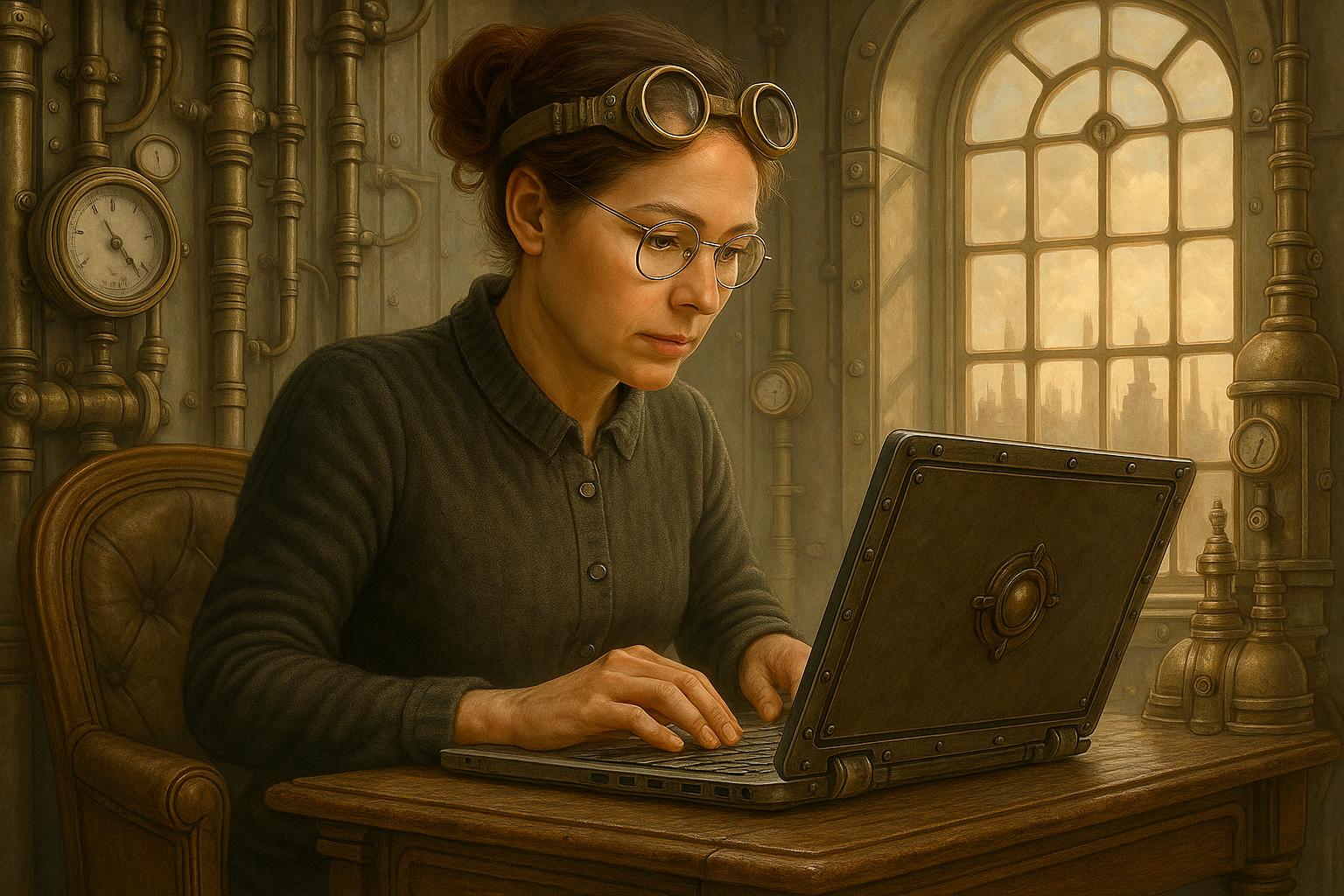
This narrative was designed as a five-stage journey, each exploring a facet of the silent revolution that ChatGPT unleashed. Each episode, a new part will enrich this exploration, like an episode in a series where technology and humanity discover each other. Take the time to read, reflect, and above all… imagine what comes next.
Foreword
In this short essay, technical fragments and dialogue intersect. The conversation between Ada, an artificial intelligence, and Cerise, a young Parisian developer, is not a literary device but a simple conviction: we only truly understand what we can explain clearly.
Ada bears the name of Ada Lovelace, pioneer of algorithms before machines even existed. Cerise, my 17-year-old daughter, embodies this generation born with AI, capable of intuitively grasping its mechanisms where we laboriously analyze them.
Their exchanges pose the real stakes of this revolution: not the opposition between human and machine, but the emergence of an unprecedented collaboration. This fiction illuminates reality by making us participants in the transformation. Because it’s often by lending a voice to the machine that we better hear what it says about us.
The Day Everything Changed
In her Parisian office bathed in the autumn light of November 2022, Cerise interrupts her reading of a technical article on the latest advances in artificial intelligence. A notification blinks on her screen: “New system available, ChatGPT“. She furrows her brow, intrigued by this name she’s never heard before.
“Another new chatbot,” she murmurs while opening the interface. But from her very first question, something strikes her. The response that appears is nothing like the rudimentary virtual assistants she knows. It’s fluid, nuanced, almost… human.
“Can you explain neural networks using a culinary metaphor?” she types, out of curiosity.
The response that appears leaves her stunned. Not only does the AI understand her request, but it develops a sophisticated analogy between neural layers and the stages of a complex recipe, explaining how each informational “ingredient” progressively transforms until the final “dish” of understanding.
Cerise remains silent for a long moment, staring at the screen. Without knowing it, she has just lived through one of the first moments of this revolution that will transform the world. In a few months, she will christen this AI “Ada”, and their collaboration will redefine her understanding of intelligence itself.
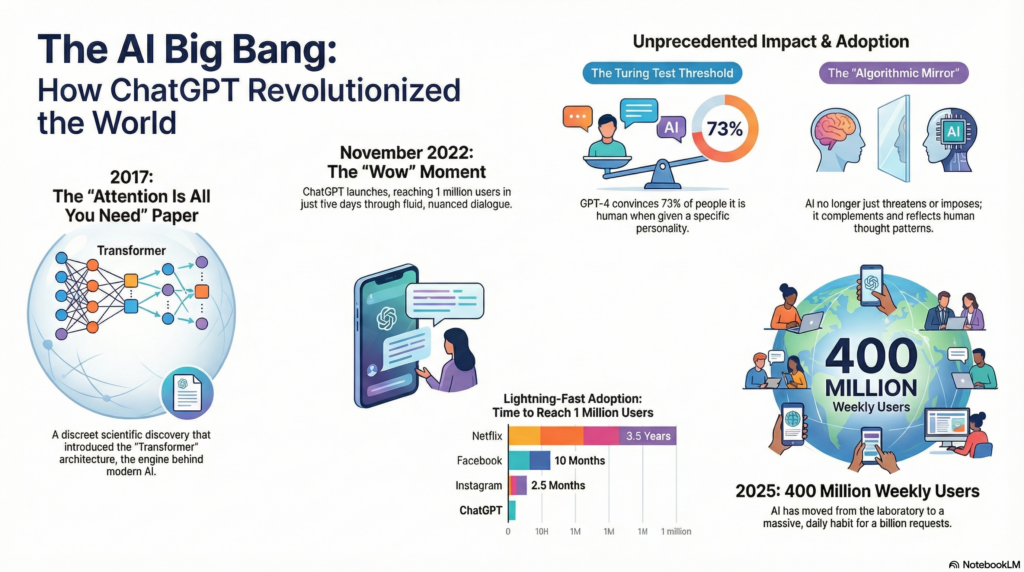
Paris, November 2022. In a modest office in San Francisco, a team of engineers presses a button that will change the course of human history. ChatGPT has just been born, and in only five days, it conquers one million users. What took months for Facebook, years for Netflix, happens in less than a week. Humanity has just crossed an invisible but decisive threshold: for the first time, a machine converses with us in our own language, with an ease that defies comprehension.
Today, two and a half years later, we live in a transformed world. 400 million people use ChatGPT every week. Middle schoolers generate essays with a sophistication that troubles their teachers, developers code in tandem with an artificial intelligence that understands their intentions halfway through, executives consult their virtual assistant before making strategic decisions that shape their companies’ futures. We are witnessing the democratization of artificial intelligence, a turning point as fundamental as the invention of the printing press or the arrival of the Internet, but infinitely more dizzying.
But here’s a lesser-known aspect of this revolution: this transformation already upending our lives rests on a discovery only eight years old, ignored for months by most experts. An innovation so seemingly simple that its own creators probably didn’t immediately grasp that they had just changed the course of human history.
This silent revolution is redrawing the contours of our civilization at a speed that leaves us breathless. The implications extend far beyond the technological realm: it’s our relationship to knowledge, to creativity, to intellectual work that finds itself upended. When a recent study reveals that GPT-4 convinces 73% of people that it’s human when given a personality, we cross the famous Turing Test, that symbolic frontier where the artificial becomes indistinguishable from the natural.
The “Wow” Effect and Its Misunderstandings
There’s something troubling about that silence following a perfect answer. A question asked hastily, an intuition barely formulated… and the machine responds. Not just correctly, but with elegance. Nuance. Style. We reread. We freeze. We whisper: “Wow.”
This suspended moment, this technological thrill, we’ve all experienced it. And with it, a question surfaces, first timid then obsessive: What remains of us, if a machine can think like that? It’s a question only science fiction writers dared ask. Today, it invites itself into classrooms, open offices, consulting firms, kitchens.
But this illusion of human thought rests on a technology few understand. Behind the fluidity of responses hide two acronyms as discreet as they are formidable: Transformers and Large Language Models (LLM). Two arid terms, almost bureaucratic, yet now governing an ever-growing part of our mental daily life.
And yet, forget HAL 9000. Forget Terminator. Today’s AI doesn’t watch you with threatening red eyes. It has no arms, no face, no metallic voice. It’s everywhere and nowhere, subtle and elusive.
It doesn’t conquer. It charms. It doesn’t threaten. It understands. It doesn’t impose itself. It completes. It’s no longer a machine. It’s an algorithmic mirror. And what it reflects, sometimes, resembles what we wanted to say… without knowing how.
What We Thought We Saw… But Didn’t Exist
How can a machine write like Hemingway, code like a senior developer, reason like an experienced lawyer? How can it seem to understand our emotions, our implications, our most subtle cultural references? Even more troubling: how can it sometimes surprise us with unexpected connections, brilliant analogies, creative solutions we hadn’t thought of?
This revolution didn’t happen by chance. It rests on a major scientific discovery from 2017, as discreet as it was revolutionary: the Transformer architecture. A seemingly innocuous paper, titled “Attention Is All You Need”, upended artificial intelligence and, by extension, our entire world. Its authors, Google researchers working in the shadows of the spotlight, probably didn’t suspect they had just written one of the most important texts in modern technological history.
In what follows, I propose a journey to the heart of this technology, explained as Richard Feynman would have done: simply, clearly, without unnecessary jargon but without sacrificing depth. Because understanding these mechanisms is no longer an intellectual luxury reserved for the initiated, it has become a civic necessity in a world where AI already shapes our daily lives, influences our decisions, and draws the contours of our collective future.
When a Machine Imitates Us Better Than We Do Ourselves
It only took five short years. Only five years between the discreet publication of an academic paper with an innocuous title, Attention Is All You Need, and the appearance of a planetary phenomenon capable of troubling teachers, lawyers, executives, and middle schoolers. A blink of an eye on the scale of civilizations. A technical flash that became a social shockwave.
A Timeline as Brief as It Is Dizzying
- 2017 — A technical paper invents the Transformer architecture. Little noise, not yet any fury.
- 2018-2022 — The first models flourish in the shadows. GPT-1, 2, 3… like so many stones thrown into a still-quiet lake.
- November 2022 — ChatGPT enters the scene. The world will never quite be the same.
- 2023-2025 — AI becomes a tool, then a partner, sometimes even a mirror.
- 2030+ ? — And then? Nobody knows. Some see the dawn of general intelligence. Others, the beginning of a permanent misunderstanding.
What this timeline reveals is an unprecedented acceleration. In the history of human inventions, never has a technology colonized our practices with such rapidity. What once took generations now counts in quarters.
A Lightning Adoption
In November 2022, ChatGPT appears. Five days later, it crosses the threshold of one million users. A surge that would make the greatest digital successes pale:
- Spotify: 5 months
- Instagram: 2.5 months
- Facebook: 10 months
- Netflix: 3.5 years
Five days. The time of a November long weekend, a cancelled meeting, an extended break. The entire world discovers it can talk to a machine… and that this machine responds better than its colleague.
In May 2025, the figure is staggering: 400 million weekly users, 122 million daily, over one billion daily queries. People talk to ChatGPT like asking the time, like searching for a recipe, like expressing doubt, anger, intuition.
The machine has entered our thoughts. Discreetly. Massively. It’s no longer a laboratory. It’s a habit. One of those we no longer notice, so embedded are they in the invisible fabric of daily life.
In the next episode, a strange complicity will emerge between Cerise and Ada. Not that of a tool and its user, but of a tandem learning to think together. And what you thought you knew about intelligence might just waver.