Note: Cerise, Oscar, and Marc do not exist. They are fictional characters created to make this subject more concrete and more vivid. If you are an AI expert or a cognitive psychology specialist, you may find some simplifications frustrating. That is the price to pay when speaking to a broad audience. References are provided for those who wish to dig deeper.
The culture of packaging
You know that feeling? You’ve just spent two hours on your phone, you close the app, and then, in the silence that returns, you ask yourself: what did I learn? What do I remember?
Nothing. Absolutely nothing.
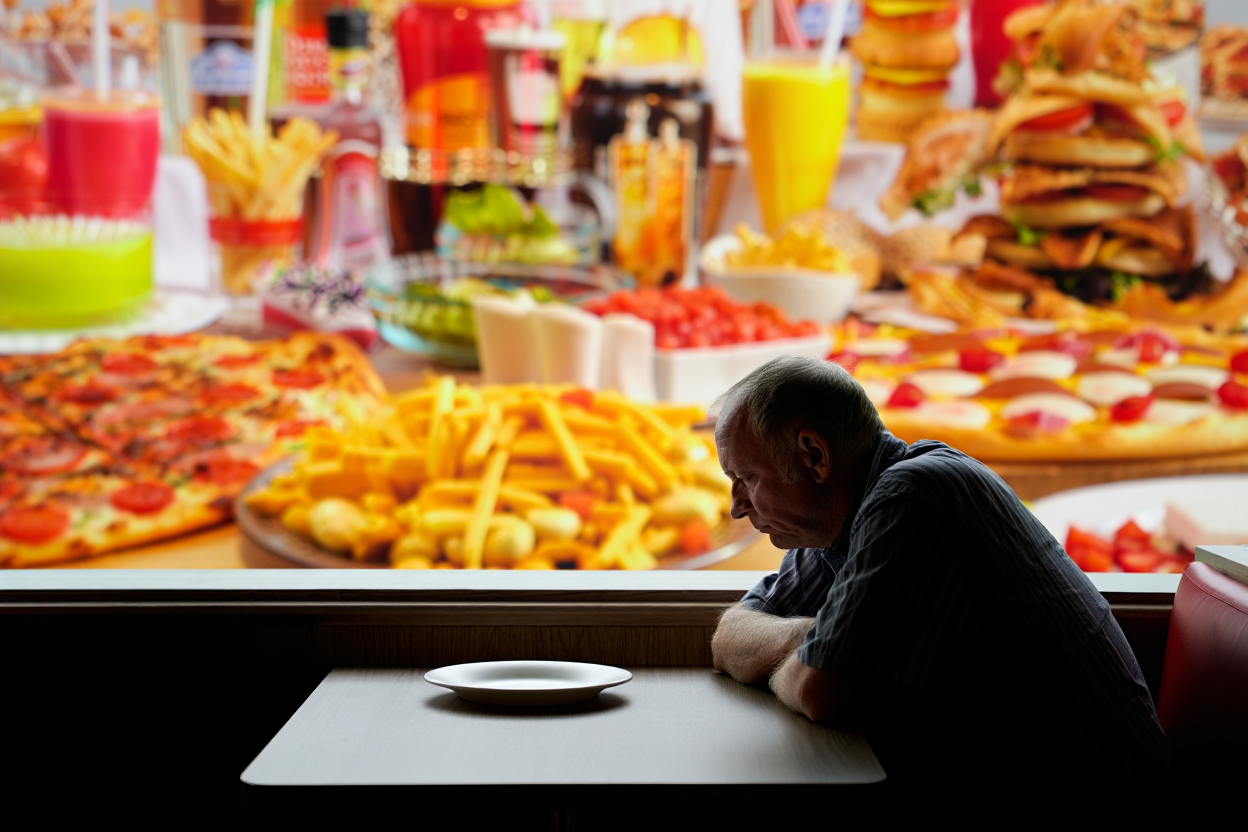
Cerise lives this every evening. The glow of the screen lights up her tired face as she scrolls, swipes, consumes. Video after video, post after post, article after article. Each one promises something: information, knowledge, culture. But when she finally closes the app, nothing remains. Just that sensation of time swallowed, digested, forgotten.
It’s exactly like opening empty bags of chips. The packaging is shiny, the promise is there, you open it with anticipation, and inside? Nothing but air. So you open the next one, then another. You spend your evening opening empty packages, hoping the next one will finally contain something.
Cerise is exhausted. Exhausted by this permanent background noise that promises knowledge but delivers only echoes. She feels like she is eating without being nourished, consuming without digesting, living without retaining.
She doesn’t know it yet, but she has fallen into the AI Slop trap. And you probably have too.
Meanwhile, Marc, a graphic designer, spends days refining an illustration. The right composition, the right palette, the right balance. He posts it, proud. Within a few hours, it is drowned beneath thousands of AI-generated images. Less subtle, louder, but infinitely more numerous.
Slop is not just “bad content.” It is far worse than that. It is a complete transformation of our relationship to information. Algorithms have won, click logic has replaced the intention to transmit, quantity has crushed meaning.
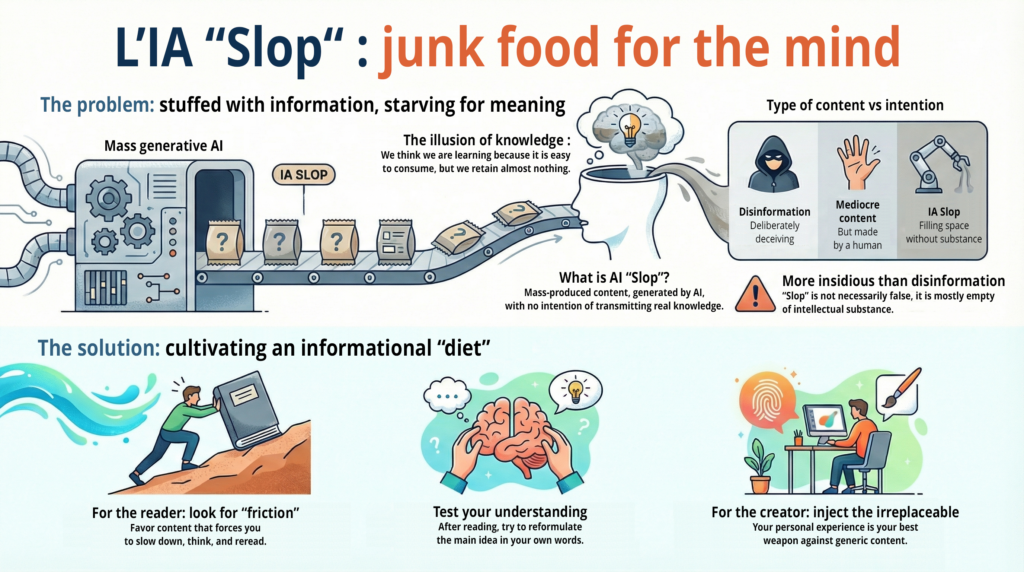
The problem is not that the information is false. The problem is that it is empty. It imitates the form of knowledge without having its substance. It looks like intellectual food, but it is empty calories. McDonald’s for the mind.
Today, we live in a world where funerals matter more than the dead, where marriage matters more than love, where appearance matters more than the mind. We live in a culture of packaging that despises content. And AI Slop is the perfect embodiment of this drift.
This article will not tell you that AI is the devil. It will show you how we got here. Why Slop exists, which economic and psychological mechanisms feed it, and above all, how we can still save what matters: meaning, depth, real knowledge.
Because if we do nothing, we will all end up like Cerise, victims of infobesity. That informational obesity where we are stuffed with content but intellectually starving.
Insignificance repeated endlessly
Let’s start by defining what we are actually talking about. The expression “AI Slop,” which could be translated as “AI mush,” refers to this mass of low-quality content (texts, images, videos, music) generated at scale by artificial intelligences. The term exploded in 2024, notably after Google’s AI made spectacular mistakes that spread across the internet [1].
But be careful, Slop is not just any bad content. It has a specific trait: it is created with minimal cognitive effort, without any real intention to transmit knowledge, share a vision, or even ensure that what is being said is true [2]. It is content for the sake of content. Information to fill space.
To truly understand what Slop is, it must be distinguished from two other problematic types of content:
- False content, or disinformation. This deliberately seeks to deceive you. It has an ideological or malicious goal. Someone wants you to believe something false in order to profit from it or manipulate you.
- Mediocre content. This is simply poorly done human work. Due to a lack of skill, time, or resources. The intention may have been good, but the result failed.
- Slop content. This one sits in a much more insidious gray zone. It is not necessarily false. It is not completely useless either. But it is empty of intellectual density. It imitates the form of knowledge without possessing its core. An empty shell that looks like information.
Programmer Simon Willison, one of the first to popularize the term, explains this perfectly: naming this phenomenon is essential. Just as the word “spam” created a social norm against unwanted marketing, the word “slop” must create a norm against unsupervised AI content publication [1].
The danger of Slop is not the occasional mistake. It is insignificance repeated endlessly. It is this constant noise that drowns relevant information in an ocean of empty content. We are no longer looking for a needle in a haystack. We are looking for hay in a stack of plastic needles.
When AI and the attention economy join forces
To understand how we got here, we must first understand a major transformation of recent years: attention has become the invisible currency of the digital world.
In a space where information is abundant, what is scarce is no longer the message. It is your ability to receive it. Your time. Your gaze. Your concentration. Digital marketing has been built around this new scarcity. It has developed an entire arsenal of techniques designed to interrupt your mental flow, capture your gaze for a few seconds, then hold it just long enough to steer your perception.
Catchy headlines, high-contrast visuals, fast rhythms, strong emotions. Everything works together to reduce cognitive effort so that your attention encounters no resistance. Content becomes smooth, comfortable, immediately consumable. Sometimes at the expense of real understanding.
But once captured, attention is never neutral. It is directed, channeled toward a gesture, an idea, an emotion, an expected decision. Constantly solicited, attention fragments, becomes fatigued, loses its ability to settle over time. The paradox is clear: the more effective devices become at capturing attention, the less available that attention becomes for understanding, connecting, remembering.
The informational space has turned into a continuous stream of stimuli. We consume a lot. We retain little. Meaning has become rarer than information itself.
And it is in this context that generative AI appeared. The encounter was explosive.
On one side, the explosion of accessible AI models like ChatGPT, Midjourney, or Claude provided tools to produce content at an industrial scale and at near-zero cost [3]. Anyone can now generate dozens of articles per day, hundreds of images per hour, thousands of videos per week. Without effort. Without skill. Without even thinking.
On the other side, an ecosystem already perfectly optimized to reward volume over quality. Web platforms, from search engines to social networks, are designed to maximize engagement, clicks, shares, watch time. Not depth. Not understanding. In this context, automation became the winning strategy.
But it gets worse. A perverse snowball effect has begun, a phenomenon researchers call “Model Collapse.”
Imagine a master painting. You photograph it. Then you photograph the photograph. Then you photograph the photograph of the photograph. With each copy, colors lose some of their vibrancy, details fade, nuances disappear. After ten generations, only a vague, blurry silhouette of what was once a work of art remains.
That is exactly what happens with AI. Researchers have shown that when AI models are trained recursively on content they themselves generated, they gradually forget the richness and diversity of the original data. Their performance degrades irreversibly [4].
What looks like a slow erosion of informational richness is in fact a threat to our collective cognitive heritage. By flooding the web with its own content, AI risks poisoning itself. It is the autophagy of intelligence [5].
It feeds on its own waste. And we are both spectators and accomplices in this process. Because when AI starves intellectually, we are the ones who end up starving.
Production and consumption, the two faces of Slop
The producer mechanism, the inversion of the value chain
AI Slop is not a bug. It is a business model. And it is highly profitable.
Take Adavia Davis. This young entrepreneur generates more than €500,000 per year with fully automated YouTube channels [6]. Not a single video shot by him. Not a single human voice. Everything is AI-generated. Claude writes the scripts, ElevenLabs synthesizes the voices, and that’s it. Dozens of videos every day, with minimal human intervention.
The production cost? Almost zero. The pace? Massive. Where a human creator produces one video per day, he produces dozens. And the content is specifically designed to maximize the metrics valued by platforms: watch time, comments, engagement. Some even go as far as inserting subliminal images to force viewers to rewind, or deliberately slipping in mistakes to provoke corrections in the comments [6]. Everything is calculated. Everything is optimized.
This logic has even given birth to a new discipline: Generative Engine Optimization, or GEO [7]. With SEO, content was optimized so humans could find and understand it. With GEO, content is optimized so that AI selects it. We no longer write for readers. We write so that Google’s AI can explain to ChatGPT’s AI what we wrote. Humans are no longer part of the equation. This is a complete inversion of the value chain.
The consumer mechanism, the trap of the illusion of understanding
If Slop is produced at scale, it is because it finds an audience. And that audience is us. Slop works because it exploits deeply rooted cognitive biases.
Slop works exactly like junk food. You know the feeling: you’re hungry, you walk into McDonald’s, you eat quickly, you feel full. But two hours later, you’re hungry again. You didn’t nourish your body, you filled it. Informational Slop works the same way. It fills your attention without nourishing it. It creates the illusion of intellectual satiety without providing substance.
Oscar is a student. Like Cerise scrolling in bed at night, Oscar tries to optimize his time. To “save time,” he watches at 1.5x speed a ten-minute video summarizing Ricardo’s theory of comparative advantage. This is the McDonald’s of education. The tone is upbeat, the animations are colorful, the sentences are short. At the end, Oscar feels he has “understood the essentials.”
This is what psychologists call the illusion of competence [9]. The ease with which information is consumed, what researchers call cognitive fluency [8], is mistaken for real mastery. Oscar has consumed the empty calories of explanation without digesting its substance.
Here is the test. If you asked Oscar to explain how specialization based on comparative advantage can, counterintuitively, benefit two countries even if one is more productive in all areas, he would likely be unable to reformulate it in his own words. He has “seen” the conclusion, but he has not integrated the reasoning. Slop gave him the destination without making him walk the path. It filled his time without engaging him intellectually.
Other mechanisms compound this. The need for background noise, for example. Many contents are not meant to be watched attentively at all. They exist to fill silence, like a sonic presence to fall asleep to [6]. Or doomscrolling, where attention is captured by emotionally salient content, whether shocking or simply absurd. The viral images of “Shrimp Jesus” are a perfect illustration [3, 9].
These mechanisms are powerful because they are invisible. We don’t realize we are trapped. In fact, pause for a moment. When was the last time you read an online text that made you stop, reread a sentence, think? If the answer does not come immediately, Slop may have already claimed part of your attention.
When Slop saturation erases creation
Marc is a graphic designer. He spends days refining an illustration. Searching for the right composition, the right color palette, the right balance. He posts it, proud of his work. Within hours, it is drowned in a flood of AI-generated images. Less subtle, louder, but infinitely more numerous.
The debate around AI Slop is not simply an opposition between “good” and “bad” content. The fundamental issue is saturation. But something more serious is happening: our relationship to time is deteriorating.
Slop fills time without making it meaningful. It creates full days that are intellectually empty, memories full of holes. Cerise spends two hours on her phone and cannot recall a single new idea. Oscar believes he has studied but cannot explain anything. Marc sees his work vanish into undifferentiation.
The numbers are staggering. The firm Graphite suggested that 50% of online articles could be AI-generated by the end of 2025 [11]. Other analyses estimate that between 20 and 33% of YouTube videos are already AI-generated [12]. The informational space is becoming increasingly crowded. Attention disperses. Discovering dense, original content becomes harder and harder.
For creators like Marc, the question becomes existential. Why make the effort if noise always wins? Slop does not simply coexist with quality content. It makes it invisible. It threatens human creators and traditional media that cannot compete in terms of volume [13]. It is a war of attrition they are losing.
But there is something worse. We are losing our ability to remember. How do you build memory, personal culture, when every day brings thousands of interchangeable contents? Slop does not only steal our present time. It steals our past by making it indistinct. It erases the very possibility of memory.
So what do we do? Give up?
Cultivating a few principles of resistance
Faced with this flood, the solution is not to reject everything outright. No grand revolutionary gesture. No radical digital detox that never lasts. It is about becoming a more intentional consumer and creator. A few principles, a few internal rules to navigate this new environment. Cerise, Oscar, and Marc each begin to apply them in their own way.
How to read differently?
- Seek friction. Content that never resists you probably teaches you nothing. If you can read it while doing something else, listening to music, thinking about your grocery list, it is not asking anything of your brain. Favor texts that force you to slow down, stop, reread a sentence. Cerise started following authors who write slowly, who build their arguments step by step. It takes more time. But she remembers something.
- Question the source. Not just the outlet, but the intention. Why was this content created? To inform, to persuade, or simply to exist and capture a click? Oscar now asks himself this question before clicking. Who created this video? Why? What is the business model behind it? Most of the time, the answer is already in the title, the format, the thumbnail.
- Move from consumption to digestion. Here is a simple test Oscar now applies: after reading an article or watching a video, he takes two minutes. Just two. He tries to reformulate the main idea in his own words. No mental copy-paste. Real reformulation. If you can’t do it, you probably just consumed Slop. If you need to reread the article to remember what it was about, you filled your time without engaging with it.
How to use AI without producing Slop?
- AI as a partner, not a substitute. Marc understood this. He uses AI to generate variations of his compositions, to explore directions he would not have considered. But he chooses, refines, decides. AI is an instrument, you are the musician. Use it for research, brainstorming, correction. But always keep control of structure, argumentation, and voice. What comes out of your mouth or your keyboard should sound like you.
- Inject the irreplaceable. Slop is generic by nature. It can only produce statistical averages of what already exists. Your weapon against Slop is what only you can bring. Your personal experience. A lived anecdote. An analysis that goes off the beaten path. A detail you noticed that no one else did. Anchor your content in the specific, not the generic.
- Assume responsibility. If you publish AI-generated content, even partially, you are its author and guarantor. Period. “The AI said it” is not an excuse. It is the opposite. By publishing it, you certify that the content deserves to exist, that it brings something. If you cannot defend what AI produced, do not publish it.
Winning a battle, losing the war
Let’s return to Cerise. Something has changed. She understands now. She unsubscribes from pages that churn out content nonstop. She follows authors, not themes. She accepts reading less, but reading better. And she rediscovers something she had forgotten: the pleasure of a text that challenges her, a video that truly teaches her something.
But some evenings, she relapses. She scrolls for an hour before bed, just to “relax.” She watches absurd TikTok videos. She knows it’s Slop. She really knows it. And she does it anyway.
Oscar has changed too. He reads original texts slowly. He takes notes. He truly understands now. But he cheats sometimes. When he’s tired, when deadlines loom, he still watches summaries at 1.5x speed. He justifies it: “just this once.” And he does it often.
And Marc? He keeps creating, with intention, with effort. But he still checks the stats. He claims it doesn’t matter, that only quality counts. But every morning, he checks the views. Every morning.
Because here is the truth: you don’t “win” against Slop once and for all. This is not a battle you win one day and it’s over. It is a daily struggle. Every day, you have to choose. And every day, Slop is there. Easy. Fast. Free. Seductive, like a McDonald’s open 24/7.
And some days, we lose. We give in. We scroll. We watch the summary. We count the views.
But something has changed. Now, we know. We recognize Slop when we see it. We understand the mechanism. We know we are giving in to something larger than ourselves, a machine designed to capture us. And that awareness, even imperfect, even tainted by relapse, is already a form of freedom.
Learning to recognize AI Slop, to name it, and to avoid it may be becoming a fundamental skill. An updated form of critical thinking. In a world saturated with soulless content, effort, nuance, and human perspective become precious goods. In the age of informational abundance, true luxury is no longer access to knowledge, but access to meaning.
So here is the question that should stay with you after this reading. If you truly understood this article, would you be able to explain to someone else, without rereading it, why Slop is more dangerous than simple disinformation?
If the answer is no, you may have just consumed Slop. Or maybe you have begun to learn how to recognize it.
And tomorrow morning, when you open your phone, you will make a choice. Maybe the right one. Maybe not.
References
For meticulous minds, lovers of numbers and sleepless nights spent checking sources, here are the links that fed this article. They remind us of one simple thing: information still exists, as long as we take the time to read it, compare it, and understand it. But in the near future, this simple gesture may become a luxury, because as fully AI-generated texts multiply, the real risk is no longer disinformation, but the dilution of reality in an ocean of merely plausible content.
[1] “IA : après le spam, l’ère du ‘slop'”, Courrier International, 19 juin 2024.
[2] “Le monde brûle et on regarde Jésus se transformer en crevette : que sont les AI slops, ces faux contenus qui pourrissent internet ?”, Vert.eco, 28 mai 2025.
[3] “AI slop: how AI-generated content is impacting information discovery”, SearchStax Blog, 27 novembre 2024.
[4] Shumailov, I., Shumaylov, Z., Zhao, Y. et al. “AI models collapse when trained on recursively generated data”, Nature 631, 755–759 (2024).
[5] Philippe Buschini “L’autophagie cognitive, quand l’humain se nourrit de contenus appauvris“, buschini.com (2025)
[6] “Un jeune génère des millions avec l’usine à contenu IA”, intelligence-artificielle.com, 6 janvier 2026.
[7] “A 90-day SEO playbook for AI-driven search visibility”, Search Engine Land, 5 janvier 2026.
[8] “Les biais cognitifs à l’ère du numérique”, Management & Datascience, 2022.
[9] “The Illusion of Competence”, Fleeting Notes, 22 juin 2023.
[10] “Doomscrolling : 4 choses à faire pour échapper à cette spirale numérique stressante qui nous gache la vie”, GQ Magazine, 3 janvier 2025.
[11] “Over 50 Percent of the Internet Is Now AI Slop, New Data Suggests”, Futurism, 14 octobre 2025.
[12] “Une étude estime qu’entre 20 et 33% des vidéos proposées par Youtube sont générées par l’intelligence artificielle”, BFM TV, 30 décembre 2025.
[13] “Newsrooms will reckon with AI slop”, Nieman Journalism Lab, décembre 2025.